Showing posts with label elections. Show all posts

Saturday, May 2, 2020

These are the 10 things people don't realize about elections

George Washington

1. First Past the Post comes with several major flaws. It creates the spoiler effect which means that with more than two candidates no candidate can win a majority, and this can lead to politicians getting elected who most of the voters oppose.

2. The only system that is worse for people than First Past the Post is a delegate system. This is what we use for the Electoral College and Presidential Primaries. Delegates are worse because they make the minority vote in states have no say in the general election outside of Nebraska and Maine. Even within Nebraska, if you are in the minority in your congressional district, your vote has no impact on the national result. This is contrary to the idea of one person one vote, which is the fundamental principal our democracy is based on.

3. There have been 4 times in American history where the next President lost the popular vote. The first time was with John Quincy Adams versus the genocidal maniac who had an unhealthy addiction to duels, Andrew Jackson. The second time was Rutherford B. Hayes being defeated by Samuel J. Tilden in 1876. The third time was when Al Gore beat George W. Bush. The 4th time was when Hillary Clinton became the first woman to win the popular vote, in 2016. To date, no woman who has been nominated to their party has lost the popular vote for President

4. The Electoral College was formed to defend slavery. If slaves had not been counted as 3/5 of a person, than abolitionist President John Adams would have been elected over known rapist slaveholder Thomas Jefferson in 1800. The Electoral College defended slavery again in 1824, and millions of people were held in bondage for 60 more years because of that most peculiar of American Institutions.

5. The American Primary System was completely reformed in 1972. Before then, most States didn't have a popular vote for the Presidency at all, and the Presidential candidates were selected by party insiders. In 1972 that changed and soon everyone had the opportunity to vote for the Presidential Primary.

6. The Presidential Primary drives down turnout. The Presidential Primary is detrimental to American democracy in several ways. Combined with the peculiar institution of the Electoral College it fully shuts out third party voices and gives significant power to those who are already well connected. It starts in two of the whitest states in the United States, and by the time most people have voted, many candidates have already dropped out. It makes America's election season last over a year, unlike any other country. This draws on the American psyche, distracting from what our government is currently doing, distracts from local races, and is bad for Democracy.

7. America's original system was more similar to the Parliamentary systems of Europe. The first thing that people forget is that Electors weren't originally locked into the votes of the People. Similar to a Parliamentary system where the ordinary person has almost no say at all on who their head of government will be. Whereas in the UK the Prime Minister is elected by Parliament, our Electoral College is equal in size to Congress (until the 23rd amendment which granted the District of Columbia 3 electoral college votes) and the electors were decided on a state by state basis. The Marshall Court in the early years of the United States significantly moved us towards a more centralized government, particularly with multiple decisions that moved power from the States to the Federal government.
John Marshall

8. America didn't vote for our Senators until 1913. Until then they were elected by our State Legislatures. In the early days you had to own land to vote at all in most states. Suffrage in the United States has been constantly expanding ever since independence, and the movement now for universal absentee voting and ranked voting, is just continuing that American tradition of constantly expanding freedom further. Being the first modern democracy with the oldest extant Constitution in the world gives us a unique standing among the world's democracies in terms of what has been tested and tried here first, or has been adopted from abroad.

9. In 2004 Howard Dean broke against tradition by focusing on small donors and extending his social media as a major campaigning tool. Until this time, Democrats had focused substantially on bigger donors. Howard Dean soon became the Chair of the DNC after his failed Presidential bid. As chair his leadership gave Democrats the Senate, then the house, and then Barack Obama used the same strategy to win the primary and then win the general election in a historic landslide, becoming only one of two men since 1960 to win a majority of the popular vote twice. Politics has taken a long time to adopt content marketing. Politics has taken a long time to adopt content marketing. There is a huge opening to become a dominant player in this subsection of the market this November with legislative and congressional races happening across the United States, and also in other democracies. This could be the year that this changes. Since Howard Dean focused on smaller donors in 2004, this led to Barack Obama leading a successful grassroots campaign in 2008 which led him to win the Presidency. Content marketing could be the next major political innovation in politics which determines who wins and loses campaigns. HieroFlux is ready to be the company which leads the way in this sector. Focus on legislative and local races has significantly increased over the last 10 years, and out of 7,383 state legislators in the country, there is a lot of room for an increase in marketing in this area which will determine winners and losers in the election this November.

10. America is right now going through a significant shift in our election system. For the first time in history, multiple states used ranked voting in the Democratic Primary and 2020 will be the first Presidential election in history where one state will use ranked voting. Ranked voting ensures that every vote counts as long as the voter fills out their ballot properly. Many other states have growing FairVote movements today to continue to improve our elections, so that government of the people, by the people, and for the people, shall not perish from this Earth.

Published using Hieroflux

Wednesday, June 13, 2018

A truly simple election system

Election day is coming up, and you have received your ballot in the mail. (I live in Washington State, everyone has mail in voting here) You open your ballot and you see the following list of candidates:
  1. Joe Schmo, (D, Centrist)
  2. Tom Bob, (D, Progressive)
  3. Grace Moon, (D, Progressive)
  4. Mary Polly, (D, libertarian leaning)
  5. Betsy Ford, (D, establishment)
  6. Jackie Ronald, (R, Trumpist)
  7. Andrew Todd, (R, establishment)
  8. George Adams, (R, Tea Party)
  9. Ronald John, (Libertarian)
  10. Nick Verde, (Green)
What are you to do? With 10 choices you need to decide how to vote. Let's assume you are a heavily leaning Democratic voter with progressive tendencies. There are three basic ways at the voter end this could look, in increasing simplicity:

1. First Past The Post, Top Two Primary
You simply vote for the candidate you like the most and you are done. Sounds reasonable, right? But wait... who is my neighbor voting for? Is this a fringe candidate? I live in a district with about 55% Democrats and 45% Republicans. If we all vote equally for these candidates of our leaning we will have 11% for each Democrat and If the Republicans fall in line between their three candidates each will receive 15%, which will mean that we will have two candidates who the majority of voters don't like. I'm going to make my best shot based on who my neighbor is voting for so at least one candidate of my party gets to the generic ballot. Hopefully I will be right.

First Past the Post, Voter Primary
I will cast my ballot for the candidate in my party I like the most. If I am not registered as a member of the party then I cannot vote however, so I might get disenfranchised. But since I live in a State with an open primary I am going to vote for the candidate I like most. But I am a Progressive, so we might end up with our ballot being split in two, yielding a moderate, who I could live with, but I would rather have someone who more represents my values. I will have to guess whether Tom or Grace will attract more voters.

Party List
I don't have a choice of which individual represents me. I'll vote for the Democrats nominate, and hope we get enough seats so at least one progressive gets into office and that they are high enough on the list.

Ranked Voting
It doesn't really matter what my neighbors or the party think of the candidates, my vote is mine and it will get reallocated if the candidate I choose is not the top pick, so my vote counts as long as I finish filling out my ballot. I will vote for Grace, Tom, Joe, Mary, Betsy, Nick. Ronald, Andrew, George, and then Jackie as my least favorite candidate. Great, I'm done and my vote will count no matter what.

Ranked voting is the easiest election system for voters to understand. You don't have to be strategic, you vote for whoever you think is best, and your vote will count no matter what.The thought process is simple, you only have to worry about your personal preference, it doesn't matter how your neighbor votes as long as you fill out your ballot your vote will count.

Also, congratulations Maine on maintaining Ranked voting. Hopefully another state will follow in your footsteps soon.

Thursday, January 25, 2018

How to make a fair election in the United States

List of Presidential elections in my lifetime Democrats have won: 1996, 2000, 2008, 2012, 2016.

List of Presidential elections in my lifetime Republicans have won: 2004.

Despite this fact that Clinton won by over 2 million votes last year, and that the Democratic party consistently wins more votes than the Republicans in nationwide elections, the only way to give the Democrats a real chance of this being reflected in the house using our current election method is to gerrymander in their favor. This is because of how Americans are split geographically.

It is impossible to make First Past the Post Single Member District (FPTP SMD) a truly proportional system no matter how you gerrymander. You will always end up with wasted votes, particularly in urban cores where you can get candidates winning by over 80% of the vote, and places where parties simply decide to not run a candidate due to there being no chance of winning.

What this does is it denies Americans a real choice in who elects us. Every vote past the 50% mark in an election is a wasted vote, because the election outcome would not have changed if that person had changed their vote or abstained. The FPTP SMD system inevitably increases the number of wasted votes in the country. Five Thirty Eight has shown we will never be able to make a system which accurately represents the desires of America with this system in their current project analyzing gerrymandering. It is not possible.

There are several solutions of course, mixed-member proportional, party-list, and single transferable vote are the most commonly used in the world today which work better to accurately represent the will of the people.

Party list is used in a large number of countries. Instead of voting for candidates directly, voters vote for the party they like the most, usually with only one vote. There are multiple ways of apportioning seats. There are many countries which use this system and end up with multiple competing parties, none of which has too much power, keeping them all in check and relatively responsive to the people. As long as a party is allowed to get into power if they win one seat this system can function extremely well, which is seen in Argentina, Austria, Bulgaria, Croatia, and many more. This also minimizes wasted votes. In a 435 seat legislature (to pick a semi-random number) under party list the number of wasted votes in this system is limited to 0.23% of total votes passed.

Mixed-Member Proportional is used in Germany, Bolivia, Lesotho, and New Zealand. This keeps the FPTP SMD at the local level, but then has a party list on top of that. There is a fixed number of districts and representatives coming from that level, on top of which you add members from the party list system as described above. Usually this is done until the percentage of seats each party has is as close as possible to the percentage they received on the party list which usually uses FPTP. You still usually end up with two main parties and smaller parties needed to form a coalition in the long run if you have a high threshold like Germany has which prevents smaller parties from gaining influence. That is one reform I believe Germany needs to do in order to make their system work better. You can still end up with large numbers of wasted votes at the district level, but having a flexible size of your legislature can fix this problem. The percent of votes which can be wasted is again limited to 1 divided by the number of total seats which are done by party list. The limit of wasted first mark votes is still 50% of votes passed in every district, assuming the district level uses FPTP.

The third option is used in Australia and Ireland, and that is the Single Transferable Vote. Candidates run in districts, and there are multiple winners for each district. As a ranked voting system, the candidate with the lowest vote count is eliminated and their votes are redistributed until the number of candidates who have reached the threshold required to be elected (usually number of votes / (number of seats + 1) + 1) is equal to the number of seats available. This is the Droop Quota and it gives the right answer all of the time for how many votes are required to be elected. Candidates represent their area and every district is competitive. You could theoretically use STV instead of FPTP in an MMP system, but this is unlikely.

With STV the biggest question is how you are going to redistrict, and there are several good ways to do this, you can focus on single split line or making districts which are as round as possible, you can try to follow existing boundaries. But the biggest point of all is that as long as you do not specifically gerrymander to favor one party or another your number of wasted votes is very low. You strike a balance between local representatives, so people who are out of the political mainstream can get elected which is one potential disadvantage to a party list system, and voters can vote for whoever they want for their first choice without their vote being wasted if their candidate is less popular the other candidates. In a 5 person race the number of votes wasted is limited to less than 20% of total ballots cast.

A fair election in the United States would use one of these three systems. I personally favor STV because I don't like giving political parties power (which I know is a very American sentiment) but I also like the extremely small number of wasted votes party list provides.

We need election reform as soon as possible. We have three main options which are tried and true across the world. Now we need to implement one of them. It doesn't matter what issue you care about, health care, education, infrastructure, foreign relations, environment, tax policy, economic regulation, scientific investment, if you don't have a good government you will not be able to reliably get good policy on any other issue and corruption will increase.

Appendix A: Maine has already voted to allow ranked voting for state elections, on Wikipedia there is a phrase which I believe needs translating to English:
Bullshit: "On October 23, 2017, the Legislature voted to delay implementation of the RCV law for all races until 2021, to allow for time to pass a state constitutional amendment to allow it.
English: "On October 23, 2017, the Legislature voted to delay implementation of the RCV law for all races until 2021, to allow one more reelection before all the motherfuckers are kicked out of office because if they really wanted it to happen they already would have passed a constitutional amendment."

Appendix B: Glossary
FPTP: First Past the Post, the system used by the United States for Congressional Elections
MMD: Multi-member district
MMP: Mixed-Member Proportional
SMD: Single-member district
STV: Single Transferable Vote
Trifecta: when one party has control of the Executive and Legislative branches of a bicameral Presidential system (eg. The United States except Nebraska)

Appendix C, news update:
Putin is the first President in American history to have a government shutdown when his party has a trifecta. (Oh, it's Trump? Silly me, a small typo, I got into the habit of substituting the Premier of the USSR with their satellite states when studying the Cold War. Wait, Russi is no longer the USSR? I couldn't tell the difference.)

Saturday, December 2, 2017

Swing States

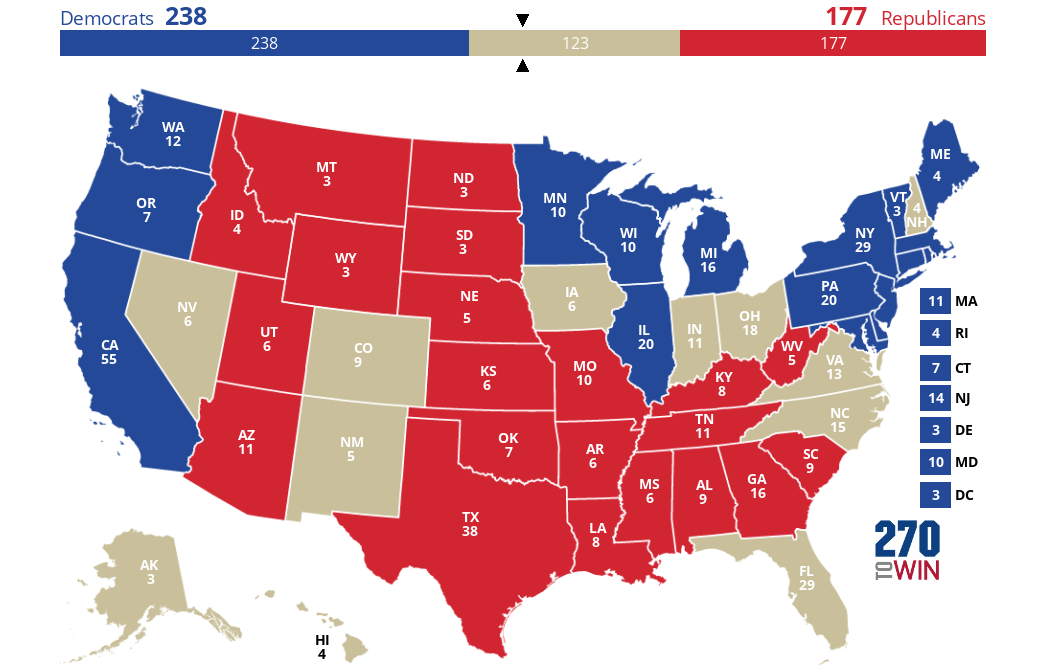
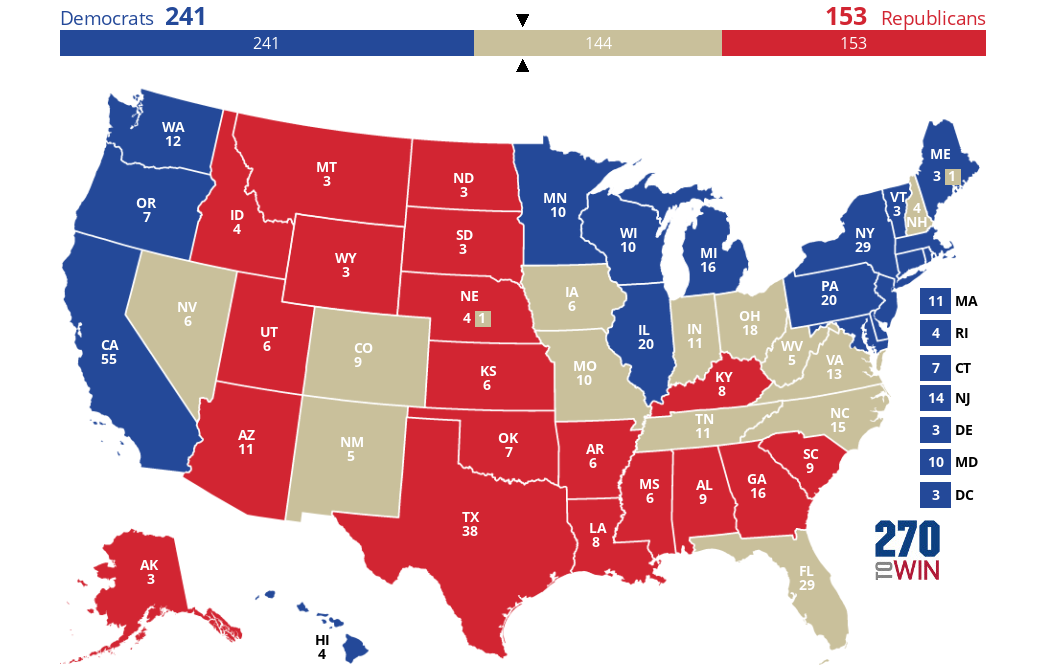
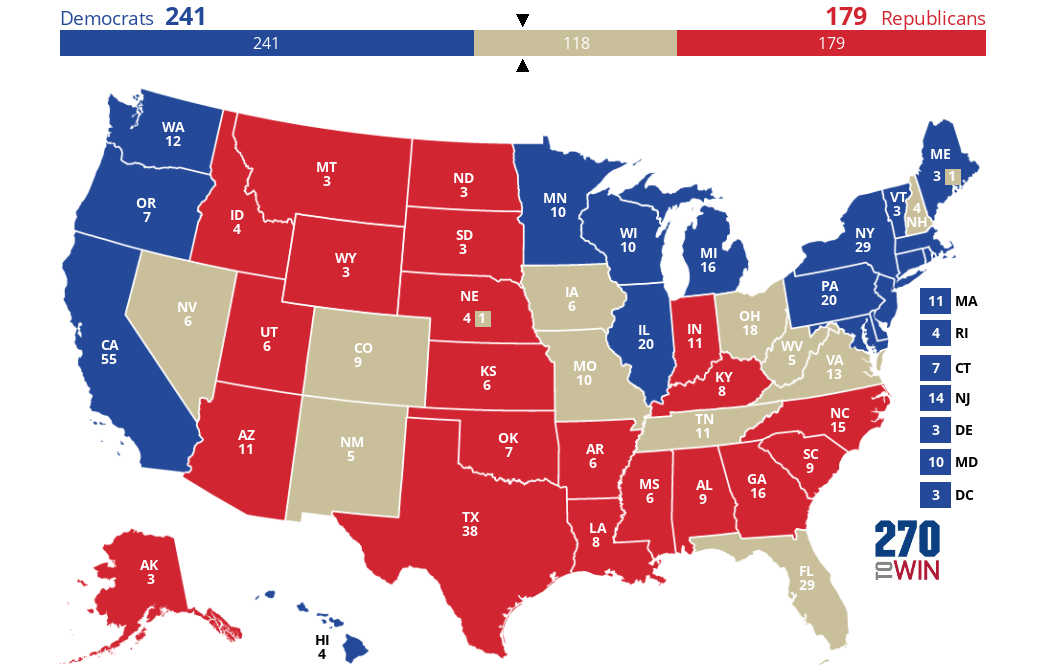
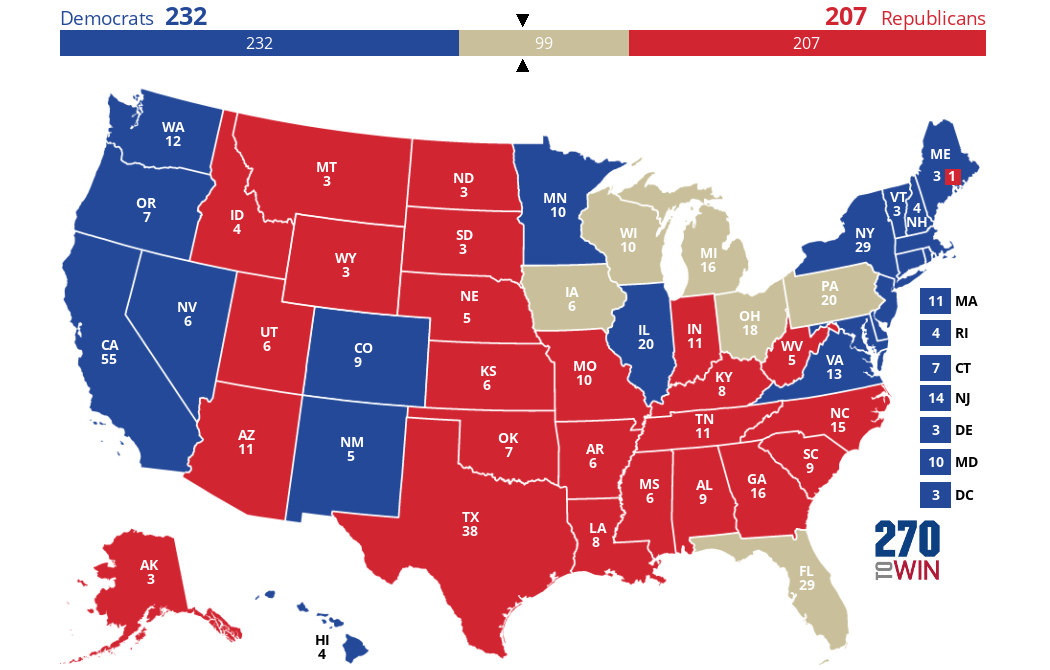
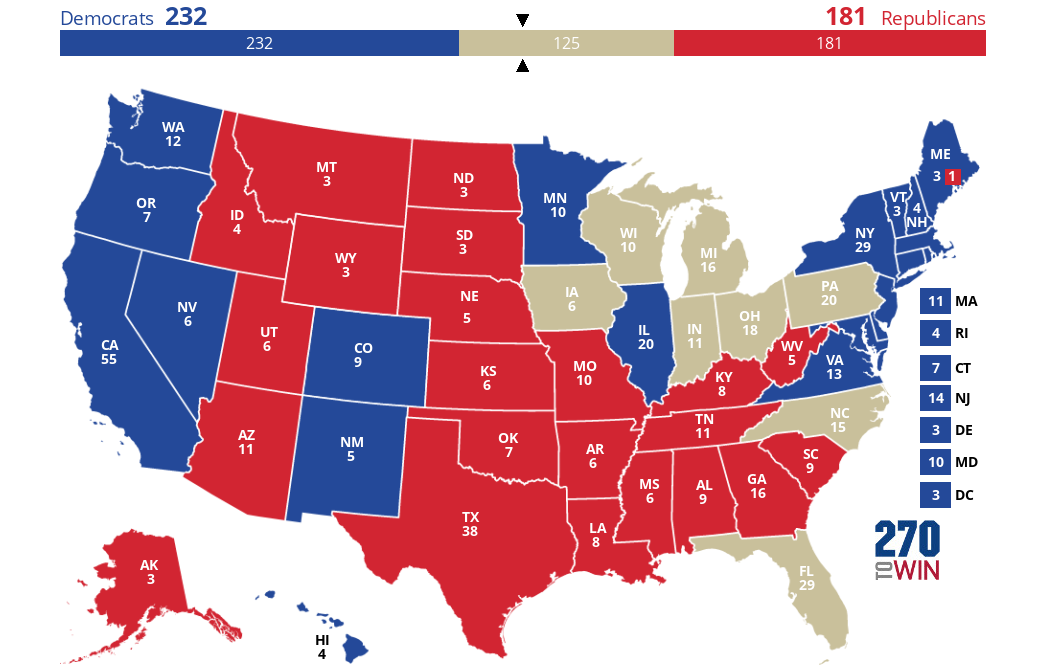
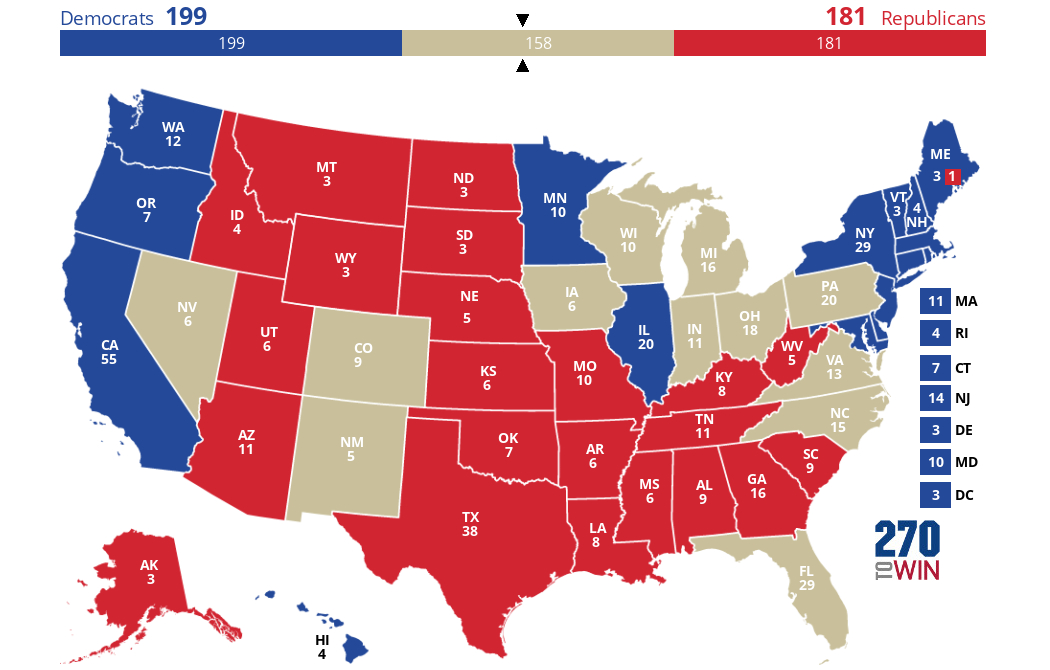
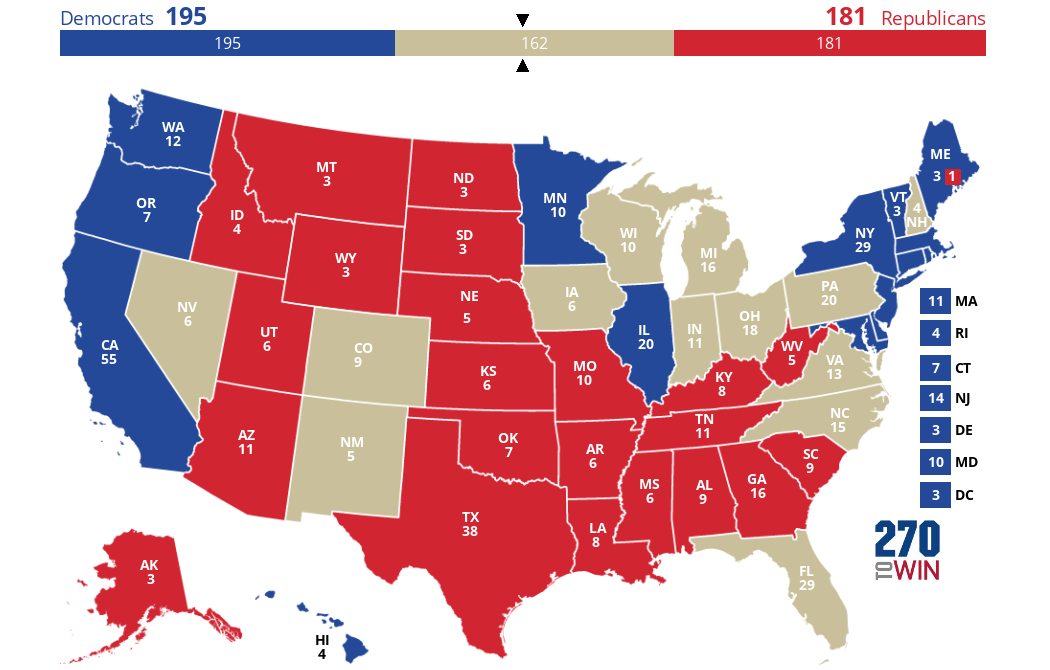
A series of maps to illustrate swing states, defined as states which have not voted for the same party for the preceding 4 Presidential elections.

Click the map to create your own at 270toWin.com
Swing States, 2016


Click the map to create your own at 270toWin.com
Swing States, 2012


Click the map to create your own at 270toWin.com
Swing States, 2008

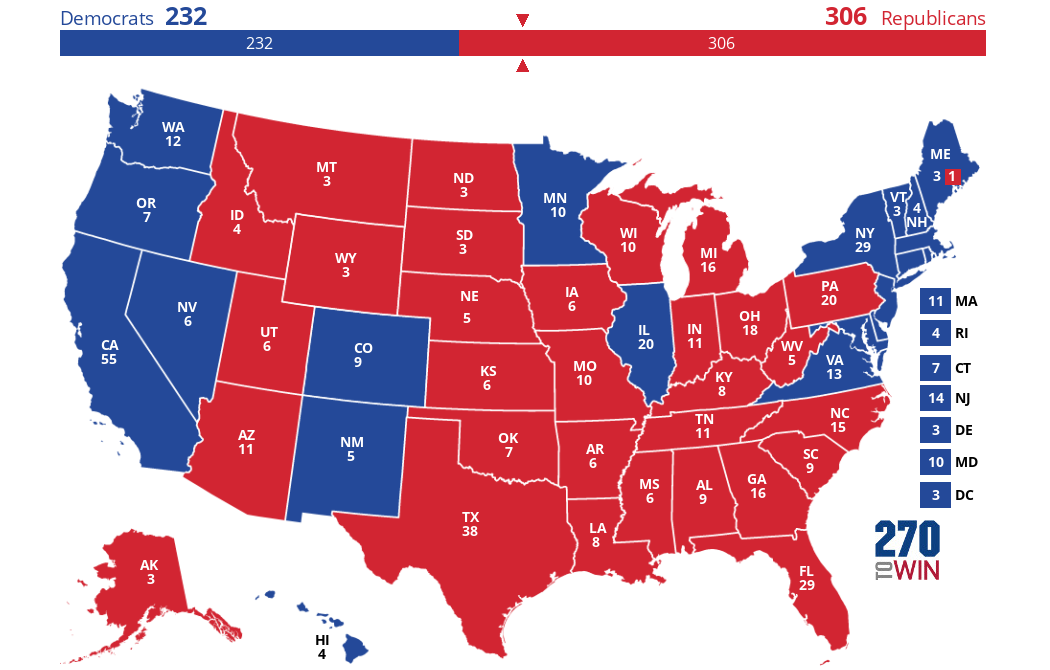
Another way to look at it, if you gradually turn states into swing states the further back you go:


Click the map to create your own at 270toWin.com
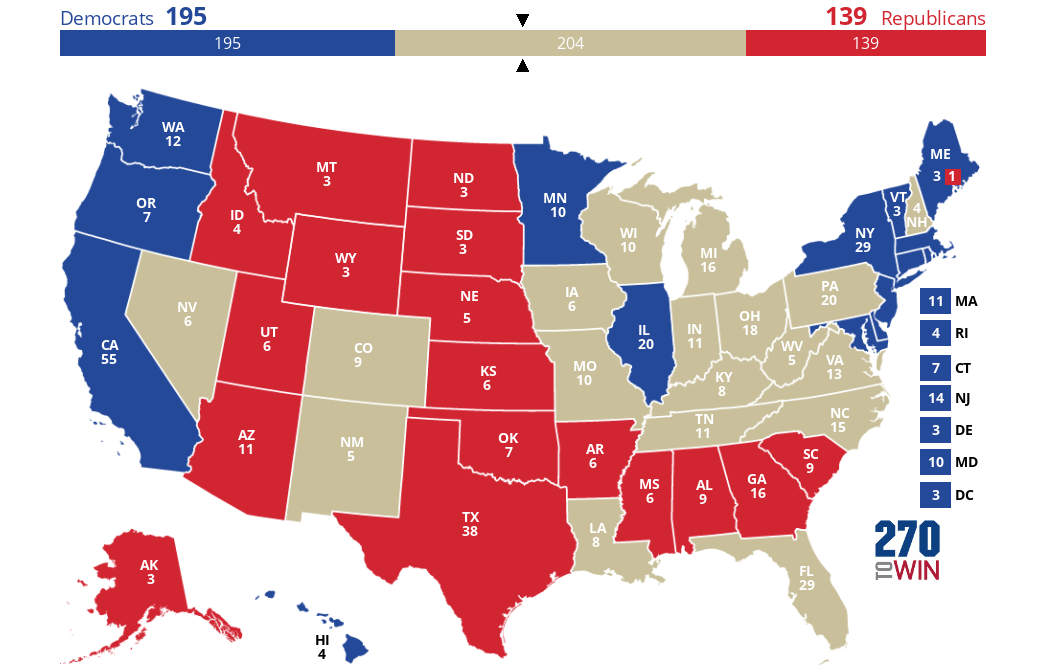
2016 results


Click the map to create your own at 270toWin.com
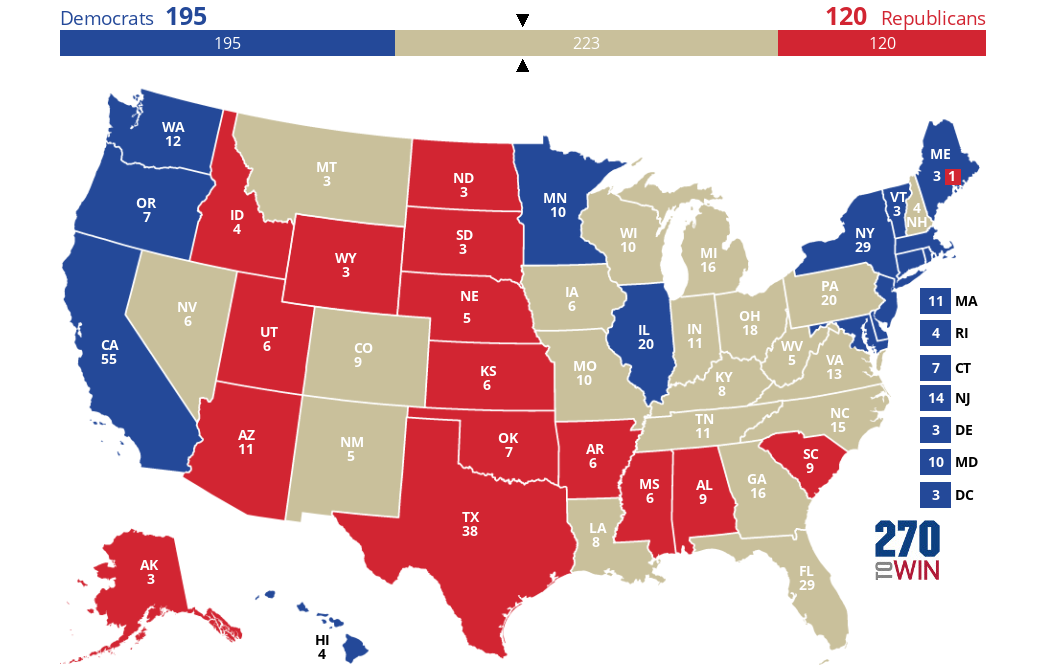
Since 2012


Click the map to create your own at 270toWin.com
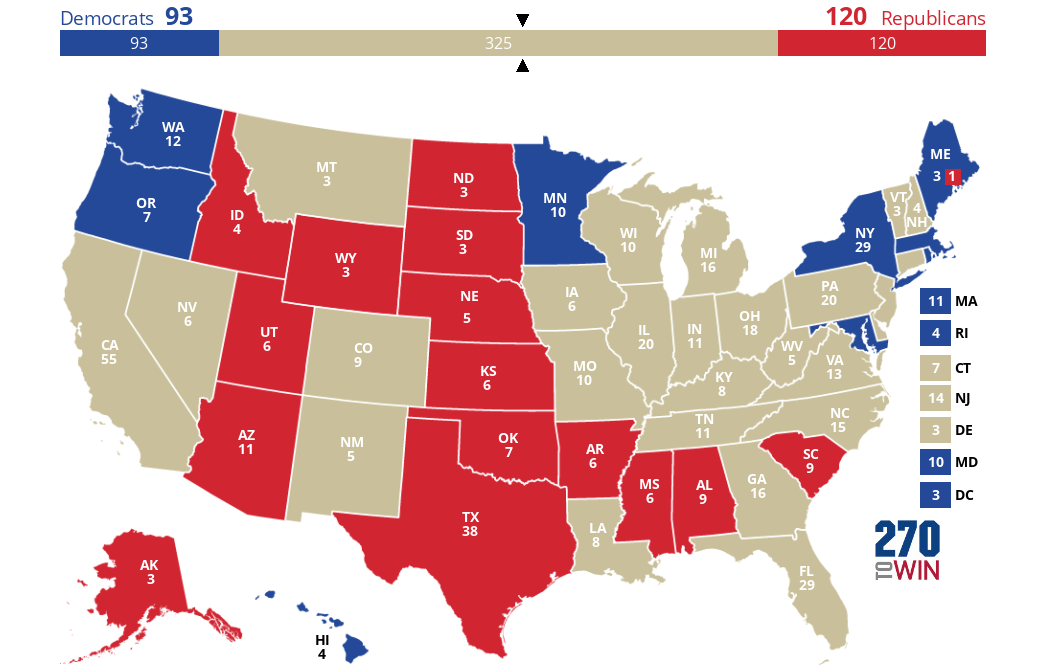
Since 2008


Click the map to create your own at 270toWin.com
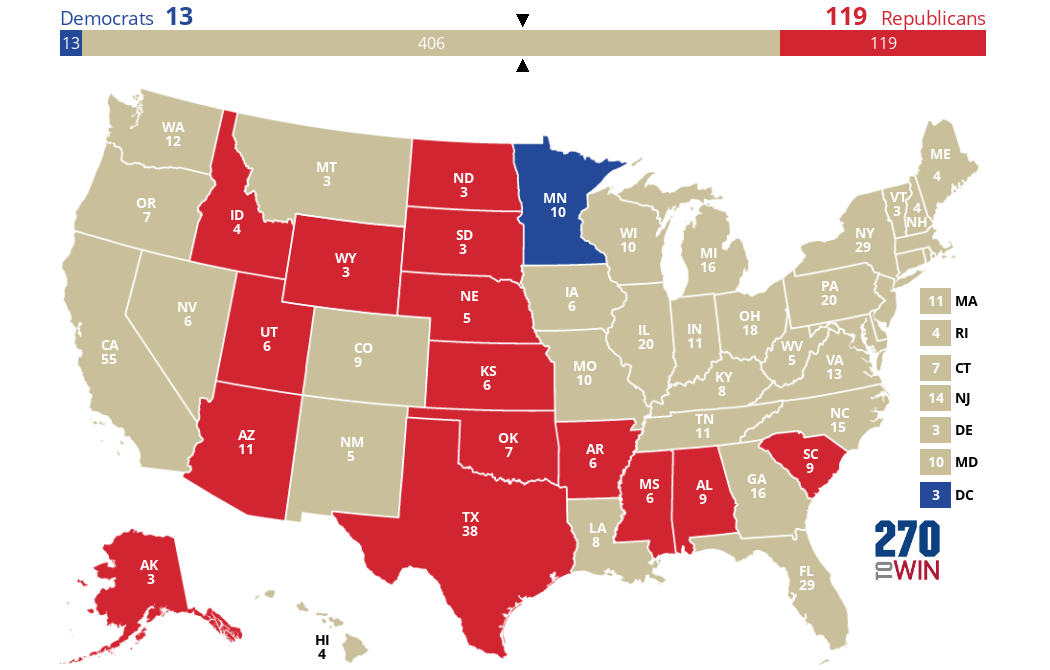
Since 2004


Click the map to create your own at 270toWin.com
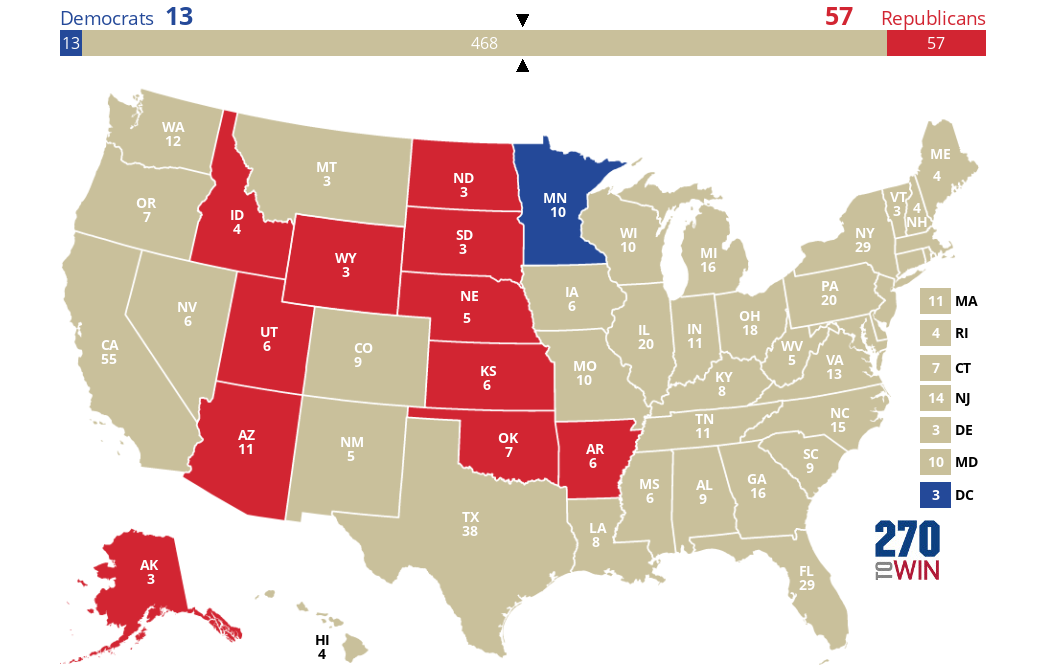
Since 2000 (repeat)


Click the map to create your own at 270toWin.com
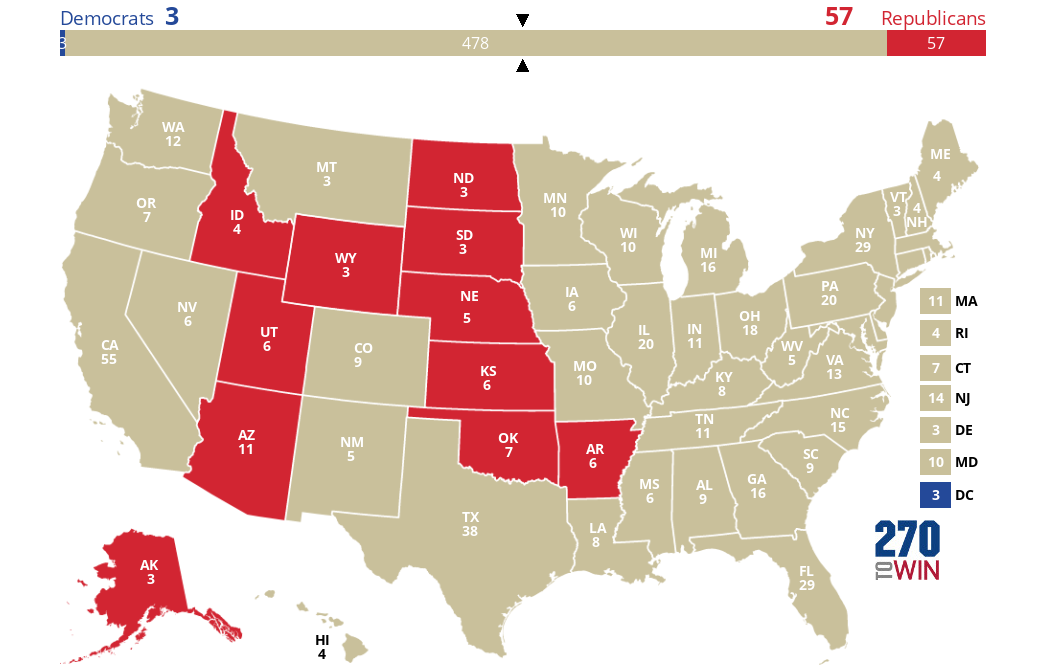
Since 1996


Click the map to create your own at 270toWin.com
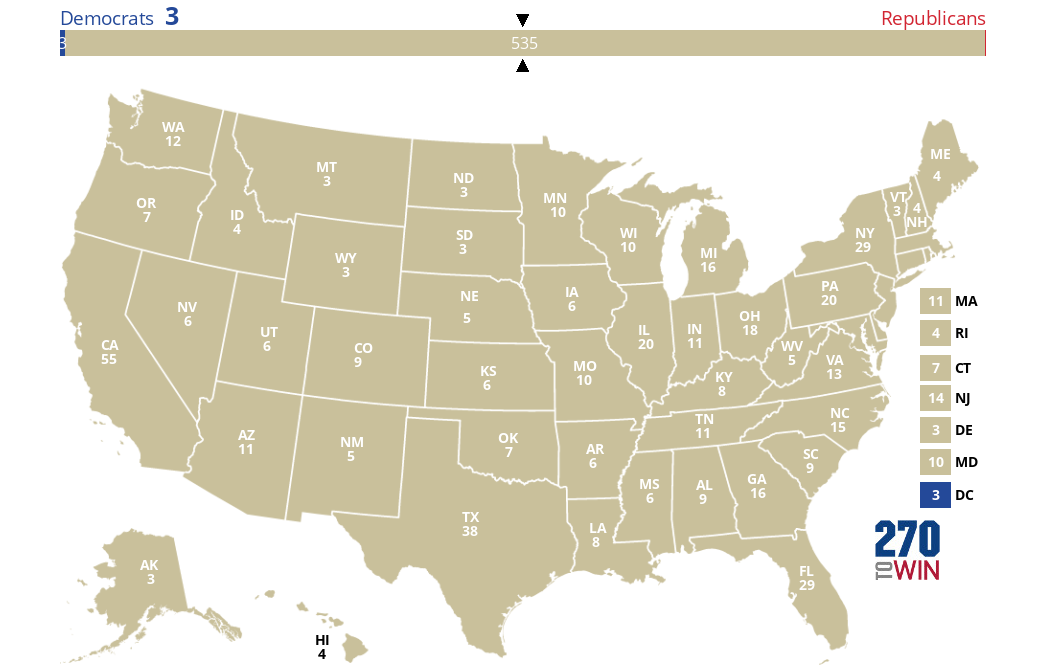
Since 1992


Click the map to create your own at 270toWin.com

Since 1988


Click the map to create your own at 270toWin.com

Since 1984 and 1980


Click the map to create your own at 270toWin.com

Since 1976


Click the map to create your own at 270toWin.com

Since 1972 and 1968


Click the map to create your own at 270toWin.com

Since 1964

1964 was the first election where DC was allowed to vote, so every state has voted for both parties except for DC over the last 50 years.

If I were hired by the DNC to ensure Trump is a one term president, I would ensure to put resources everywhere I can. The first step is to fight against voter discrimination laws which should have started several years ago. It doesn't matter if you are polling 10 points ahead of the other major party if your voters cannot vote for you.

While fighting those laws in the courts and ensuring people have the right to vote, we need to also fight gerrymandering. If the Supreme Court rules that partisan gerrymandering is illegal than there will be many more cases to ensure fair districting. This will mean that we will have many more competitive districts.

Getting a great candidate in 2020, such as Kamala Harris, would help a lot to win the Presidency, and ending the super-delegates to have the primary done with a straight popular vote would be a very easy way to increase legitimacy of the Democratic Nominee. That wouldn't take any laws to change, only some rules. It would also improve the image of the Democratic Party in the eyes of Millennials. If the primary is open and ranked then we will have the best candidate possible with no question of their legitimacy.

That will be enough to win the 2020 election. Campaign everywhere and have the first national primary in America's history. Supporting local candidates, and have every Presidential rally be with a local politician to get them name recognition will help the Democratic Party more accurately match its vote share in its success.

In the long run, implementing ranked voting and ideally ending the electoral college are the only ways I know of to make a truly fair election system where voters have the ability to kick out members of congress and legislatures who don't speak for them. After that, there will be no single Democratic Party because it will split into multiple parties at various levels of liberalism which will be good for America and voters by getting more viewpoints into the national debate.

The best we can do in 2018 is get good strong candidates nationwide running for every single seat in every legislature and support them so they can win.

I know this is a big change and a big dream, but that's the only way this crazy world has ever improved. Fight for the ideal system and get as much as you can. Hopefully someone at the DNC will read this.

Thursday, June 8, 2017

United Kingdom General Election, 2017

If the projections are correct, then we are going to see a hung parliament this year. There are a couple possibilities which are based off of history:
1. Conservative/Liberal Democratic coalition as existed under Cameron's first ministry. I think this is unlikely since the Conservatives are in favor of a return to a Pre-World War I European Order which is what Brexit would bring, and the LibDems are the most opposed to a hard Brexit of the three major parties. They are also completely at odds with each other on environmental policy, making such an arrangement completely ridiculous and unsustainable.
2. Conservative/Labour. Labour is in favor of a soft Brexit and less strong on the environment as the LibDems, making them significantly closer to the hardline conservative policies of the Conservative Party which are very similar to the Republican party of the USA before Drumpf cheated his way into the White House. This would be very similar to the current arrangement in Germany between SPD (think centrist) and the CDU (drifts between very liberal and paleo-conservative on social policy, combined with the most conservative economic policy in all of Europe of the major parties I have studied) and should not be ruled out for Britain. It would be far more sustainable than a CLD coalition in my observation of their platforms.
3. Labour/Liberal Democratic/Scottish National Party would be the only stable coalition which could be formed with the current political arrangement. The Liberal Democrats have a more moderate although still ardently Keynesian economic policy from the results I got with iSidewith, are in line with Labour on social policies, and when it comes to Environmental and foreign policy will make Labour more liberal (in the International Relations part of the ideology). I think this coalition would destory Brexit (hallelujah) and will not end up with the writs being called early (aka a new election), given how their differences I can find are more or less regarding minutia, and will make the Labour Party policies which are more on the loony side under their current leader less likely to pass, while very important legislation which they agree on, such as killing Brexit, will be able to bypass the inevitable conservative opposition. SNP and Labour are very similar on most issues, I got the same score for each on the iSidewith quiz I took. This would mean stable and reasonable policy for Britain for the next 5 years.
4. The most likely of them all, and a win for the Brexit camp, would be a Conservative/Democratic Unionist alliance. This would ensure Brexit happens, and a ridiculous economic policy in line with Thatcherism. This is very unfortunate for Britain.

I hope for this reason that we see an LLD government in the coming years. I think it would be best for Britain economically, socially, preserve the European Union, and govern them as best as possible until the next election comes (whenever that will be). Unfortunately, this will likely not happen with the Conservatives and Democratic Unionists making a coalition with barely enough votes to have more than 50% of the seats.

Wednesday, October 19, 2016

Democratic Strategy

I am currently working for Washington CAN, the oldest progressive non-profit in Washington State. We are getting out the vote in two districts currently, Washington State Legislative districts 30 and 44. If we succeed in flipping these two districts we could flip the entire Washington State House of Representatives which would is an essential step forward in getting progress in our state on important issues such as education, health care, and infrastructure which we all rely on.

The current state of United States legislatures is very poor. Democrats control only 7 state governments in full. Republicans control 23. 4 states have Democratic legislatures with a Republican governor, 11 states have democratic governors without control of the state legislatures. This means that Democrats are missing a pipeline of new talent for leading our country, will be unable to get constitutional amendments passed, and the Republicans have 31 out of the currently required 34 state legislatures to get through constitutional amendments. Given the shifting demographics of the United States, there is a lot of work that we can do right now to regain state legislatures to the point where major goals, such as Medicaid expansion, high quality infrastructure and other vital issues can be achieved. We will not get these issues passed however until our legislatures are made of people who actually care about the well being of the people, and given the state of the Republican party, that means they have to be Democrats.

A big cause of why state legislatures are overwhelmingly Republican is because of gerrymandering. State legislatures draw the boundaries for themselves in most states, and for Congress. The Democratic party needs to bring forward state initiatives in states across the country where gerrymandering has taken hold to use the single-split line method, and ideally ranked voting with multiple winners per race in order to make it so state legislatures more accurately represent the wishes of the American people. This will make it so Republicans will lose control across the country.

In order to make this happen, we have 4 easy pick ups this year with split legislatures. Democrats could easily pick up the state legislatures in Washington, Maine, Colorado, Kentucky, Iowa, Minnesota, New York, and New Mexico. Washington and Colorado only need the Democrats to pick up two seats in order to control the state. In New Mexico Democrats only need 4 more out of 70 seats. This would bring them to fully control 10 state governments, and then in 2018 pick up 4 more governorships to control 14 state governments around the country, with the Republicans still at 23 state governments and 31 legislatures.

Once we end the split governments, the states which need to be targeted next are Nevada, Montana, Pennsylvania, and New Hampshire. All of these states have less than a 20% split Democratic to Republican, and are good targets for Democrats to reclaim more governments. This will put Democrats at controlling 18 state governments, bringing Republicans down to 21 state governments and 27 state legislatures. Given their closeness to tipping, we cannot let them slip.

We also need to reclaim 6 governorships where Democrats control the state legislature, Maine, New Mexico, Illinois, New Jersey, Maryland, and Massachusetts.


Status (states) States (seats needed)
Hold governorship, hold legislature (7) Hawaii, Rhode Island, California, Delaware, Oregon, Vermont, Connecticut
Pick up governorship, hold legislature (4) Illinois, New Jersey, Maryland, Massachusetts
Pick up one house, retain governor (4) New York (9), Colorado (2), Washington (1), Minnesota (7)
Pick up one house, pick up governor (4) New Mexico (2), Maine (6), Iowa (8), Kentucky (9)
Pick up legislature, retain governor (3) Montana (7), Pennsylvania (25), New Hampshire (42),
Pick up legislature and governor (2) Nevada (7), Arizona (11)
This will give democrats control of 24 state governments by picking up 10 governorships and 142 seats in state legislatures (out of 7383 in total). This is doable.

Once Democrats focus and get out the vote in these 24 state governments, the remaining states we will need to focus on are Michigan, Virginia, Florida, Wisconsin, and Ohio. These 5 Republican controlled governments frequently vote for the Democratic President and elect Democratic Senators. This will give Democrats a majority of state governments. What this will mean for working families is more mass transit, better infrastructure, improved schools, and expanded access to Medicaid. If the Progressive wing of the party gains influence it will hopefully mean a more progressive tax code and more efficient government programs.

The 5 remaining stretch states which will give Democrats the 34 governments needed to approve constitutional amendments and dominate the country are Missouri, Kentucky, West Virginia, Louisiana because they have Democratic governors which will give Democrats 33 state governments. The one final state which Democrats would have the ability to gain will probably be Texas given massive demographic shifts over the next decade which will bring Texas into play by 2020. Georgia as well could be in play within a decade from demographic changes which is an extra bonus for the Democrats. Given the stubbornness of people who support Donald Trump, I expect at least another ten years of the alt-right having a significant impact on the Republican party. This is the opportunity of a generation for the Democrats to dominate the US and make significant changes beyond Obamacare to improve equality and opportunity for everybody.

Picking up another 27 state governments will be a monumental shift in American history. Of course state and county parties are going to need to be well organized to get great leaders running at all levels of government, but the national party should spend its resources to get real gains as soon as possible. Here is a rough schedule on how the National Democratic Party should focus on regaining state governments.

In 2016-2018 we need to focus on the states where we already control at least one house while retaining the 7 states we control. We could gain 12 state governments in the next two years, bringing us to 19 state governments by the time we get to the 2020 election.

In 2020-2022 we need to focus on the three states where we control the governorships (on top of the State Parties working hard over the next 4 years) which will bring us up to controlling 22 state governments in total.

In 2024-2026 we need to start to pick up the next 5 states I mentioned (if we haven't gotten them already) and whatever states in the preceding two lists we haven't managed to get.

Finally in 2028-2030 we could pick up the remaining 5 states to gain control of a supermajority of state governments across the country.

A lot can happen in 14 years of course, and it is possible Democrats could make these gains before 2030. I do believe however we should focus as much energy as possible on these local races to gain state governments. This is the only way we are going to be able to get progress on issues which improve the lives of all Americans which the Republicans have blocked for decades.

Friday, August 14, 2015

What goes to Referendum

Across the world, referendums are frequently used for making changes to policy when politicians don't want to stick their necks out.

The biggest problem with referendums is that they are only usually used for things that politicians don't want to go through. When there is an issue that has immense support of the businesses that sell government materials to go to war or spy on people these issues don't go to referendum, but are passed in violation of the will of the people.

The biggest issue I see with referendums is how they are frequently staged. I frequently find the ballots to be written to confuse voters so people abstain which hurts people's faith in democracy. Initiatives need to be clearly written so people understand what they are voting for.

The last British referendum in 2011 to change their election system was fraught with problems and is one of the three recent referendums that makes me wary of how referendum are used. Here is a list:

  1. The Conservative Party made a large deliberate effort to misinform people in how ranked voting works. Anyone who has taken a comparative politics class (as many politicians have) should understand how the system works given how it is used in Ireland, Australia, and has the fewest issues when using standard election system criteria. This helped swing the election by making it so many voters didn't understand what they were talking about. Examples include claiming ranked voting supports extremist candidates, when they can only do this when they cross the threshold which is unlikely and is shown to not happen where ranked voting is used. Their use of Australia as an example of safe seats ignores the fact that there are only two parties in Australia who campaign for elections and have broad support, and it would be different in Britain because they have a tripartisan system which will make it so there will be fewer spoilt seats. The Conservatives made these lies because they are in the minority and only 36% of people in Britain support them which means they would need to reach out to voters under such a system and abandon their corrupt practices and support of issues like the Iraq War and Austerity. Labour is a center-right party when it comes to their positions which is why they failed to make a stance. Their party would split because they are the party of Tony Blair who destroyed Britain with his colleague Margaret Thatcher given how he didn't propose any alternative and now they are stuck with David Cameron. This is these old stuffy and corrupt parties made the stances they did.
  2. The people in favor of the referendum made mistakes in how they campaigned. One example is how they didn't address tactical voting which is absolutely necessary in FPTP because you can't necessarily vote for who you want but is less so in ranked voting because you can vote for exactly who you want regardless of who other people are voting for. They messed that up. They could have pointed out the fact that over 60% of people in Britain oppose the Conservative Party but they won over 50% of the seats which violates the majority criterion and a ranked voting system would fix this problem and force the Conservatives to appeal to voters, but they failed to do this in their foolishness. Such mistakes makes me doubt how much into the issue they really were.
The same question was asked by New Zealand's Referendum in 2011 when voters were asked which voting system they want to use. Most people don't know enough about certain issues and don't have the time or energy to fully understand which option is best for them. You end up with people voting along party lines against their own interest. It would be far better for the politicians who are directly elected by the people to be given a commission of experts (in this case, political scientists) who understand the pros and cons to each system and then choose the best option. Most people don't have the education they need to make an informed decision, and all people end up being worse off.

My final example (getting off the elections on elections issue) is more local for me, with a proposal for greater Seattle's mass transit referendum going up once again next year on whether to expand mass transit. There is absolutely no reason Sound Transit should not have the full authority under the local governments it is a union of (Snohomish, King, and Pierce counties which compose the core of the Greater Seattle area) to have the full authority to consult with urban engineers to design the best possible mass transit plan for the region, develop how to do it as efficiently a possible, and then provide the service that our region needs to cut down on congestion and maintain our quality of life. A 10 year time frame is frankly ridiculous given how China built high-speed rail across an area the size of the US East of the Mississippi in around 5 years. The County Councils should have the authority to collect taxes and spend as they see fit, given how they are elected by the people directly, so that they can gather the information to make the best decision for the people. All in all, I think the use of referendums should be outlawed and governments should be required to govern. If people don't like the decisions the county council makes, they have every right to run an initiative on the issue, run against them in the next election,  and then vote them out in the next election.

Despite my distrust of referenda, I still believe we should continue to be able to use initiatives as needed. We have several initiatives growing right now in Washington State which have a lot of support. One is the Carbon Tax which I am putting some time and energy into because I know it is the best way to reduce our carbon emissions while receiving our double dividend, and will help make our tax structure more progressive. It will send a clear message to the legislature that this is an important issue for a majority of people in our state. This is a good and necessary part of any democratic society and an essential check on the power of the government. I also think that we should be able to have a national initiative in the USA assuming we get the right percentage of voters to sign on to the ballot.

When there is an idea in a legislature, they should only have two options, to pass it or kill it. They should not be able to weasel their way out of governing by sending it to the people. They should have the full ability to tax and spend as needed, and if people have a problem with this they should have every right to repeal laws by the initiative process or vote their legislators out. All referenda tend to do is postpone essential services which people need and usually don't understand.

Saturday, November 8, 2014

2014 election and implications

The 2014 election on Tuesday is following some extremely predictable patterns of American politics. It saw the lowest turnout since 1940, which is probably due to the general malaise of people saying "both parties are the same", which has some truth with some members of the Democratic Party being right-wing, such as Landrieu of Louisiana, and a few others who lost on Tuesday, but this malaise is likely a symptom of single-winner districts and first past the post. I have more information below.

NCSBE and Election Project along with US News have good data

This turn to voting for another party despite being partially cause by low turnout is also a recurring pattern in American politics known as the Six year itch.

Section 1: Turnout
If we wanted to measure how turnout decreased and where it decreased we would want to have the following information, which I have already done in a spreadsheet:

  1. We will want to know if having a governor's election increased turnout substantially.
  2. We will want to also know if having a senator's election increased turnout substantially.
  3. We will want to know if political alignment of a state changes voter turnout.
  4. We will want to know if political polarization of a state changes voter turnout, whether a state like Ohio and Florida which are extremely close in number of Democrats and Republicans will have a different turnout than a state like Hawaii or Utah.
There are more types of things we can do when it comes to seeing what effects turnout, but these are the four measures I am going to choose to analyze.

I took this data and measured in a spreadsheet the data based on them, here are my results:
  1. States with governor elections had a voter turnout of 37.44% (with a standard deviation of 8.2%) versus a turnout of 36.17% (with a standard deviation of 6.4%) for states that had no governor with a correlation of 16.7%. This demonstrates a very weak correlation between voting for governor and people turning out. The long-term average shows a turnout increase of 3% (governor = 43% vs. non-governor of 40%) with a standard deviation of 5% with elections and 7% without elections. Their correlation is 19%. This demonstrates that having governors elections still has a weak correlation. The other way we can measure correlation is to take two elections and find the correlation between them for each state, and the correlation between 2010 and 2014 for all 50 states is 78.3%, which is very strong. This means voters in states tend to vote year after year or not, with a little dependence on whether they are electing their governor. Lurking variables include voter access laws, and state corruption.
  2. States electing a senator had a voter turnout of 38.3% versus 35.9% for states that were not electing a senator with a correlation of 23%.
  3. Political alignment has a correlation of 27.04% with voter turnout. Political polarization has a correlation of 27.50%. The more polarized a state is the more likely it is people will vote, so this empirically demonstrates that one way to increase voter turnout is to have competitive districts as opposed to safe seats.
So in order to increase turnout we should implement an election system which ensures that every vote counts which means every district must be competitive. The best way to do this is STV, which I have written about a lot.

Section 2: 2016 (focused on strategy options)
History tells us that when one party takes over congress in the 6th year of a presidency it is almost always followed by a changing of the party in the next election, This has in fact occurred 14 times now in American history (out of 16 two-term presidents) which is a rate of 87.5%.

This type of arrangement where Congress is controlled by one party and the President is controlled by another has occured now 11 times (including this new instance), and out of 10 previous occurrences only one of them has not seen the Presidency flip parties, which started in 1946 and ended in 1948 when both houses of Congress became controlled by the Democrats and President Truman was reelected. This bodes well for the Republicans if history repeats itself again.

Then if the Democrats want to maintain control of the Presidency it is prudent to study President Truman and the Republicans of the late 1940s. It was a time of economic recovery, and there was a recession after World War II which helped the Republicans a lot in 1946. An economic recovery would then probably help the Democrats a lot. President Truman was also up for reelection which is different from this time. The election of 1988 is also pertinent since the last two years of Reagan's presidency saw the Democrats dominate both houses, and all of George HW Bush's presidency for a total of 6 years, which is unusual because out of the past 10 times this arrangement has happened 5 have lasted only 2 years, 1 lasted 4 years, 3 lasted 6 years, and the longest lasted 8 years. This is in other words a very unstable political arrangement. This means there is a 50% chance that 2016 will see a new party arrangement.

For the Republicans, the best they can do is have a charismatic leader who can capitalize on their advantage and take the Presidency. They need a strong Vice Presidential candidate who can turn on centrists as opposed to Sarah Palin and Paul Ryan. For the House they want the map to stay the way it is, which will not happen since Florida is already going to change. 

For the Democrats, they want a politician who people can look up to. They need someone who can get people to turn out to vote and vote for their local representatives. Turnout is going to be key, and they need to run strong candidates in every congressional district in the country to try to take as many seats as possible. Florida is going to be forced to redraw their districts to not be so gerrymandered in favor of the Republicans, and there are other states where this can be done, such as Ohio, Pennsylvania, North Carolina and Texas which will make the house elections much more balanced in the next election. They need to appear more liberal than the Republicans and not complacent in their demands. Getting new faces into the party who are from the progressive wing would be useful, and speaking to women, African Americans, and Hispanics would help get the vote out. Hopefully there will be a primary season with candidates who have experience to move the party back in line with their voter base. This will give the Democrats a massive advantage in the next election. Pushing for ranked voting would be another very smart move.

Section 3: Policy
The next two years will be difficult, and the Republicans will put forward budgets which will be from the interests they represent. Fortunately, President Obama has a veto pen and will hopefully use it. The only danger is that since we do not have a Line-item veto it is likely the Republicans will put things into budget bills that Obama would veto, but since he does not have the authority to veto budgets they will pass. People will inevitably blame the President for this Congressional decision, but it will not change the fact of who makes these changes. Gay marriage will continue to move through the court system, and the Supreme Court will likely support gay marriage in the very near future. Supreme Court nominations from Obama over the next two years will need to be moderate to get past Congress, I however doubt that there will be any retirees or deaths.

It is not going to be an exciting two years away from the courts, and there will hopefully not be a lot of court action on economics given the economic makeup of the court of 1 libertarian and 4 conservatives. This is very favorable to conservatives, so even though it will be dangerous it is likely more decisions like Citizens United v. FEC will be filed.

Sunday, September 14, 2014

Lebanon's Elections

Lebanon is currently undergoing what I consider a constitutional crisis, and has been since the 23rd of April. In order for a President to be elected he must be elected by a 2/3rds majority of Parliament, more like a Prime Minister in other countries. This however means if no one receives a 2/3rds majority there will be a second election and this continues on forever until someone is elected.

The Presidential election was supposed to happen in April and it is now September. This has taken a total of 5 months so far, and is showing no signs of stopping. This makes me think it is time for Lebanon to look at alternatives to electing their president and the only mechanism I can recommend is to make the President popularly elected using IRV which will prevent future problems and ensure that every vote counts with no wasted votes or spoilers.

Hopefully someone with influence in Lebanon gets the message that a better system is possible. 5 months is just too long to wait for an election to finish.

Friday, May 16, 2014

India 2014 shows the faults of FPTP

The largest election in the history of the world just finished in India, with a turnout of over 800 million people. The election saw a landslide victory in terms of seats for the Bharatiya Janata Party, which has been criticized as being too far right by America's Republican Party, so that is not a good thng.

I'm analyzing the details of the election by vote count and party share in the Lok Sabha and this is like the most recent elections in Canada and the UK which saw an immense difference between vote share and seat share by party in the election. Here is a basic summary table for the largest winners of the vote and seats:

Party Vote share Seat share Election error (Seat share-Vote Share
BJP (right-wing) 31.3% 51.9% +20.6%
Indian national congress (center-left) (INC) 19.4% 8.1% -10.7%
Bahujan Samaj Party (center-left) (BSP) 4.2% 0 -4.2%
All India Trinamool Congress (center-left) 3.9% 6.3% +2.4%
Samajwadi Party (SP) (center-left) 3.4% 1% -2.4%
All India Anna Dravida Munnetra Kazhagam 3.3% 6.8% +3.5%
Communist Party of India (far-left) 3.3% 0.1% -3.2%
Independents 3.0% 0.6% -2.4%

Needless to say it is obvious that India is not doing well with First Past the Post given the extreme swing in vote share and seat share. This is not healthy for democracy and they clearly need to reform their system so that their elections can be more fair. Looking a the previous year at breakdown state by state shows that this huge swing which is almost certainly due to vote splitting goes down to the local constituency level which creates huge imbalances with over 500 seats in the Lok Sabha. The only solution that will guarantee local representation along with proportionality is the single transferable vote.

References:
Official website
2014 Wikipedia
2009 Wikipedia

Monday, March 10, 2014

We've seen these Russian elections before

Putin is going to say that he will leave it to the people of Crimea to decide whether they want to join Russia. There are two problems with this:
  1. Putin has used this strategy before in Abkhazia and South Ossetia, and he did this after deporting all of the ethnic Georgians in these areas. If he does the same thing as Crimea there is no question how they will vote.
  2. Russia has a reputation of getting very results on their elections, by having ballot stuffing, harassment, and other issues which are widely reported on. I see no reason to believe this will be any different.
The  election will be a sham and everyone knows it, it is an old Communist tradition of having "elections" where you always know who will win. China and North Korea use these and the USSR did, and the elections in Russia look more like the old Soviet elections every year. Since there will almost certainly be no EU or UN observers (except of course the Russian observers) there can be no doubt who will win the election, regardless of what the people in Crimea want.

http://t.co/3nPsA0qEUs

Saturday, April 27, 2013

State Legislatures

First, a summary of how state legislatures do elections because it is detailed. 49 out of 50 states in the United States have a bicameral legislature currently (all but Nebraska). The way that these chambers are run differs state to state, but there are big similarities across state lines. There are three systems currently in use in state legislatures. 39 states (except Arizona, Idaho, Maryland, Nebraska, New Hampshire, New Jersey, North Dakota, South Dakota, Vermont, Washington, West Virginia) have a simple yet ineffective system of having one representative per district, and two sets of districts, one for their upper house and one for the lower house. Every state has one representative per district in their upper (smaller) house. However, 11 states break this trend. I haven't done the analysis yet on the efficacy of each election and how many are accurate to the statewide voter choice, but hopefully I will someday. 5 states (Arizona, Idaho, New Jersey, North Dakota, and Washington) have one representative per district for their upper house (as normal) but two representatives per district for their lower house. How they vote for them varies, some are block voting (where people vote for as many candidates as there are seats and the two candidates with the most votes win) and some have separate elections for the two seats.

Before I describe the other districts, both methods present a problem. If you have the same population voting for these candidates and they can't rank their choices, you run into the spoiler effect and wasted votes. What ends up happening is you don't have a representation proportional to the choices of the district and you have usually one party win all the seats in a single district. Except for an example (Vermont) most states have only Democrats and Republicans in their state legislatures. The districts are regularly redrawn and you run into the problem of Gerrymandering.

South Dakota and Vermont residents could have either one or two representatives in their district. This doesn't solve the spoiler effect. They are all proportional in population per representative, but has all the problems of first past the post.

The remaining three states (Maryland, New Hampshire, Virginia, and West Virginia) have block voting, which is when you have a list of your candidates and you vote for as many candidates as there are seats, but what makes them different is that there is a large range between how many representatives you might vote on. You could represented by as few as one, or for some people in New Hampshire could have as many as 11 representatives. The population per representative(s) is all proportional, but since it is block voting, it doesn't increase the chance of third parties being represented and doesn't solve the spoiler effect, which means votes are wasted. They are on the right track, but block voting is not good enough to have a truly fair election system.

One question I have struggled with is why we have two state houses in all but one state. The disadvantages I can see is it takes legislation longer to get through government,  and the upper house always has the spoiler effect because it is a one representative per district. This is a historical leftover. In New York, the two houses were similar to Parliament and (at the time) our Congress in that the Senate was elected by owners of land, and the House of Representatives represented everybody. In Washington State the House was elected every two years and the Senate every four. So, depending on when the different states entered the Union changes the reason why all but one has two houses.

I see no particular advantage today in maintaining having two houses, and see a few disadvantages  It takes legislation longer to get through (which takes money, because they get paid to be there, and many states have time limits as to how many days they may be in session) and this can put good legislation on the back burner in order to pass a budget or some other duty that is routine and forgettable. If the representatives really represented the opinions of their constituents than there is no reason why it should take longer than reasonable to pass legislation that the people want to be passed.

The history of bicameralism goes back to the history of the Parliament of the United Kingdom. England's Parliament was established on 15 June 1215, and consisted of lords only as described by the Magna Carta which seriously limited the King's power. They evolved out of the Feudal system as members of the higher levels yet below nobility desired to have more power, and councils were formed which gave them more power. Parliament's main power was to levy taxes, among other powers. King Edward I was trying to unite the British Isles and parliament's power grew considerably. The House of Commons became an independent house from the House of Lords in 1341 under King Edward III. As the United Kingdom took over the British Isles over the next hundred years Parliament grew as an institution and bicameralism took shape. I will do another post on this someday... it's complicated.

Then when we get to the United States founding we have the famous Grand Compromise which created our form of bicameralism, with a Senate which was originally voted on by State Legislatures, and the House of Representatives was voted into power by whoever the State Legislature deems fit to vote (and still is). The New York example demonstrates how the two houses were set up similar to Congress and Parliament. Each state has a different story, so to generalize would be inaccurate. But what is important is that all but one state today has a state legislature.

Should we move to unicameral legislatures? From the point of view of making sure that all views are represented it would make sense to have only one chamber and have the members be elected using the Single Transferable Vote method which is the most accurate way to set up a legislature. Having only one representative per district for the upper house has no advantage in terms of the majority criterion of elections and hurts the possibility that a third party could be represented. This would be easily remedied by having both houses be elected using Single Transferable Vote, but then what would the point of having two houses be? Arizona, Washington and other states that have two representatives per district in one house and one in the other house don't see an increase in representation of minorities and see the same two parties again and again. With only two seats it is difficult to get more than two parties represented, and having one seat makes it practically impossible in most cases.  It would make sense to have multiple representatives for each district and have them be elected by Single Transferable Vote which is the best way to guarantee that they will represent the people.

Kindle Fire HD 7" Tablet, 16GB B0085P4OWM (Google Affiliate Ad)

Saturday, February 16, 2013

The Future of American Politics

We all have heard about how the Republicans are so opposed to deficit spending. Where were all the hard-core Republicans in Congress when Bush turned a surplus into a $400 billion deficit?

We all have heard about how Democrats are doves, where were the Democrats when the Iraq War got almost unanimous approval in 2002?

We all like to hope that Democrats will defend our freedom of speech, where were they when the Patriot Act was passed?

We all like to think how the Republicans put the deficit first as our most pressing national priority... but why do they seem to think that cutting only the $414 billion that the Department of Health and Human Services spends on everything except Medicare (which they want to keep) will balance a $900 billion budget?

We all like to think that the Republicans want a small federal government, but why then did almost all of them support the No Child Left Behind Act, bank bailouts, and PATRIOT ACT which expanded the role of the Federal government?

We like to think the Republicans are the party that supports America's future, but why do they keep cutting funds for schools?

We like to think that Democrats are in favor of expanding access to inexpensive high-quality college, but why have there been a total of 0 major college-education bills over the past 4 years providing more assistance been in the spotlight?

We like to think that Democrats are in favor of helping the poor, then why did Clinton pass the reform for TANF with the Republican-led congress which made it mostly a state-run program with 56 bureaucracies instead of 1?

We hope Democrats will stand up for what has to happen, but why did they not go to the Supreme Court when the Republican-led governments of Ohio, Pennsylvania and Florida gerrymandered their congresssional districts in ways that are very clearly designed to give Republicans an edge in both the maps and the votes?

This is because neither party truly represents America. If the Democrats represented America they would be a very different party. They would be pushing very hard to bring back the Work Progress Administration, and would have started pushing for an increase in the minimum wage a decade ago. The Democrats would have signed the Kyoto Agreement in 2009 when they had a chance. They would push for serious election reform to make it so that every vote counts, and gerrymandering will have almost no power. I am glad Obama is trying to push his party left on voting reform, climate change, and serious economic policy, and I hope he succeeds. I hope he pushes for making the border with Canada easier to cross, not harder. I hope he will seriously balance the budget by taxing capital gains as regular income, because that is all it will take. I hope he roots out waste in every agency, including the Department of Defense, and shortens the deadline for that agency to audit themselves. It shouldn't take years for an audit to be finished.

Why does this happen? Within both parties are large caucuses. We saw the Republican factions very clearly during last year's primary:

  • Santorum with his Christian Democracy platform and soft opposition to the secular state. (I’ll call them Christian Republicans)
  • Ron Paul with his libertarian small government ideology in everything except abortion (Libertarian Republicans)
  • Mitt Romney with his beliefs between the two, believing in more social policy controls yet not to the point of Santorum. (I’ll call him Republican National Convention)

This is a really uneasy alliance between the three wings. I expect it will someday split.

The Democratic Party also has some uneasy disagreements which to those of us who were involved in Occupy are starting to become apparent on the ground. While I am not and do not wish to be a registered Democrat when it comes to my beliefs I fit into one of these camps. I expect we will start to see it during future Presidential election years like we saw it during last year's Republican primaries.
  • Although unorganized, a large number of Democrats fit under the ideology of the Progressive Party (aka Bull Moose) of Theodore Roosevelt. These people are pro-globalization (which alienates them from the Libertarians and Greens), favor nothing less than Universal Health Care (which the Democratic Leadership Council and Libertarian Democrats fail to support and many oppose), and are pro-free trade with nations that have similar economic and political statuses yet oppose free trade for non-business practices (alienating them from everyone else) and are unlikely to support free trade to support American businesses alone, they are also likely to support free travel. They support regulation of the worst aspects of the financial industry. Some will favor a strong military to be used only when necessary. Elizabeth Warren is the epitome of the Progressives.
  • You see the more traditional Democrats who want less government involvement in social lives and more governmental regulation in banking and the stock market along with pro-globalization leanings (Democrat Leadership Council). These people do not favor Universal Health Care but favor more centrist approaches. These people favor compromise to hard policy. Obama is the epitome of this party.
  • You see people more in Ron Paul’s libertarian camp who avoid the current Republican Party like the plague due to their social policies (Libertarian Democrats).
  • You see more isolationist Democrats, the anti-WTO protesters of the 90s who continue to take an anti-military, pro-visa, pro-tariff, and are shifty on immigration in terms of foreign policy along with some more mainstream Democratic policies (Progressive Democrats, merge with Green Party). Whether they will gain seats remains to be seen, but they are a powerful force of solid left wing Democrats and should not be underestimated.
  • Some Democrats will join the left-wingers of the Republican Party (Blue Dogs). These people oppose universal health care and when it comes to free trade do not focus on fair trade as a prerequisite.

It would be quite possible to divide the Democratic party on these five lines. It is becoming a very uneasy alliance when you get into it. With so many different ideologies it makes for politics constrained in political beliefs by regional tendencies giving people in different parts of the country fewer choices once the general election comes because the Democratic candidate will be able to outspend the Greens and Socialist Workers. If the Democratic Party split into 4 or 5 factions than we will see more debate.

The Tea Party will be split between the Libertarians and Christian Republicans.
So, I predict that in the next 30 years we will see a reorganization of the American political spectrum as the parties change and we get a more diverse mix of parties. From left to right on the economic scale.
  1. Progressive Democrats/Greens (PD)
  2. Progressive Party/Bull Mooses (PP)
  3. Democratic Leadership Council (DP)
  4. Republican National Convention (GOP)
  5. Christian Republicans (CR)
  6. Libertarian Democrats/Libertarians (LP)

Here is the list of parties by social scale from smallest to largest involvement in personal affairs:
  1. Progressive Party/Bull Mooses (PP)
  2. Progressive Democrats/Greens (PD)
  3. Democratic Leadership Council (DP)
  4. Libertarian Party (LP)
  5. Republican National Convention (GOP)
  6. Christian Republicans (CR)

Here is a table for comparison. Vertical is economic, horizontal is social. Top-left is left-wing. Small vs. Big is the comparative size of involvement of the government.
Small SocialMedium smallMedium bigBig Social
Small Econ(Anarchy)LP
Medium smallPDDP (status quo)GOP (status quo)CR
Medium bigPP (W. Europe)(NAZI)
Big Econ(Soviet Union)


There is one more dimension that must be accounted for which is foreign policy: Here is a list of parties, isolationist on top, involvement on bottom:
  1. Libertarian Party (LP)
  2. Progressive Democrats/Greens (PD)
  3. Progressive Party/Bull Mooses/Congressional Progressive Caucus (PP)
  4. Democratic Leadership council (DP)
  5. Republican National Convention (GOP)
  6. Christian Republicans (CR)

I am expecting that the modern Bull Mooses will be more inclined to cooperate with other countries as opposed to the interventionism of Theodore Roosevelt which with the modern politics of America would not fit with their other policies. The Christian Republicans’ policy towards the Middle East puts them on the bottom.


This will be a much healthier system for American politics and we will need a new election system, which I have already talked about. Without using ranked voting we will find that there will be major spoilers which as we saw in 2000 dissuade people from breaking party line in the future. Changing will make every vote count and make it possible for strong political minorities to form their own parties. People will be able to vote their conscious and issues that currently get swept under the rug, like drone bombings (which I will hopefully blog about soon) or our relations with Israel, or issues that aren't even brought up, like our Relations with Canada or Progressive Capital Gains that could receive wide support if discussed, which neither party wants to talk about. This will be good for America.

Another thing that we have seen throughout history is that what happens in America doesn't stay in America. The very idea of democracy which developed here is now used in almost every country. By changing our election system it will be front page news around the world which will make countries like Canada and Britain more seriously consider changing their election systems. It will be a great step for mankind across the world.

I know the factions will continue to disagree in the major parties, and I hope that we can adopt an election system soon before people feel the same way we felt about how Ralph Nader spoiled the election and then go back to voting party-line. The differences in the parties are growing and I think we will.

Wednesday, January 16, 2013

How to fix America's election system

I have proposed a few ways to improve our election system in this country, and over the past few months I have further clarified my ideas and thinking about the issues have come to agree with almost everything FairVote proposes. They have a number of proposals to improve our country's system and I highly recommend them.

I am unhappy with my last post back in March on how to fix our election system and see one big issue with it which is that I proposed to continue to have a primary, which is bad because primaries tend to have lower turnout, having only one election increases turnout and increases the validity of the election. Voting twice is expensive and time consuming, which must be avoided.

Instead, I have a counter proposal with a better way, which is mostly similar to Fairvote's plan but not completely. I also want to put in some advantages I see with it.

Congressional election
Make Congress bigger. Eliminate the Senate. Make 600 seats in the House of Representatives and abolish the Senate to more accurately represent the views of the American people. The Senate unnecessarily bogs down the process to pass legislation which helps people who want to stop the status quo and makes it so that people who want to improve the country have an extra hurdle. With only 100 Senators it is easier for the same amount of money to have a much larger impact in lobbying (which saves money for lobbyists and hurts the people) and with the filibuster makes it so that minority rules. It makes the voices of people in Wyoming, Montana, Alaska, and Delaware far more important than people in California and Texas. The Senate is usually not representative of the American People, and if eliminated the House of Representatives could do exactly what their constituents tell them to do, which is the goal of Modern Democracy. Government of the People. It will make good legislation that the American people are behind easier to pass because it will need the majority of the Representatives to be passed and that is it. This will take a Constitutional Amendment, but so did the bill of rights, abolishing slavery, giving African Americans, women, and 18, 19, and 20 year olds the right to vote. Basically the biggest successes in our history. The Senate was created in the beginning to represent not the People but the State legislatures, the elite, so it must go! The Senate also will never fully represent the diversity of viewpoints in a state, and will never proportionally represent the views of Americans by any measure, and will never give the opportunity for third parties to get a voice. If we moved the Senate to an IRV system making that the only change we would find a very dull legislature with almost no diversity because there would be a lot of Libertarians. The Democrats and Republicans would both find a compromise in the Libertarian party with their votes, and because Democrats and Republicans would lose votes (how much each would lose to the Libertarians in initial votes is hard to say) it could be a very bland institution that is not representative of what the people want.

So we are left with a House of Representatives with 600 representatives, one per 500,000 on average, which is much better than today's one per 700,000. This will make every individual's vote go farther and have a larger impact. With more representatives it will be easier to get minority views represented accurately which will give a more accurate view on what the American People support, what Democracy is all about. I agree with Fairvote that there should be superdistricts where the candidates are elected by Single Transferable Vote. I support STV because it is about the candidates, people are not locked into one party or another, and it is easy to understand how to use. It is very similar to IRV which is already used in several cities in California. http://californiansforelectoralreform.blogspot.com/2012/08/2012-ranked-choice-elections-for-sf.html This is something Americans will understand. It also helps to hurt the impact of money from a few people in elections. Learn more about STV here in a Kiwi accent and then Learn where Ranked Voting systems are used.

By doing this it will substantially increase the possibility of third party viewpoints getting elected if the people agree with their policies and instead of voting against the party you like least which is necessary in First Past the Post voting you can vote for your favorite candidate regardless of how popular you think the person may be because if the person doesn't win your vote moves to your second favorite choice which is a great way to increase election turnout because votes will count. It will also make it harder to gerrymander, which is why the Republicans won the House in 2012 despite losing the popular vote. This will seriously improve our elections. Vice President Joe Biden,  Senator John McCain, when you both said you would support anything to increase voter turnout, this is what you are looking for.

Right now, if a third party were to develop in the United States it would create a spoiler effect for the party which comes closest to its views and the party that isn't split would win. I have already explained what happened in Canada in 2011. If it can happen in Canada's elections it can happen in ours.

Presidential election
For the same reason as Congressional election, we need a much simpler election to increase participation and make sure that every vote counts. This is Instant Runoff Voting, as Fairvote proposes. We will not need primaries and can make candidates run and since voters rank their candidates there is no spoiler effect. This will make elections much more efficient, allow third parties to run without spoiling the election and make every vote count.