I checked a book out from my school's library by a Canadian economist Stephen Clarkson "Does North America Exist?" which analyzed the impacts of NAFTA up to 2008 when the book was written and various impacts seen by the three nations involved.
I read this in what has become my usual way where I don't read every word but do more of a Cosby Method type of reading which allows me to read the book much faster while still learning what the book has to say. I find this easiest with physical books which is why I still read physical books along with the electronic copies which I find to be harder to read quickly than a paper copy. I highly recommend the Cosby Method.
The first big compliment I have for the author is he did a superb way of academically laying out his book so that people can easily answer any question they have within his topic. The other glowing point is the 80 pages of references he uses which is very professional.
One main argument is how NAFTA has a power imbalance given how the United States has the 1/4 of the population and over 80% of the economy in the agreement. This means that there is a reduction in the decisions Mexico and Canada can make unilaterally when it comes to decisions effecting all the involved nations. There are solutions for this, with a court system with NAFTA and other actions which would balance out the power dynamics of the free trade area.
The book discusses how NAFTA effects agriculture and textiles which are the two most controversial industries effected by NAFTA. It lays out the statistics on the arguments downplaying most misconceptions on both sides of the aisle. It really makes it clear that NAFTA was neither an absolute bust to the economy or a cure-all for all the economies woes.
Banks are a non-issue more or less in NAFTA since there is no real central organization dealing with transborder banking, and the book lays out details. Other issues include capital markets and copyright law. I highly recommend the detailed descriptions on these issues.
In general, those are the basic arguments the book makes, and the data behind it makes them more or less irrefutable. I have learned a good bit from this book.
ISBN: 978-0-8020-9653-1
Showing posts with label free trade. Show all posts
Showing posts with label free trade. Show all posts
Sunday, August 3, 2014

Tuesday, April 1, 2014
The largest problems with people who are against NAFTA
The TPP is not free trade, it is managed trade that is only designed to
expand copyright law until nothing is in the public domain. I do not
support the TPP and this post should not be construed as that I support
that incredibly destructive economic plan that is being proposed
currently because it will damage our economy by restricting copyright
and restricting creativity.
The biggest problem with people who are opposed to Free Trade is the arguments they make. First of all they don't see free trade as an opportunity to subsidize goods made in nations that respect people and want to close our borders completely. In Europe we see the consequence of lack of free trade with the US in their dependency on Russian natural gas and oil, which is causing major international relations problems currently in that they have no reaction to Putin's latest actions in Ukraine. The lack of free trade in oil and natural gas in a US/Canada/EU trade bloc hurts average Europeans and the economy of the EU every single day.
Second, their arguments tend to be fallacious. One argument I have honestly read in my international relations textbook from the anti-globalization people is how opening free trade with Mexico caused an increase in direct imports from China. This is ridiculous because it didn't change our relationship with China. We still pay the tariff for all of the Chinese goods, but these two events happened simutaneously and opening our border with Mexico had no effect on the taxes on Chinese imports.
Third, they support dictatorships by not opening the borders for people from those countries to visit the US, Canada, Australia, Japan, and EU. We do have more freedoms than Middle Eastern nations, China, and Russia. If we open the borders to allow more tourists and students to visit us from these countries they will choose our liberties over their regimes and it will help overthrow these entrenched dictatorships and move them towards a more stable democracy. By keeping high barriers to tourism from these countries it further alienates them and increases the power of their internet censorship complexes. In short, visas for people from unfree nations support the dictatorships.
Fourth, when I read arguments from prominent tariff supporters they tend to get their basic facts wrong, which makes me discount most of their arguments through lack of trust and makes me a centrist on this issue. I am still waiting after doing a lot of reading on this issue for a well-researched argument based on data that convinces me that tariffs are good for the global economy and freedom. I have never found one.
For this reason I am in favor of free trade between nations of good human rights values to start because there is absolutely no reason to not have those rights. The US and EU represent over 30% of global economic output together, which means we have an incredible amount of economic power over poorer nations to encourage them to develop their human rights. Free trade should be seen as a way to increase freedom because there is no evidence that it hurts the average person in general, and in fact there is plentiful evidence that average people benefit when foreign firms come in on the average, which means you must remember that there will be in large samples a bell shaped curve with the anecdotes on the left and right giving the nuggets that extremists will latch on to.
The biggest problem with people who are opposed to Free Trade is the arguments they make. First of all they don't see free trade as an opportunity to subsidize goods made in nations that respect people and want to close our borders completely. In Europe we see the consequence of lack of free trade with the US in their dependency on Russian natural gas and oil, which is causing major international relations problems currently in that they have no reaction to Putin's latest actions in Ukraine. The lack of free trade in oil and natural gas in a US/Canada/EU trade bloc hurts average Europeans and the economy of the EU every single day.
Second, their arguments tend to be fallacious. One argument I have honestly read in my international relations textbook from the anti-globalization people is how opening free trade with Mexico caused an increase in direct imports from China. This is ridiculous because it didn't change our relationship with China. We still pay the tariff for all of the Chinese goods, but these two events happened simutaneously and opening our border with Mexico had no effect on the taxes on Chinese imports.
Third, they support dictatorships by not opening the borders for people from those countries to visit the US, Canada, Australia, Japan, and EU. We do have more freedoms than Middle Eastern nations, China, and Russia. If we open the borders to allow more tourists and students to visit us from these countries they will choose our liberties over their regimes and it will help overthrow these entrenched dictatorships and move them towards a more stable democracy. By keeping high barriers to tourism from these countries it further alienates them and increases the power of their internet censorship complexes. In short, visas for people from unfree nations support the dictatorships.
Fourth, when I read arguments from prominent tariff supporters they tend to get their basic facts wrong, which makes me discount most of their arguments through lack of trust and makes me a centrist on this issue. I am still waiting after doing a lot of reading on this issue for a well-researched argument based on data that convinces me that tariffs are good for the global economy and freedom. I have never found one.
For this reason I am in favor of free trade between nations of good human rights values to start because there is absolutely no reason to not have those rights. The US and EU represent over 30% of global economic output together, which means we have an incredible amount of economic power over poorer nations to encourage them to develop their human rights. Free trade should be seen as a way to increase freedom because there is no evidence that it hurts the average person in general, and in fact there is plentiful evidence that average people benefit when foreign firms come in on the average, which means you must remember that there will be in large samples a bell shaped curve with the anecdotes on the left and right giving the nuggets that extremists will latch on to.
Wednesday, October 2, 2013
Free Trade in exchange for Human/Worker's Rights
Globalization is inevitable. As travel around the world is inexpensive now and communicating across the continents is instantaneous and free with email, nothing is going to change it. Instead of fighting globalization, we should make an attempt to make free trade and travel improve people's livelihoods across the world. The United States should foster this growth because it helps people’s well-being in other nations and creates middle classes and stability in former dictatorships. Granting free access to our 16 trillion dollar economy, limiting access through tariffs, or denying entry fir the world's worst nations would be a gigantic incentive for foreign governments to improve their human rights records.
One excellent example on how such a policy would improve the world is China. We should support free trade with developed nations with comprehensive labor laws to protect those people’s workers because workers' rights are human rights. If a country which currently lacks in human and/or labor rights laws received a huge tariff for transactions with the United States they would be forced to change. The goal of such an action is to improve the lives of people across the planet without having money fall right into the hands of those who abuse the people.
We should also give free trade to any country that protects workers’ rights as long as other human rights are not being broken. We could pressure on developing economies to develop trade union laws by putting a 30% tariff on imports from countries that we do not have free trade with, but once fair labor laws are established along with basic human rights laws the United States should allow free trade. This will improve the status of other countries and provide markets for goods and improving everyone's quality of life. Countries that infringe on the human rights of their citizens or long-term residents (the State Department will be instructed to treat both equally and with no distinction) would have their free trade removed, and tariffs appropriate to their international crimes.
Fighting free trade like the AFL-CIO has been doing is a losing battle with globalization and the internet. No progress has been made for 20 years, it clearly isn't working. Global corporations are here and with that comes immense pressure for free trade. Many on the left have tried to prevent free trade and have fought globalization but with the increase in communication and trade around the world would mean ending globalization at this point is impossible. By doing this they have left the table and have had no input because they are so extreme.So, we need to make sure all of our free trade agreements are based on equal terms to fight exploitation, which will benefit people not just in America by preventing the exporting of jobs for cheaper wages by global corporations, but prevent the exploitation of poor people across the world who work for far less than America.
One last step would be tying it with visa-free travel for American citizens which will increase people-to-people communication and help undermine foreign tyrannies.
This would be a better world with these types of laws, but just opposing free trade and being an ideological purist won't make a meaningful difference. It never has.
One excellent example on how such a policy would improve the world is China. We should support free trade with developed nations with comprehensive labor laws to protect those people’s workers because workers' rights are human rights. If a country which currently lacks in human and/or labor rights laws received a huge tariff for transactions with the United States they would be forced to change. The goal of such an action is to improve the lives of people across the planet without having money fall right into the hands of those who abuse the people.
We should also give free trade to any country that protects workers’ rights as long as other human rights are not being broken. We could pressure on developing economies to develop trade union laws by putting a 30% tariff on imports from countries that we do not have free trade with, but once fair labor laws are established along with basic human rights laws the United States should allow free trade. This will improve the status of other countries and provide markets for goods and improving everyone's quality of life. Countries that infringe on the human rights of their citizens or long-term residents (the State Department will be instructed to treat both equally and with no distinction) would have their free trade removed, and tariffs appropriate to their international crimes.
Fighting free trade like the AFL-CIO has been doing is a losing battle with globalization and the internet. No progress has been made for 20 years, it clearly isn't working. Global corporations are here and with that comes immense pressure for free trade. Many on the left have tried to prevent free trade and have fought globalization but with the increase in communication and trade around the world would mean ending globalization at this point is impossible. By doing this they have left the table and have had no input because they are so extreme.So, we need to make sure all of our free trade agreements are based on equal terms to fight exploitation, which will benefit people not just in America by preventing the exporting of jobs for cheaper wages by global corporations, but prevent the exploitation of poor people across the world who work for far less than America.
One last step would be tying it with visa-free travel for American citizens which will increase people-to-people communication and help undermine foreign tyrannies.
This would be a better world with these types of laws, but just opposing free trade and being an ideological purist won't make a meaningful difference. It never has.
Wednesday, April 3, 2013
A Free Market Requires Regulation
Free markets are very important. They allow people to create organizations to (hopefully) manage resources efficiently which can create wealth for the people involved who own the organization or work for the corporation for mutual gain. From this we get excellent products that range from the necessity (food) the extremely useful and powerful (the computer I am using) to downright mundane (the little Darth Vader "easter eggs" on my desk right now). But this consumption creates things that people want and/or need which improves our quality of life and when done correctly, this system is clearly the best, here are a few reasons why:
- The Ease of Starting a Business Index and Human Development Index clearly correlate, and by having markets which people can easily enter and exit makes it so that people who have great ideas can capitalize the idea and it raises wealth for not just them but their employees, investors, and through taxes their entire country which invests in infrastructure which makes it so more people with great and useful ideas can improve their personal livelihoods, communities, countries, and our shared world. This is good news. This means that people who farm can capitalize on their farming which encourages an increase in food.
- Maintaining reasonable tax rates means that people can afford things like food, clothing, transportation and other essentials, and they can have ways to get around, defense, firemen, policemen, which keep society running and when those public services among others leave anarchy ensues, which is bad for business and bad for people. The truth lies somewhere in the middle.
- When someone has a remarkable idea, lets say Bill Gates and Steve Jobs pioneering the computer sector which has had a positive effect on every single sector of the economy and has led to events like the Arab Spring, a fair degree of capitalism allows these people to get something good out of their ideas which incentivizes great ideas beyond their intrinsic value to a personal gain for the people who improve our world.
- Having low barriers to free trade allows creative companies to expand their useful services to people around the world without unnecessary impediments which helps consumers, employees, and owners of businesses.
- Easy access to credit allows small business owners to invest in themselves, provide great services, and improves the economy as a whole.
- Hiring people needs to be easy, because that is how companies are able to grow and people who just want to live can get the money they need to survive and hopefully prosper.
However, it is very easy for the good things of capitalism to become too much, and that is why there need to be reasonable regulations to prevent abuses of the system.
- If no one has education, people won't have the tools they need to get started with forming their own businesses or getting their high paying jobs which holds back an entire economy. It is no mistake that the countries that lead the world in distribution of income provide the least expensive and best education in the world, and countries that adopt such policies see huge economic growth (such as China in many parts of their country).
- If there are no public services because the emphasis is completely on having low taxes society runs into the situation that is seen in a lot of undeveloped parts of the world, where there is no stability and if you start your company your chance of being stolen from and having no way of protecting your assets hurts ordinary people and the economy.
- If there are tariffs and downright barriers to trade that are extremely high than there is no incentive to export. The incentive for people to compete and improve products is lessened and everyone suffers. That was one thing that happened during Herbert Hoover's administration here and around the world which I suspect was a major factor in the huge decrease in global economic output during the early 1930s.
- If free trade is completely unmanaged you run into the situation of a concentrated amount of wealth which in history is a bad thing for stability whether it is the Russian Revolution, Fall of Communism, or Arab Spring. There need to be some regulations so people can organize unions and get paid what they are worth. It is a delicate balancing act, that when the sweet spot is hit can provide massive benefits.
- If predatory lenders are able to lend to whoever they want and run out of money they can cause a negative impact to the economy beyond the people involved in the company and their lenders. When corporate fraud is allowed to persist for years on end, it will collapse eventually and the people who invested in the company and worked for the company will be hurt, which can be millions of people if a large company fails. It is less expensive and more sustainable to have reasonable regulations in place that prevents the situation from developing in the first place.
- In places where people are not allowed to organize earnings are lower, unemployment is higher (on average), and people are worse off. "Right to Work" laws are hypocritical because they prevent people from getting wages higher which drives consumer spending. The difference between slavery and some wages some businesses give becomes small in many situations like the factories on the border in Mexico. This is both an economic and a moral issue. I have a small business and if I don't get people to buy my services nothing else matters, I will be broke. People need to be able to organize which creates the long-term demand for an economy which creates larger incentives for people to start their own businesses when they know people will be able to buy their products, larger businesses can sell more high-value goods, and increases the value of the economy.
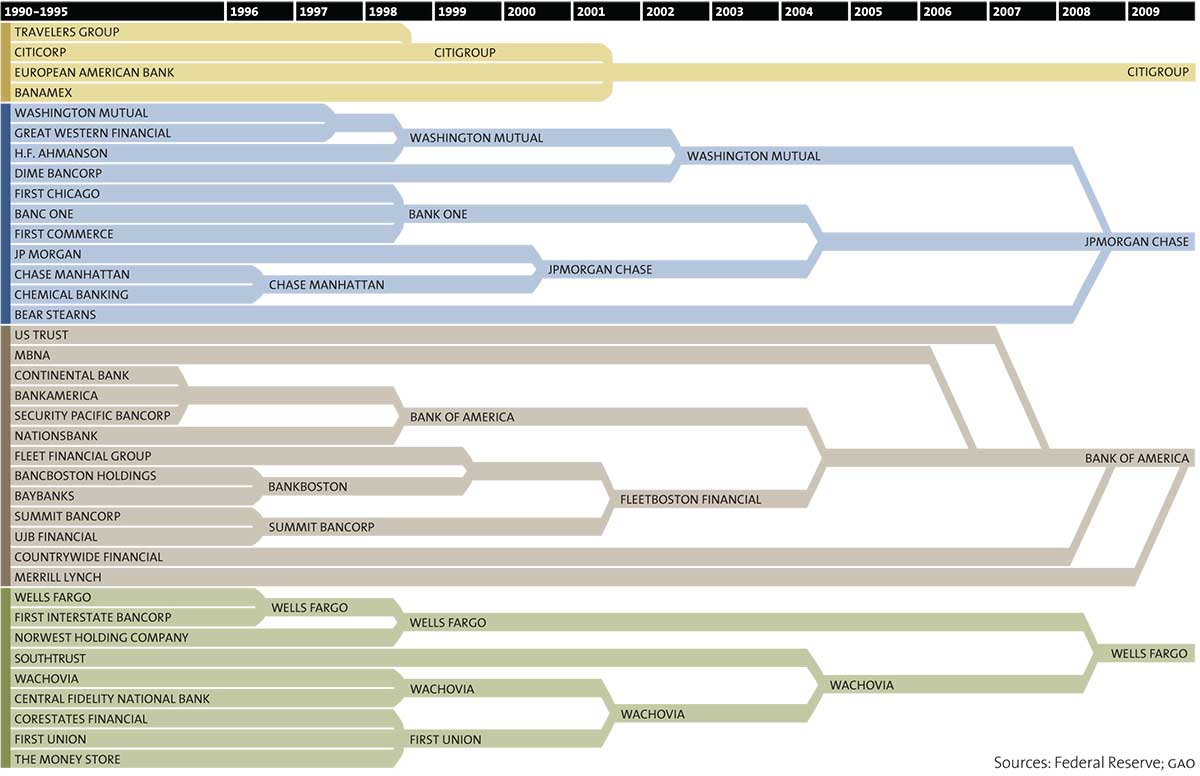
- When companies are able to buy out competitors easily and control entire markets it creates massive problems for everyone who doesn't lead the company. Today we have this problem in America when companies buy each other out which hurts competition which means that when one company fails, it has a huge market share, as was seen with banks in this famous graphic. In the movie business, six studios control 79.4% of the American and Canadian market share, which can't be good for creating new movies that question a number of issues that their owners wouldn't want to be talked about, like countless excellent documentary films.
- What we saw today was where Disney decided to close Lucasarts, despite it being one of the most popular game studios seeing all of my friends, and firing 150 people on the spot which is cold and will mean they will make absolutely nothing out of those games. Though they are thinking of contracting out to other studios, Disney would make more money by just keeping the games developed in Lucasarts which mean they get to keep 100% of the profit, which they don't want for some reason. A smaller company would never consider going out of business for such a reason, but would take their company and figure out how to make their company more profitable instead of just killing it.
The economy is a delicate organism, and it needs reasonable laws that are out of the way when not needed, and has good laws that creates a system where fraud and recessions can be avoided or at least minimized. To have an unrestrained free market creates a situation where recessions will happen, as we saw in 1929 and 2008, which is bad for everyone from the unemployed man on the street to the richest man in the world. To have an economy like existed in the Soviet Union or exists today in North Korea is just as bad in the short and long term as a system where people are able to be extorted in the name of profit for no pay as happened in the American South in the name of slavery.
Monday, March 4, 2013
The Left has a choice to make on peace
Foreign policy usually takes the back burner when it comes to politics. Neither party in America pushes hard for a solution to the Palestinian-Israeli conflict, human rights in China or North Korea, or other important issues. The left however has a large split today, and that is between people who support free trade and people who support tariffs, because of the negative effects of some free trade agreements.
Free trade has a number of large benefits. It allows people to find work in places that pay better and escape poverty in poorer countries (which has some disadvantages, nothing is perfect), it allows free travel to come on the scene which can fight the interethnic tensions and wars that often rise when travel is restricted. To have free travel you need free trade.
Free travel, the eventual elimination of customs between different countries and allowing people to move freely will have a lot of power to eliminate hatred between different groups of people. I strongly believe that if the people of Israel and Palestine could talk to each other and there were fewer restrictions on movement the conflict would diminish and they would find they have more in common than they believe. The same political debates, the same hopes, the same dreams, and the far right in both Israel and the PLO will fall making peace possible. I believe that if people from America and Mexico could easily talk to each other and we helped them fight the violence that ravages so many communities the racist tensions that exist with the far right in my country will have less influence. There are reasons why the southern border is a very Democratic area, even in Texas.
To do this requires free trade. Free trade will be the start, and then the left needs to get together and support free travel, and within the mechanisms of free trade labor needs to demand a living wage for an honest day's work. The status quo of no communication between nations brought more conflict and allowed people like Hitler to get entire nations to do the unspeakable, because most people didn't know what the other side was actually like. There is a reason there have been no wars within the EU (an previously EC) since World War II. Personally, I believe free travel is a critical part to world peace, and is worth the costs of free trade. I also don't see how the costs of free trade are permanent.
Free trade has a number of large benefits. It allows people to find work in places that pay better and escape poverty in poorer countries (which has some disadvantages, nothing is perfect), it allows free travel to come on the scene which can fight the interethnic tensions and wars that often rise when travel is restricted. To have free travel you need free trade.
Free travel, the eventual elimination of customs between different countries and allowing people to move freely will have a lot of power to eliminate hatred between different groups of people. I strongly believe that if the people of Israel and Palestine could talk to each other and there were fewer restrictions on movement the conflict would diminish and they would find they have more in common than they believe. The same political debates, the same hopes, the same dreams, and the far right in both Israel and the PLO will fall making peace possible. I believe that if people from America and Mexico could easily talk to each other and we helped them fight the violence that ravages so many communities the racist tensions that exist with the far right in my country will have less influence. There are reasons why the southern border is a very Democratic area, even in Texas.
To do this requires free trade. Free trade will be the start, and then the left needs to get together and support free travel, and within the mechanisms of free trade labor needs to demand a living wage for an honest day's work. The status quo of no communication between nations brought more conflict and allowed people like Hitler to get entire nations to do the unspeakable, because most people didn't know what the other side was actually like. There is a reason there have been no wars within the EU (an previously EC) since World War II. Personally, I believe free travel is a critical part to world peace, and is worth the costs of free trade. I also don't see how the costs of free trade are permanent.
Subscribe to:
Posts (Atom)