Showing posts with label democratic party. Show all posts

Sunday, May 3, 2020

Jen Perelman for Congress

On January 20, 2005 George W. Bush was sworn in for a second term. He had successfully eroded our civil liberties with the PATRIOT ACT, gotten us into an oil war with Iraq, and was already starting to rattle sabres with Iran. Virginian Terry McAuliffe was the chair of the DNC during this election. The Republican party gained another 4 seats in the Senate for  a total of 55 seats and another 5 seats in the House for a total of 232 seats. Terry McAuliffe was then replaced as the chair of the DNC by Vermonter Howard Dean. In 2006 we got the House, along with 6 governorships, and in 2008 we got the first Democratic trifecta since 2 January 1995. The future looked very bright. We had a young and popular President who supports universal health care, free community college, and expanding AMTRAK. If this wasn't good enough, he also was the first person of color in the office. He preserved more land than any other President in history, and he wouldn't have been able to do any of that if it wasn't for Chair Howard Dean's leadership. We had a majority of State Legislatures, briefly had a filibuster proof majority in the Senate, and over 300 seats in the House. Howard Dean had done a phenomenal job of historic proportions.

In a fairly unorthodox move, he stepped down after providing the biggest victory for progressive politicians in American history and he was replaced by Virginian Tim Kaine. A few things went very wrong at that point. Democratic politicians who did not cooperate on major issues, including health care, education, and transportation, were not held accountable for their votes by the party. As a consequence there was no party unity on major issues and the Republicans got a majority of governorships in a census year as well as a majority in the House. By doing this, they were able to gerrymander many different states, guaranteeing continued Republican dominance of the House for the next 8 years.

Kaine rightfully stepped down after that defeat which he had engineered. He engineered it by continuing to support Democrats who stepped away from the party line, which made a lot of voters feel like there is no difference between Democrats and Republicans. By giving them that much leeway, he significantly weakened President Obama and many voters, myself included, feel betrayed to this day. Tim Kaine significantly contributed to the animosity of the Democratic National Committee by Progressives by allowing too much leeway for members of Congress. We live in a country which uses first past the post, and because of this we have a two party system. We don't have a third party to hold conservative Democrats accountable. If he had held Democrats accountable by guaranteeing that they will be primaried if they do not support the President, they would have towed the line and we could have gotten a majority in 2010 by expanding our turnout.

He was replaced with Floridian Debbie Wasserman Schultz. She followed Tim Kaine's strategy which follows four major tenants:
  1. Do not support state legislative races. They need to raise money first on their own in order to get any support. This is what I heard from my party leaders in my local legislative district.
  2. Members of Congress have almost complete leeway in how they vote. If a Democrat votes against the party line, oh well.
  3. Do not rile Republicans. This means if they decide to gerrymander states and erode federal laws regarding voting rights and other critical laws, that is their right in our Jacksonian democracy. Do not exercise our power to bring rogue states in line with Federal law using the courts.
  4. We must appeal to the median voter.
In 2014 we lost the Senate as a result of these policies, and as a direct consequence of Wasserman Schultz's utter incompetence and fear of doing something meaningful, combined with having Tim Kaine as Vice President, whose biggest legacy is the Speakership of both John Boehner and Paul Ryan, Hillary Clinton lost the Presidency in 2016. As a consequence of the actions of Debbie Wasserman Schultz, Neil Gorsuch and Brett Kavanaugh are probably both going to be on the Supreme Court until around 2050.

After working in politics for 5 years, my conclusion from talking to thousands of voters is that median voter theorem is complete bullshit.

Also, a consequence of having some political experience under my belt is I believe very strongly that every inaction when you are in a position of power is itself an action.

She is still in the House today after engineering the election of Donald Trump through her cowardice. I do not believe she is qualified to be a canvasser for the Democrats or any left of fascist initiative after her gross incompetence and negligence put us in this situation.

Fortunately, for the people in her home district, there is a fantastic opportunity to end the career of the person who put Donald Trump in power through her actions. Over the last week on her twitter account, Jen Perelman has endorsed paid family leave, has spoken out about moderates trying to rehabilitate the image of the war criminal George W. Bush, she is the co-chair of her local League of Women Voters, and an attorney.

But most importantly, she did not engineer the election of Donald Trump.

If you are able, please donate to her campaign today https://secure.actblue.com/donate/jen2020.

If you are able to donate or not, please follow her on her Twitter @JENFL23.

Saturday, November 3, 2018

Winning strategy 2018 and 2020 for the Democratic Party

2018 is going to be a pivotal year in American politics. The Governors which are elected this year will be able to veto gerrymandered maps following the 2020 census, meaning that the impact of this year will be felt for a minimum of a decade. Being able to take a slight majority in the Senate (getting back to the maximum of 60 seats of 2009-2010 is going to be impossible right now) is going to significantly reduce the power of Donald Trump, protecting America from his homophobic, sexist, racist, and inequality driving policies.

The most important elections this year are without a doubt the local city, county, and state level elections. 87 out of 99 State legislatures are up for election this year, either in full, or in part. Granted, there is a lot of gerrymandering nationwide, but with Trump's approval rating and being accused of federal crimes by his top staff of his campaign team, it is going to be a very hard year for the Republicans. Every person who chooses to run as a Republican this year needs to answer for the President's behavior, and why they choose to associate themselves with someone whose presidency is failing in a way we haven't seen since Richard Nixon. This gives the Democrats a massive advantage.

But, merely running as the anti-Trump party won't be enough, because once Trump is gone we will need to have something to show that we stand for, not just against. We can start by looking at issues the majority of Americans agree on, which I have already written about here.

Particular priorities the Democratic Party can take on which I think will help win elections and gain support are:
  • Improve the Affordable Care Act. Increase access to Medicaid, implement a Federal public option for health insurance. Make it so anyone can opt in for Medicaid or Medicare. Increase quality of Medicaid in many states by removing it from state government and make it run like Social Security Old Age Insurance where it doesn't matter which state you live in.
  • Paid parental leave for the first 4 weeks of a child's life for both parents and grandparents. Increase the existing tax credit for parental leave to 100% for all businesses and all income levels.
  • Implement the high speed train plan Obama proposed in 2009.
  • Significantly increase federal subsidies for local transit, and building light rail in major cities across America. Significant federal subsidies if free transit for riders is implemented.
  • Free community college tuition for everyone.
  • Fully subsidize tuition at every public college.
  • Significantly increase number of small business loans.
  • Dismantle our nuclear arsenal which wastes tens of billions of dollars per year.
  • Set a timeline to end our use of fossil fuels in transportation by 2030.
  • No new pipelines in the United States. Respect the treaties with Native American nations.
  • Implement a carbon tax which will increase at an exponential rate with no exemptions for any special interest group.
  • Have capital gains taxed as regular income. This should balance the budget.
  • Have tax rates be determined by an equation with 90% of households getting a negative income tax, and a top tax rate of 50%. Negative income tax for all households below $100,000 per year for a single person. Have adjustments for household size. Proposal available on my blog.
  • End the Home Mortgage Interest Deduction which inflates the cost of housing and has no justifiable reason for existing.
  • Implement a universal basic income to reduce income inequality.
  • Pardon all standing student loans, and pay back all interest which has already been paid since 2008.
I started to write this, and most of the tenants are already on two existing lists. They are on the official Democratic Party Platform for 2016, and  on my annual post about platforms which are based on majority support. Democrats  are winning the generic battle for Congress and Trump's support cannot even reach 40%. The platform is not the issue, and should not see any major changes this year or in 2020, it is already a progressive platform.

The only area where Democrats are doing worse than the GOP is in strategy. The party needs to be more supportive of local candidates first of all, and give them as much support as possible across the country at every level. We need grassroots democracy, because all politics is local, and the greatest Presidents in history start out by being great leaders of their communities.

When it comes to tipping point states, here is a list of states by their electoral college votes sorted by the Cook Partisan Voting Index:

State Number to ratify Number of States Votes Number needed Vote in 2016 PVI Number of Votes Number needed
Hawaii
50 4 264 D 18 4 264
Vermont
14 3 261 D 15 7 261
California
31 55 206 D 12 62 206
Maryland
7 10 196 D 12 72 196
Massachusetts
6 11 185 D 12 83 185
New York
11 29 156 D 12 112 156
Rhode Island
13 4 152 D 10 116 152
Illinois
21 20 132 D 7 136 132
New Jersey
3 14 118 D 7 150 118
Washington
42 12 106 D 7 162 106
Connecticut
5 7 99 D 6 169 99
Delaware
1 3
R 6 172 96
Oregon
33 7 99 R 5 179 89
Maine
23 4

3 183 85
New Mexico
47 5

3 188 80
Colorado
38 9

1 197 71
Michigan
26 16 99 R 1 213 55
Minnesota
32 10

1 223 45
Nevada
36 6

1 229 39
Virginia
10 13

1 242 26
New Hampshire
9 4
D 0 246 22
Pennsylvania
2 20 99 D 0 266 2
Wisconsin
30 10

0 276 -8

You notice Ohio and Florida? Their votes are unnecessary for winning the Presidential election. We should still try our best to win their Governorships, because that is about 8 seats in the House we can pick up between them, and because we can. Getting more control over their state legislatures will be a really big change in terms of constitutional amendments, growing Democratic leadership for the 20s, and gaining a strong base. To get a constitutional majority to amend the constitution we will need 3/4 of the State legislatures, or 2/3 to call a convention. The states we would need to gain in order to do this on top of the states we need to win the Presidency (from the most conservative to least, again by PVI) would be Florida, Iowa, North Carolina, Ohio, Arizona, Georgia, Texas, Alaska, Indiana,Mississippi, Missouri, Louisiana, Montana, Kansas, and Alabama. In short, any amendment to the constitution will require bipartisan support.

Another bonus for the Presidential election is that Trump has a negative approval rating in every state I listed in the table above, as well as Iowa, Ohio, with North Carolina with a dead heat, given the Democrats a massive advantage to counter his incumbency advantage in 2020.

The biggest message for the Democrats this year, is go big or you will go home.  We need to campaign as much as possible, candidates need to get out and talk to people nationwide, listen to their concerns, have an attitude to solve problems and then next year to succeed in following through.

Governors

The absolute most important races this year are the Governor races in a handful of states. 6 states with very Democratic PVI scores are Vermont, Maryland, Massachusetts, Illinois, Maine, and New Mexico. We can pick up several of these states this year, and we also have a shot at getting Michigan, Nevada, New Hampshire, Wisconsin, and Pennsylvania. If we pick up Governorships in every state which have a PVI which swings towards the Democrats we will have 22 states, by picking up 9 new states (yes, it is that bad). Some of the governors are more moderate and popular, Massachusetts and Maryland will be hard to pick up. This election is the Democrats to win as long as they don't screw up.

Interstate Vote Compact and State Legislatures

The best way to guarantee majority rule in the 2020 election will be to have a majority of states sign onto the Interestate Vote Compact. This will likely be the first step in eliminating the Electoral College altogether.

The good news is when it comes to the Interstate Vote Compact, the 11 most Democratic states have already signed on. We only need the 12 other Democratic leaning states to sign on in order to have a majority in 2020, forcing Trump to win a plurality of the vote in order to win, which is going to be very difficult given the Mueller Investigation which continues to pick people off of his election team faster than he can hire people. Some of these states, Delaware, Oregon, New Mexico, Nevada, have Democratic majorities in both houses and haven't signed the compact yet. If they sign it will add 21 votes to the compact bringing the total to 190 out of the 270 needed. The remaining states which have split legislatures are Maine and Colorado which both have 18 R-17 D in their Senates. New York has a 32-31 R split in their Senate, and we can pick up at least one Senator this year. We just need to pick up one Senator seat in each of these three states and the Governor of Maine (which we will likely get) in order to pick up three valuable Trifectas.

If we could get a few more moderate states to sign on to the Interstate Vote Compact that would go a long ways towards making it pass. This is unlikely because it is almost impossible that it will benefit the Republicans, but the reasoning is that it is better for Democracy because it makes the Presidential election a popular vote as opposed to the Electoral College.

The legislatures with the slimmest Republican majorities (by percentage in both houses) are:
  1. Virginia (48% D)
  2. Maine (47.6% D)
  3. Illinois (47% D)
  4. Minnesota (46% D)
  5. Nevada (42% D)
  6. Arizona (42.5% D)
  7. Alaska (42.5% D)
  8. Iowa (40.9% D)
  9. Mississippi (38.58% D) 
  10. Montana (38.5% D)
In order of number of seats we need to pick up in State Houses:
  1.  Virginia (1 seat)
  2. Arizona (5 seats)
  3. Maine (5 seats)
  4. Michigan (8 seats)
  5. Montana (9 seats)

In order of number of seats we need to pick up in the State Senates:
  1.  New York (1 seat) and TRIFECTA
  2. Colorado (1 seat) and TRIFECTA
  3. Maine (1 seat)
  4. Minnesota (1 seat)
  5. Virginia (1 seat)
  6. Arizona (2 seats)
  7. Nevada (2 seats)
  8. Wisconsin (3 seats)
  9. Alaska (4 seats)
  10. Iowa (5 seats)
  11. Florida (5 seats)
  12. Texas (5 seats)
  13. West Virginia (5 seats)
  14. South Carolina (5 seats)

I believe if we do this in the next 3 days, Democrats will win this week, and if we continue to push we can win a trifecta in 2020.

Saturday, December 2, 2017

Swing States

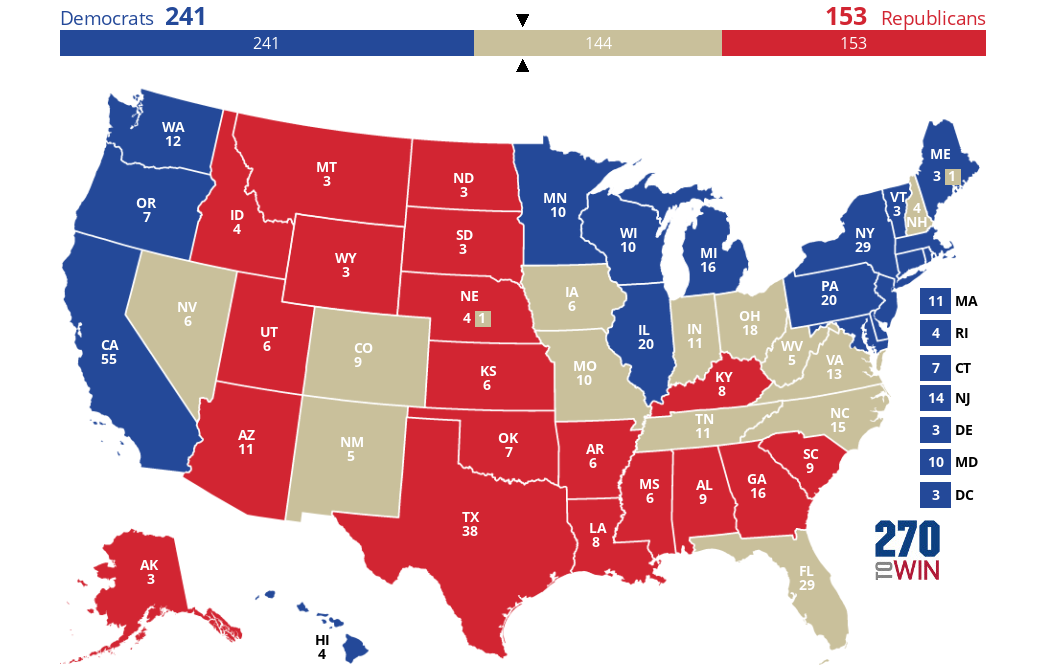
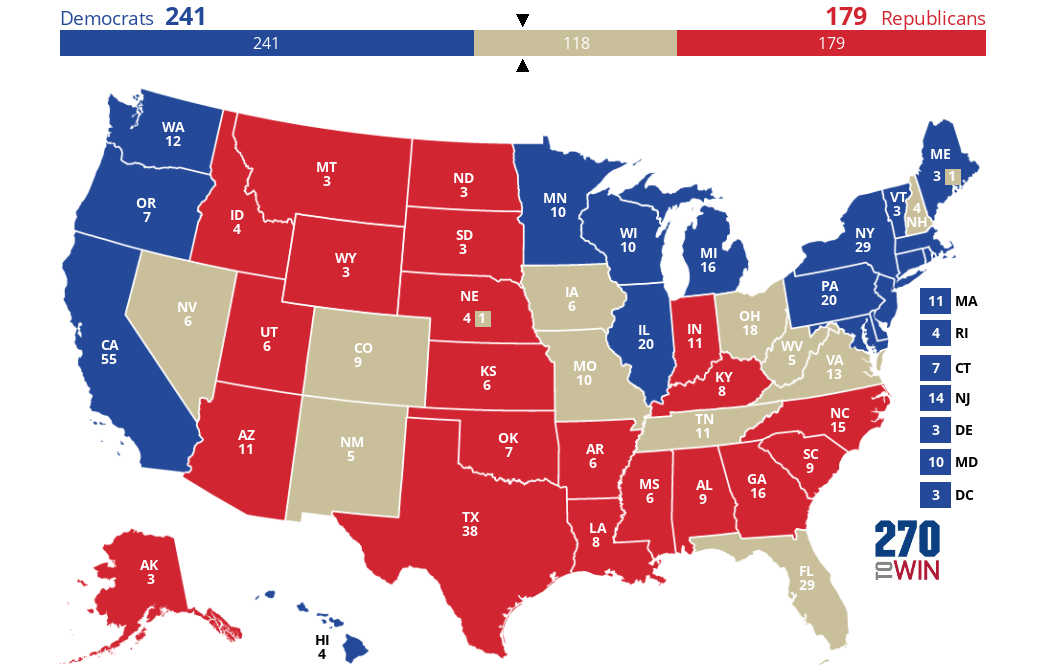
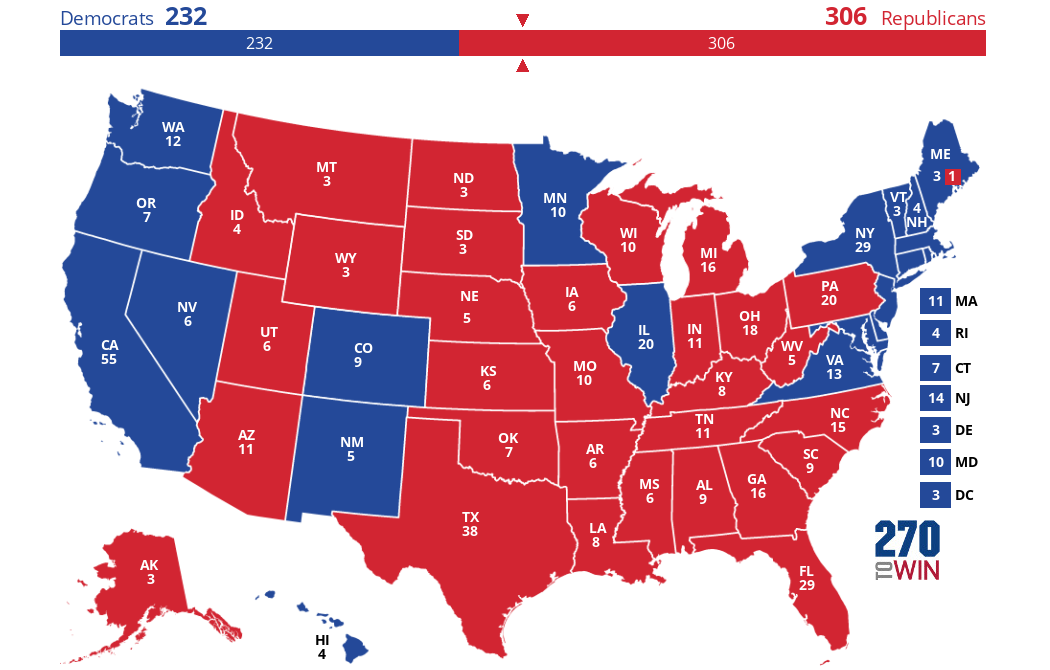
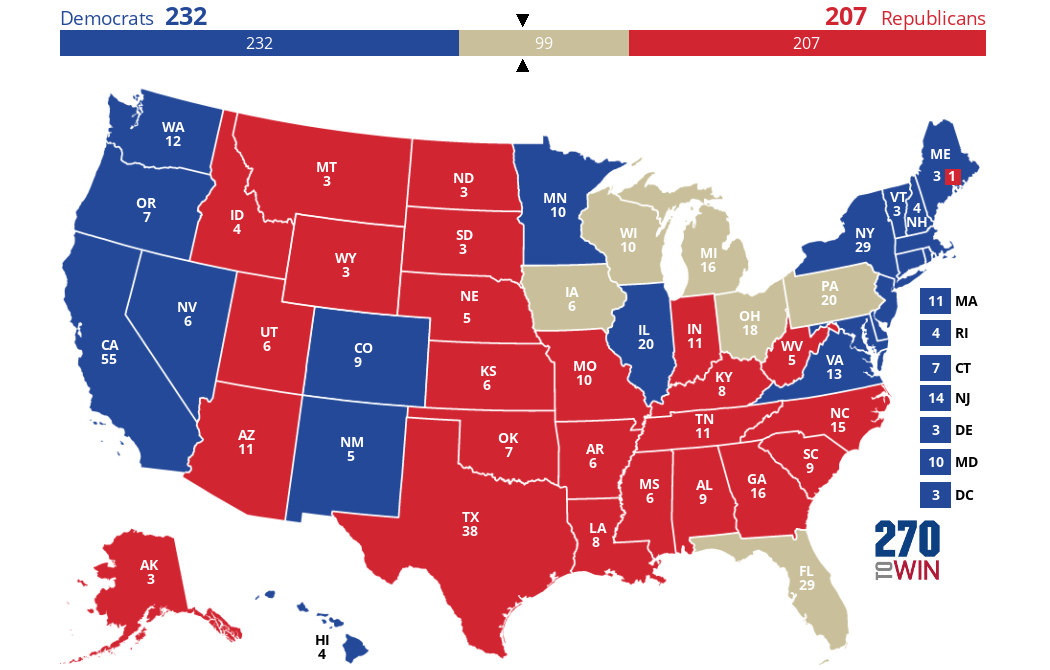
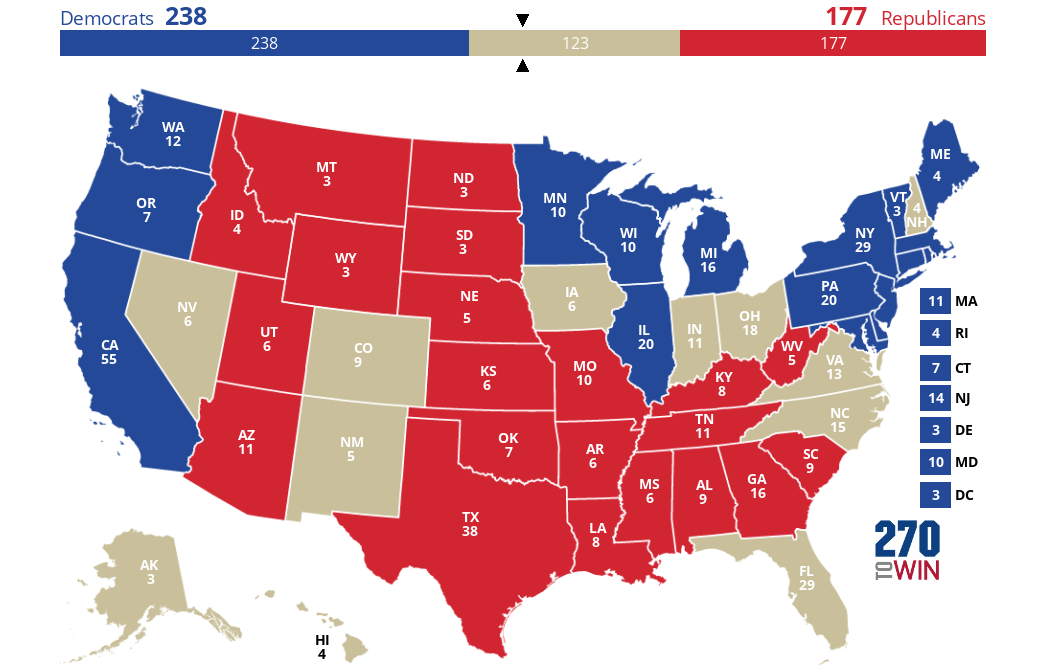
A series of maps to illustrate swing states, defined as states which have not voted for the same party for the preceding 4 Presidential elections.

Click the map to create your own at 270toWin.com
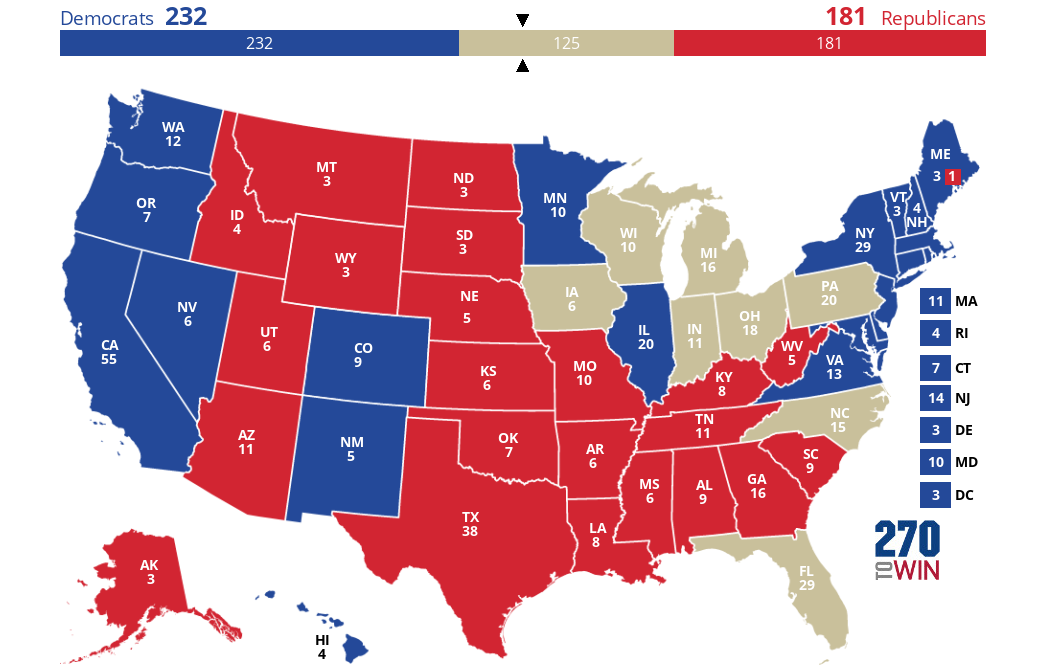
Swing States, 2016


Click the map to create your own at 270toWin.com
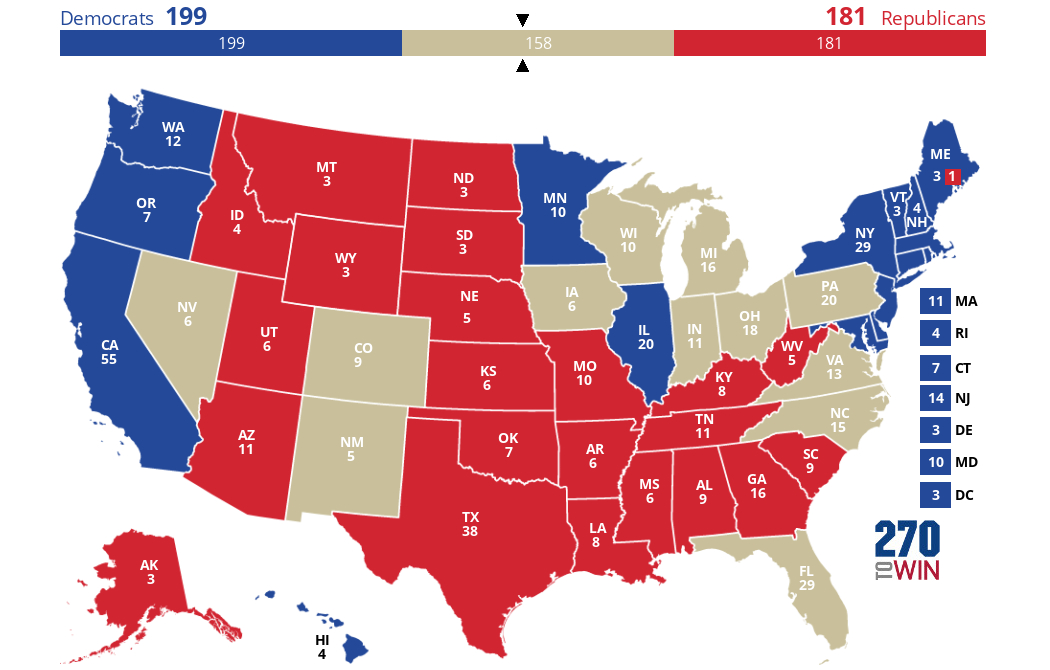
Swing States, 2012


Click the map to create your own at 270toWin.com
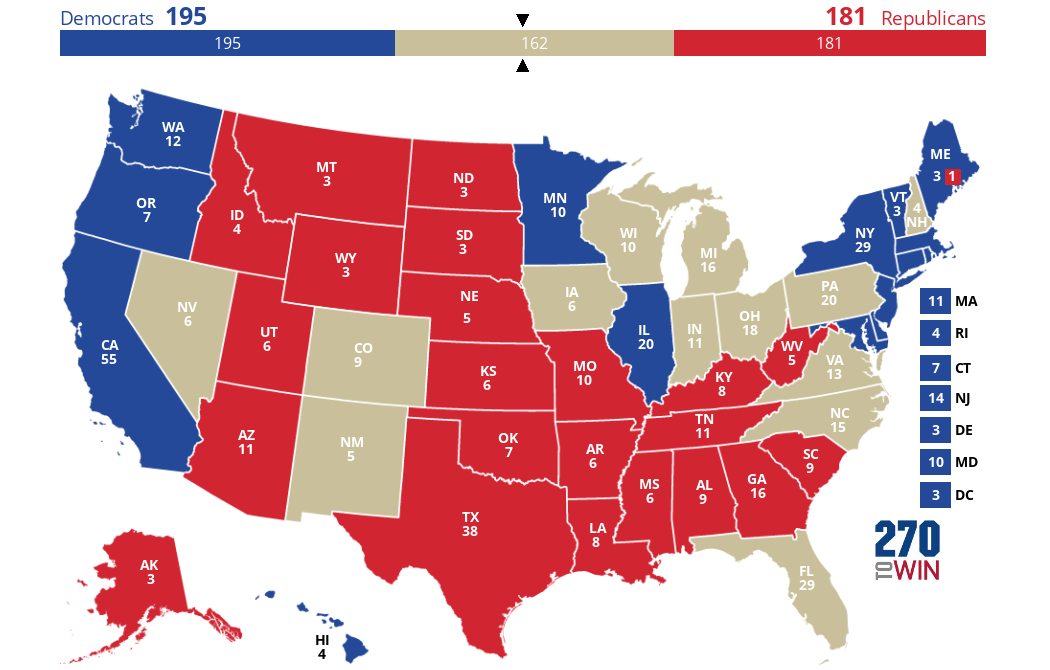
Swing States, 2008

Another way to look at it, if you gradually turn states into swing states the further back you go:


Click the map to create your own at 270toWin.com
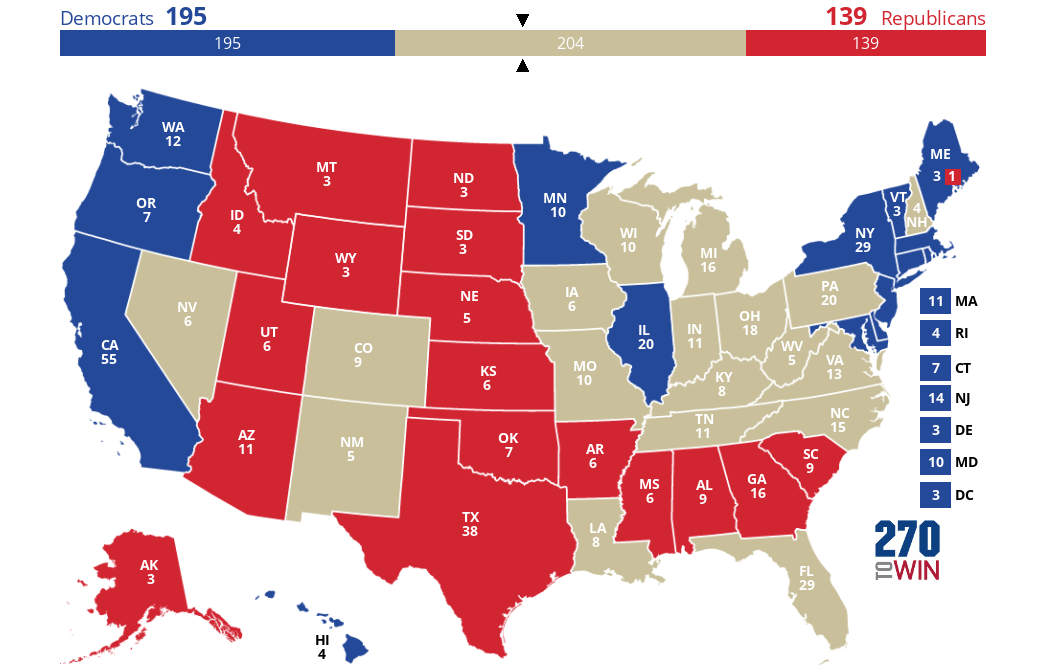
2016 results


Click the map to create your own at 270toWin.com
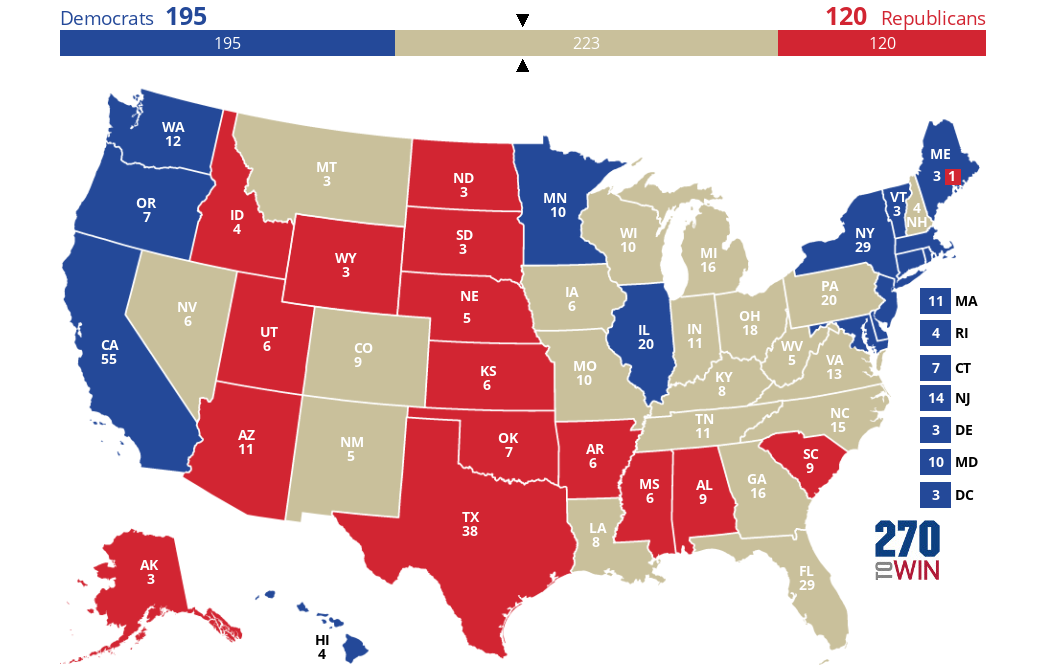
Since 2012


Click the map to create your own at 270toWin.com
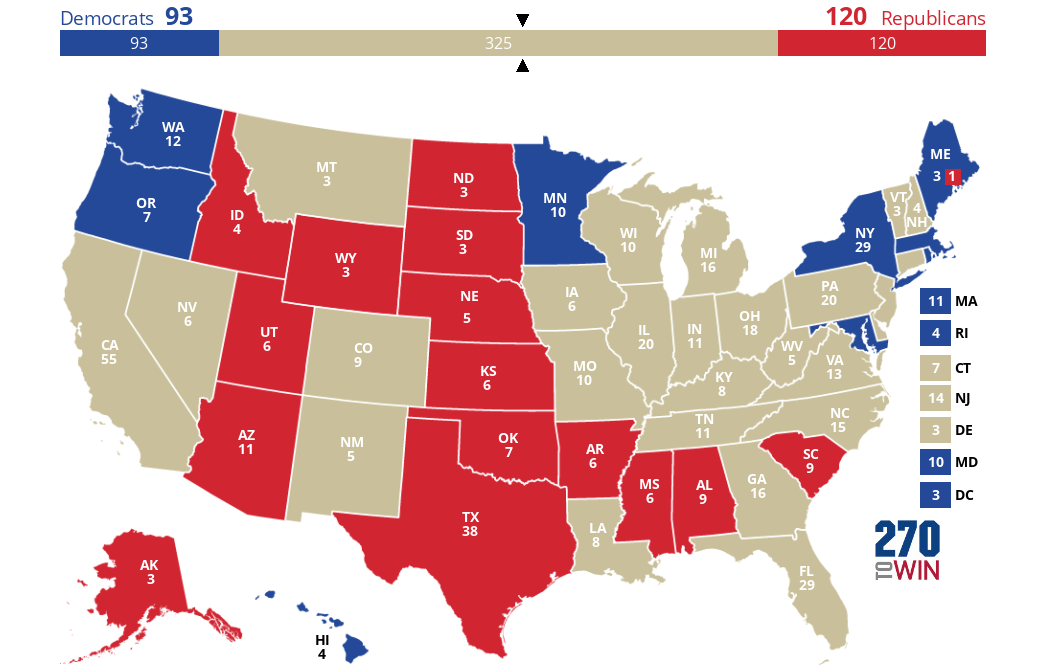
Since 2008


Click the map to create your own at 270toWin.com
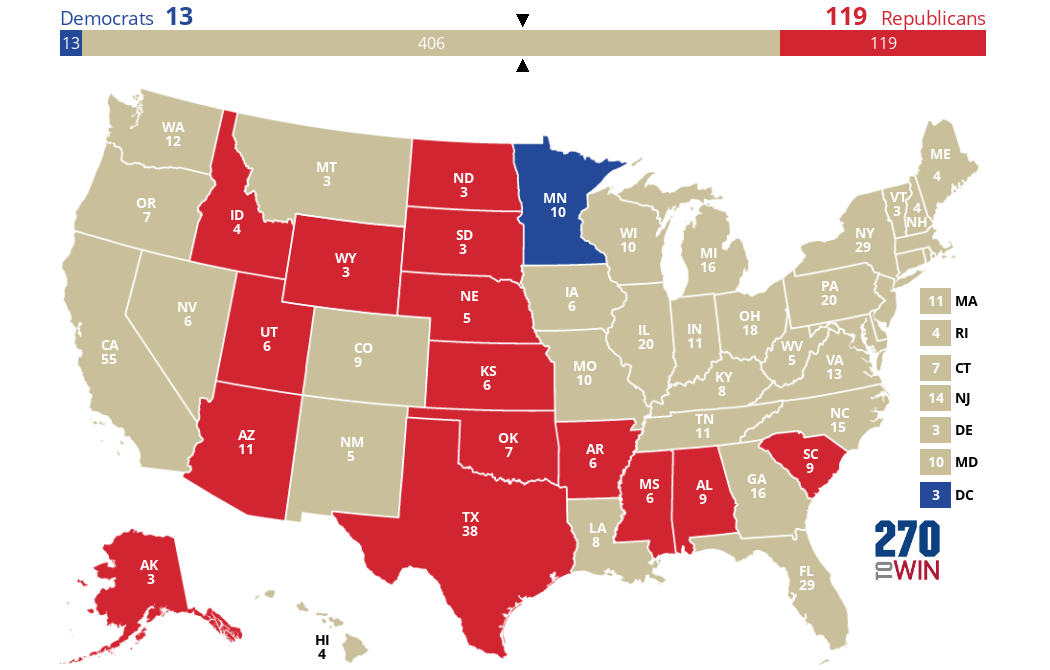
Since 2004


Click the map to create your own at 270toWin.com
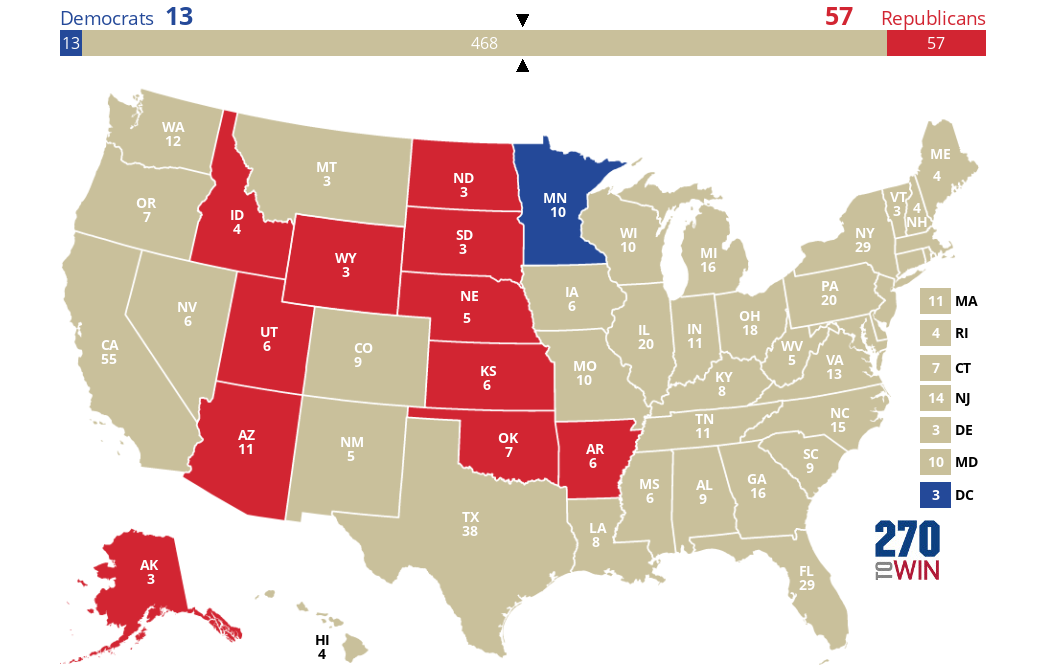
Since 2000 (repeat)


Click the map to create your own at 270toWin.com
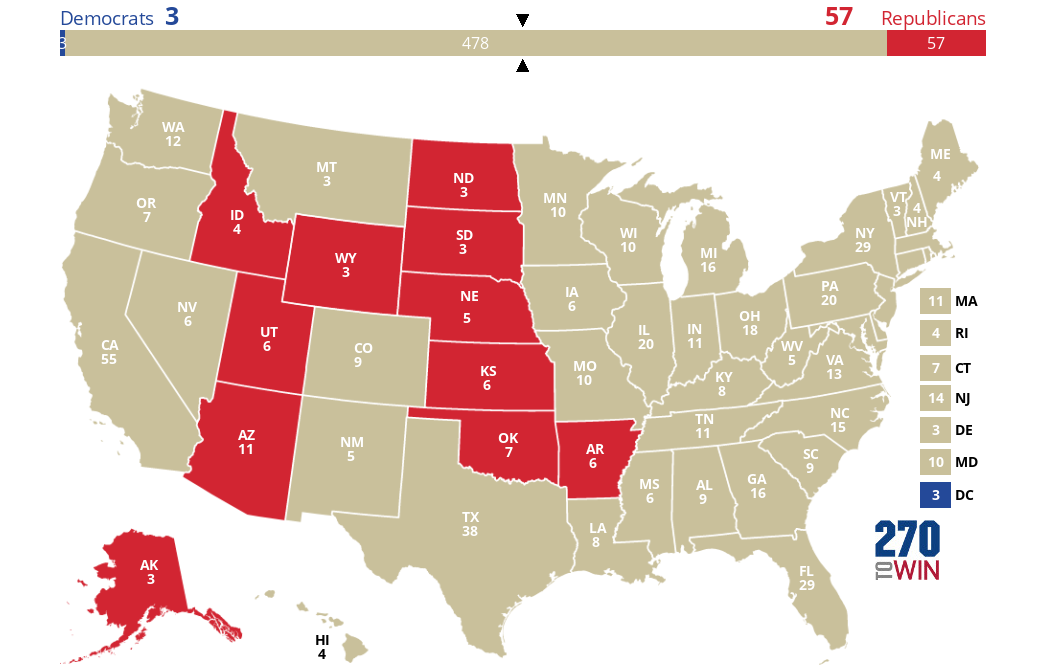
Since 1996


Click the map to create your own at 270toWin.com
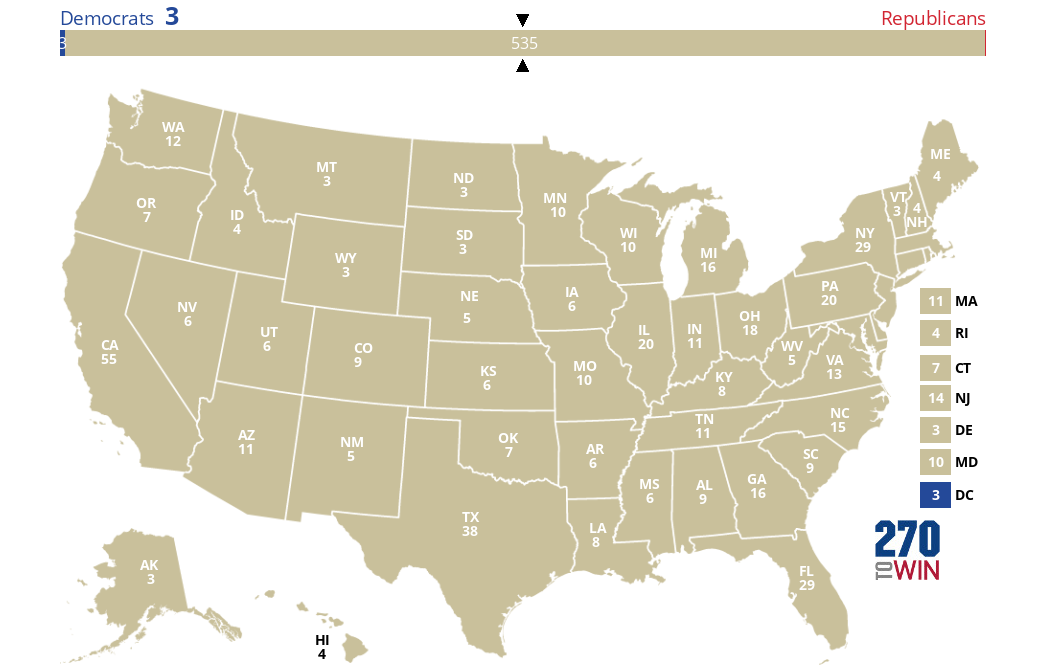
Since 1992


Click the map to create your own at 270toWin.com

Since 1988


Click the map to create your own at 270toWin.com

Since 1984 and 1980


Click the map to create your own at 270toWin.com

Since 1976


Click the map to create your own at 270toWin.com

Since 1972 and 1968


Click the map to create your own at 270toWin.com

Since 1964

1964 was the first election where DC was allowed to vote, so every state has voted for both parties except for DC over the last 50 years.

If I were hired by the DNC to ensure Trump is a one term president, I would ensure to put resources everywhere I can. The first step is to fight against voter discrimination laws which should have started several years ago. It doesn't matter if you are polling 10 points ahead of the other major party if your voters cannot vote for you.

While fighting those laws in the courts and ensuring people have the right to vote, we need to also fight gerrymandering. If the Supreme Court rules that partisan gerrymandering is illegal than there will be many more cases to ensure fair districting. This will mean that we will have many more competitive districts.

Getting a great candidate in 2020, such as Kamala Harris, would help a lot to win the Presidency, and ending the super-delegates to have the primary done with a straight popular vote would be a very easy way to increase legitimacy of the Democratic Nominee. That wouldn't take any laws to change, only some rules. It would also improve the image of the Democratic Party in the eyes of Millennials. If the primary is open and ranked then we will have the best candidate possible with no question of their legitimacy.

That will be enough to win the 2020 election. Campaign everywhere and have the first national primary in America's history. Supporting local candidates, and have every Presidential rally be with a local politician to get them name recognition will help the Democratic Party more accurately match its vote share in its success.

In the long run, implementing ranked voting and ideally ending the electoral college are the only ways I know of to make a truly fair election system where voters have the ability to kick out members of congress and legislatures who don't speak for them. After that, there will be no single Democratic Party because it will split into multiple parties at various levels of liberalism which will be good for America and voters by getting more viewpoints into the national debate.

The best we can do in 2018 is get good strong candidates nationwide running for every single seat in every legislature and support them so they can win.

I know this is a big change and a big dream, but that's the only way this crazy world has ever improved. Fight for the ideal system and get as much as you can. Hopefully someone at the DNC will read this.

Sunday, July 9, 2017

When liberals fight, liberals win

When liberals go to court, liberals usually win. That is a large chunk of the history of the civil rights movement, for some reason today it is in vogue to disparage the work of lawyers (many of whom were POC) who eliminate legal barriers. If we had been more vicious while Obama was President at fighting gerrymandering we could have had a competitive election in 2014 and 2016, which would have made it so the laws which prevented people of color from voting would have never been proposed or passed, but oh well, at least we waved some signs. We need a lot more of this and to pool our resources to hire the lawyers to get this work done.

This legal fight against Dakota XL should have happened as soon as the pipeline was proposed, but it was the failure of liberal environmental organizations and the President to not press for this as soon as the illegal pipeline was proposed. This is part of a general trend which includes Democrats not fighting gerrymandering and many other weak aspects of the modern Democratic Party which makes them irrelevant to modern American politics.

The only way out of our current predicament is through ranked voting and a breaking down of the big tents.

http://sciencevibe.com/2017/06/19/oops-turns-out-the-dakota-pipeline-was-illegal-after-all/

Saturday, April 15, 2017

3 years in advance, 2020 prospects

Trump's first 100 days have been relatively uneventful compared to what it looked like 3 months ago. He failed to repeal the Affordable Care Act, has reduced his plans for the border wall. On the downside he has approved more pipelines, implemented a hiring freeze for the government, and slashed funding for services we rely on, like the EPA, FDA, and many other agencies we depend on. Some decisions are more nuanced, such as the actions in Syria, and it remains to be seen whether our increased involvement in Syria will defeat ISIS. He banned refugees which hurts the fight against international terrorism. His protectionist policies threaten our economy. He praises Putin will claiming NATO allies need to pay up. Officials from multiple intelligence agencies expect meddling by Russia in our election. We have seen more nepotism in this administration than any other in living memory. He removed environmental reviews for many infrastructure projects, putting our health at risk. Despite critizing Obama for vacation he already has spent more on vacation than Obama did per year on average. The very fact that he tried to repeal health care without a reasonable approval shows he does not care about the average American and is just looking for

In 2020 we are going to need a change of pace to reinstate the services he has already cut. The next president of the United States is probably in office already, and is likely either a governor or senator currently. Trump is the first president to not be a sitting Senator or governor since Eisenhower, and most Presidents in history have been one or the other. In order to be an effective candidate the Democratic nominee will need to be:

  1. Someone who understands science and listens to professionals in order to make the right decision.
  2. Someone without a history of corruption. I will only consider governors from the top half of states because of this.
  3. Someone with a good media presence and excellent speaking skills.
  4. A strong progressive background
  5. Popular
The first metric I think we should examine are the most popular politicians in America. On this metric Bernie Sanders stands out as the most popular politician in America. People know who he is and his policies are popular enough for him to get +29 points (favorable - unfavorable) in a Fox News poll. The other polled was for Elizabeth Warren who also polled positively, despite only 70% of respondents knowing who she is (a massive improvement from previous polls). A Sanders-Warren or Warren-Sanders ticket would blow Trump out of the water in 2020 if they chose to run. Bernie Sanders is doing the best in primary polls right now, although it is certainly too early to call. Sanders and Warren match all 5 requirements I can think of in order to be a successful president. O'Malley also won a poll in Iowa, and he would be a fantastic president.

When it comes to governors, the following are at the top of the list:
  1. Former Delaware governor Jack Markell was the most popular Democratic governor in the nation with 66% approval, 5% more than Bernie Sanders. He has been a leader on lgbt rights and the environment, and has improved state campaign finance laws. He would be a great President if he chose to run. Delaware scores well on corruption rankings.
  2. Mark Dayton of Minnesota is the second most popular Democratic governor in America currently at 61% percent approval, but he doesn't have the strong anti-corruption record of Markell. Minnesota scores very well on corruption rankings.
  3. John Hickenlooper already can't walk into a room without people asking him to run for president, like when he was on Wait Wait Don't Tell Me a few weeks ago.  He has an amazing economic policy, strong on gun control,  and is in favor of marijuana legalization. He would be a fantastic president. Colorado scores very well on corruption convictions.
  4. Kate Brown of Oregon is enjoying 58% approval and is strong on all metrics. Oregon is the least corrupt state in the nation.
  5. Jay Inslee of Washington is at 56% approval and a strong progressive on most issues, despite opposing Initiative 732. Washington is the second least corrupt state in the nation.

So, my ideal primary would see Bernie Sanders (who will likely win) on the stage with Kate Brown, John Hickenlooper, Elizabeth Warren, Jay Inslee, and Mark Dayton. These are 6 individuals who do the best they can given their available information and we would be lucky to have any of these individuals as our next president.

More details:
Candidate Age on 20 January 2021 State
Kate Brown 60Oregon
Jay Inslee 69 Washington
Elizabeth Warren 71Massachusetts
Bernie Sanders 79 Vermont
John Hickenlooper 68 Colorado
Mark Dayton 73 Minnesota

The first thing about these heavy hitters is that they are all fairly old to be President. Most Presidents have usually been in their 50s with an ordinary bell curve with the median at 55. Obama was 48 when he became President, Clinton was 46. All other Presidents since Kennedy have been older. Trump is the oldest President ever at 70 years old upon inauguration. These 6 candidates are all very good people but also would continue to be yet another baby boomer President. It would be ideal in my opinion to have a younger President (like Obama, the most successful since LBJ by a wide margin). All of these candidates had the opportunity to run in 2016 and only one of them did.

For younger politicians, the following spark my interest:

  1. Senator Tammy Duckworth is a veteran from Illinois with an excellent record.
  2. Keith Ellison is a representative (the only President elected from the House so far has been Lincoln) but a strong progressive voice for our country.
  3. Kamala Harris of California has a fantastic record as a prosecutor in California and I expect great things from her.

There are not very many ideal presidential candidates in America today. The Democratic Party has failed  to get a pipeline of candidates from the local level to be a dominant force in politics like the Republican Party has done. They need to fight gerrymandering and voter discrimination now in order to be a competitive party nationally. Until this happens we will continue to see the Republicans rule the country at all levels of government. But, we have 9 great choices for President, hopefully one will win the election in 2020 and make Donald Trump the first one term president in a generation. We can do it, if we choose to.

Sources:
https://www.benzinga.com/general/politics/17/04/9302898/americas-most-and-least-popular-politicians
https://mic.com/articles/171382/a-fox-news-poll-just-found-that-a-socialist-is-the-most-popular-politician-in-america#.61keVuNrG
https://morningconsult.com/governor-rankings-april-2017/

Wednesday, October 19, 2016

Democratic Strategy

I am currently working for Washington CAN, the oldest progressive non-profit in Washington State. We are getting out the vote in two districts currently, Washington State Legislative districts 30 and 44. If we succeed in flipping these two districts we could flip the entire Washington State House of Representatives which would is an essential step forward in getting progress in our state on important issues such as education, health care, and infrastructure which we all rely on.

The current state of United States legislatures is very poor. Democrats control only 7 state governments in full. Republicans control 23. 4 states have Democratic legislatures with a Republican governor, 11 states have democratic governors without control of the state legislatures. This means that Democrats are missing a pipeline of new talent for leading our country, will be unable to get constitutional amendments passed, and the Republicans have 31 out of the currently required 34 state legislatures to get through constitutional amendments. Given the shifting demographics of the United States, there is a lot of work that we can do right now to regain state legislatures to the point where major goals, such as Medicaid expansion, high quality infrastructure and other vital issues can be achieved. We will not get these issues passed however until our legislatures are made of people who actually care about the well being of the people, and given the state of the Republican party, that means they have to be Democrats.

A big cause of why state legislatures are overwhelmingly Republican is because of gerrymandering. State legislatures draw the boundaries for themselves in most states, and for Congress. The Democratic party needs to bring forward state initiatives in states across the country where gerrymandering has taken hold to use the single-split line method, and ideally ranked voting with multiple winners per race in order to make it so state legislatures more accurately represent the wishes of the American people. This will make it so Republicans will lose control across the country.

In order to make this happen, we have 4 easy pick ups this year with split legislatures. Democrats could easily pick up the state legislatures in Washington, Maine, Colorado, Kentucky, Iowa, Minnesota, New York, and New Mexico. Washington and Colorado only need the Democrats to pick up two seats in order to control the state. In New Mexico Democrats only need 4 more out of 70 seats. This would bring them to fully control 10 state governments, and then in 2018 pick up 4 more governorships to control 14 state governments around the country, with the Republicans still at 23 state governments and 31 legislatures.

Once we end the split governments, the states which need to be targeted next are Nevada, Montana, Pennsylvania, and New Hampshire. All of these states have less than a 20% split Democratic to Republican, and are good targets for Democrats to reclaim more governments. This will put Democrats at controlling 18 state governments, bringing Republicans down to 21 state governments and 27 state legislatures. Given their closeness to tipping, we cannot let them slip.

We also need to reclaim 6 governorships where Democrats control the state legislature, Maine, New Mexico, Illinois, New Jersey, Maryland, and Massachusetts.


Status (states) States (seats needed)
Hold governorship, hold legislature (7) Hawaii, Rhode Island, California, Delaware, Oregon, Vermont, Connecticut
Pick up governorship, hold legislature (4) Illinois, New Jersey, Maryland, Massachusetts
Pick up one house, retain governor (4) New York (9), Colorado (2), Washington (1), Minnesota (7)
Pick up one house, pick up governor (4) New Mexico (2), Maine (6), Iowa (8), Kentucky (9)
Pick up legislature, retain governor (3) Montana (7), Pennsylvania (25), New Hampshire (42),
Pick up legislature and governor (2) Nevada (7), Arizona (11)
This will give democrats control of 24 state governments by picking up 10 governorships and 142 seats in state legislatures (out of 7383 in total). This is doable.

Once Democrats focus and get out the vote in these 24 state governments, the remaining states we will need to focus on are Michigan, Virginia, Florida, Wisconsin, and Ohio. These 5 Republican controlled governments frequently vote for the Democratic President and elect Democratic Senators. This will give Democrats a majority of state governments. What this will mean for working families is more mass transit, better infrastructure, improved schools, and expanded access to Medicaid. If the Progressive wing of the party gains influence it will hopefully mean a more progressive tax code and more efficient government programs.

The 5 remaining stretch states which will give Democrats the 34 governments needed to approve constitutional amendments and dominate the country are Missouri, Kentucky, West Virginia, Louisiana because they have Democratic governors which will give Democrats 33 state governments. The one final state which Democrats would have the ability to gain will probably be Texas given massive demographic shifts over the next decade which will bring Texas into play by 2020. Georgia as well could be in play within a decade from demographic changes which is an extra bonus for the Democrats. Given the stubbornness of people who support Donald Trump, I expect at least another ten years of the alt-right having a significant impact on the Republican party. This is the opportunity of a generation for the Democrats to dominate the US and make significant changes beyond Obamacare to improve equality and opportunity for everybody.

Picking up another 27 state governments will be a monumental shift in American history. Of course state and county parties are going to need to be well organized to get great leaders running at all levels of government, but the national party should spend its resources to get real gains as soon as possible. Here is a rough schedule on how the National Democratic Party should focus on regaining state governments.

In 2016-2018 we need to focus on the states where we already control at least one house while retaining the 7 states we control. We could gain 12 state governments in the next two years, bringing us to 19 state governments by the time we get to the 2020 election.

In 2020-2022 we need to focus on the three states where we control the governorships (on top of the State Parties working hard over the next 4 years) which will bring us up to controlling 22 state governments in total.

In 2024-2026 we need to start to pick up the next 5 states I mentioned (if we haven't gotten them already) and whatever states in the preceding two lists we haven't managed to get.

Finally in 2028-2030 we could pick up the remaining 5 states to gain control of a supermajority of state governments across the country.

A lot can happen in 14 years of course, and it is possible Democrats could make these gains before 2030. I do believe however we should focus as much energy as possible on these local races to gain state governments. This is the only way we are going to be able to get progress on issues which improve the lives of all Americans which the Republicans have blocked for decades.

Saturday, October 15, 2016

Race and gender

Nate Silver, who I deeply respect and read frequently released a picture earlier this week showing how the election would look if only men or only women voted this year, to a difference that set off the internet, at least the part of the internet made super liberal people, who tend to be most of my friends.

However, as is so often the case in news, there is a much deeper level to this than meets the eye.

Looking at exit poll data from 2012 we can see that the "gender gap" is very different from what most people imagine it as.

First, Nate Silver is correct about how women voted in 2012, here is the map for reference:

In 2012 (for states which data is available) women voted like so:

This does show some significant swing states in the women vote for Clinton. Indiana, Missouri, Kansas, Arizona, and potentially a few other states which CNN did not conduct exit polls in 2012.

Nate Silver also demonstrates in the male vote that they are overwhelmingly voting for Trump.

In 2012 however, the male vote regardless of race would have looked like this:
So, according to the latest projections, Trump is projected to pick up the male vote Michigan and Colorado and retain the men in all the other states which Romney won the male vote in 2012.

This gender divide picture changes however when you take into account both race and gender.

White men voted like so:
This shows a large number of massive swing states for Republicans if only white men were allowed to vote. Romney would have won every state (for which I can tell given data limitations) except Washington, Oregon, Vermont, and Massachusetts. Every other state for which I could find data would have voted for Romney in 2012. This would be approximately 494 electoral college votes for Romeney, leaving only 44 for Obama.

Is the gender divide what changes American politics? Well, white women voted like so:
This would have given Romney many important states, including Florida, Virginia, Maryland, Pennsylvania, New Jersey, Ohio, Michigan, Colorado, New Mexico, and Nevada. Romney would have won 349 electoral college votes if only white women were eligible to vote. More than enough votes to carry the nomination if voting were limited to white voters only.
With Obama carrying only the northwest and New England given a white only vote, Romney would have won 479 electoral college votes. A landslide victory without question.

The only reason Democrats can win nowadays is with minority voters who form a voter bloc. For every state with data, I find Democrats easily winning the majority of Latino and Black voters, both men and women. The Democrats have become a massive coalition of minorities and white allies since President Johnson, and that is their ticket to winning. This is why Republicans work for voter ID laws, which limit minority turnout. With their opposition to programs which raise people out of poverty, who tend to be disproportionately minority due to centuries of discrimination, there is no wonder why minorities have flocked to Democrats with their support of education, health care, and other essential services that prevent people from falling down completely. 

This is why it is important when studying gender or race to check to see if there is not a lurking variable behind what seems like an easy correlation. The real reason we see more women voting for Democrats is not simply from significant numbers of women flocking to the Democratic party, but from a higher voter turnout among minority women versus minority men. The gender divide is small, but the difference in turnout between minority men and women is large enough to tilt national elections. With millions of African American men incarcerated for minor crimes across the country they are ineligible to vote which does not give the male demographic the Democratic boost needed to also side slightly to the Democratic Party.

For the future this has major consequences for American politics. Hispanic/Latino Americans are growing as a percentage of the population, partly through immigration, and also through a higher birth rate than white Americans. It is now impossible for Republicans to win the Presidency without being accepting and open to these Americans, and they are likely to lose important states such as Arizona and Texas, and Florida is going to be out of reach within 10 years as the demographics shift.

The Republican Party right now is a reactionary party, and Donald Trump represents this reaction from the far right of American politics to a new America which is more diverse than at any other point since independence. With Nate Silver currently giving Clinton an 81.9% chance of winning the election with 322 electoral college votes under their Polls Plus Forecast, this strategy is clearly not working and if Democrats vote down the ballot this year it could be a total catastrophe for the Republican party.

Until the Republican Party becomes less racist the Democrats will retain the Presidency. It is time to focus down the ballot, end gerrymandering and kick the Republicans out of state legislatures as soon as we can. That will probably be in 2022 assuming that there are ballot initiatives in 2018 and 2020 to reform or end gerrymandering. The current initiative in Maine for IRV has the potential to spread across the country like how gay marriage in Maine and Washington spread across the country in the blink of an eye. With ranked voting and multiple members per district in more states, the Democrats and major third parties (eg The Progressive Party) will gain power, forming coalitions and increasing opportunity for everybody. Hopefully these efforts will spread like wildfire, we can change the law to allow (or even require) members of congress to be elected using ranked voting and then we will have governments which reflect the wishes of the people.

This is the foreseeable future of American politics. The racial divide is real and the biggest determinant of which party wins.

Sources:
CNN Exit Polls 2012
http://fivethirtyeight.com/features/election-update-women-are-defeating-donald-trump/

Saturday, October 8, 2016

Time to work down the ballot

Trump with his latest move has made his final mistake. He has alienated people of every minority over the last year, Hispanics, Muslims, African Americans, and with his latest train of disgusting degrading remarks he is now losing the support of the Republican Party, with some calling for him to withdraw from the race.

What is striking about this is how none of these types of comments are new for Trump to say on cable news. What is different this time is how he is not targeting a racial group but all women in the world. The modern Republican Party endorsed Trump through all of his racist comments and openness to his bigotry over the last year. They have shown they do not care about Black Lives, Muslims, Hispanics, Native Americans, or anyone who is not white to be honest. Their unwillingness to stand for all Americans and support of a blatantly racist candidate makes them the most despicable party in this country over the last 150 years.

Trump is going to lose. He is a racist rapist who doesn't deserve any time on the news. Only the Democratic Party has shown that it is willing to at the bare minimum to oppose people like Donald Trump and vote for things like the Lilly Ledbetter Act. Granted, the Democratic Party has a lot of room to improve and need to be better about passing legislation with their important pieces intact, in cases including the Affordable Care Act, and voting against legislation which is opposed to American principles, including the PATRIOT ACT. But these are small issues compared to the amount that Donald Trump has already destroyed our civil discourse and wants to move our country backwards. The Republican Party supports him so I must assume this means they support his policies as well.

We need to vote down the ballot and kick out as many Republicans as possible. We need to elect strong progressives in local, state, and Federal offices this year if we are to move our country forward. The President gets all of the headlines, but Congress as a body is just as powerful as she is. Most Presidents in history are former Senators or Governors (Clinton, Obama, Bush, Clinton, Bush, Reagan, Carter, Ford, Nixon, Johnson, Kennedy, Truman, and Roosevelt all were either a Senator or Governor before becoming President) meaning the 46th President is already in office somewhere. Senators and Governors usually are State Legislators when they are elected to Federal Office for the first time, and those individuals grow their campaigns originally through being leaders in their local communities years before they run for office.

The President who will be elected in 2028 is currently in their 30s right now somewhere in the country. This individual is possibly running for a state legislature seat right now in some state in this country. This individual is starting their political career which will catapult them to the Presidency this year only if people get out to vote. Elections down the ballot matter because a future President is running for a legislative seat this year and the only way they are going to lead the United States as President is if they get elected in a month. Do you want that individual to be a progressive fighting for the Bill of Rights and opportunity, or yet another corporate tool who believes that unlimited money in elections is a good thing and that internet surveillance works? (hint: Generals in the military say it doesn't) The only way we are going to be able to secure our future is if we vote for our local races this year all the way down to that boring county commissioner position, which is actually a very important role for determining land use and many other services we rely on everyday. Great leaders in American history start at the bottom, as community organizers gathering petition signatures as they move up the food chain. We get the leaders we deserve by who we elect into those positions.

Please fill out your ballot. Your county needs you.

Wednesday, July 13, 2016

The General Election has begun

So, the Sanders revolution has ended. Clinton has won the nomination, and I am now seeing countless Sanders supporters I know claiming they will "never vote for Clinton" "Vote for Stein" and other rubbish.

For me, I originally wanted a Warren/Feingold dream team ticket. I wrote about this dream way back in 2013. I still wish Warren had run and know that if she had that she would have won the Presidency in a landslide by gathering all of Sanders supporters and a large number of Clinton supporters. However, this did not happen obviously so we have to stick to what is available at the moment.

When it comes to criminal records, Clinton has never been indicted once in her life. Even the Senate committee on Benghazi which is composed of Republicans whose entire purpose is to discredit Clinton and send her to jail to give Republicans the nomination to Donald Trump is unable to get any dirt on Clinton to the point where she can be indicted. When it comes to criminality, no one has ever been able to prove that she has ever committed a crime.

When it comes to policy, Clinton comes out to be about the same as Obama. The political compass for 2008 puts her as slightly more capitalist than Obama and the same level for social issues. In 2016 she has moved more right in both directions than she was in 2008, and Sanders is about the same point when it comes to social policy as she was in 2008. Clinton will probably drift slightly further to the right in the general election because of the median voter theorem, but as president I do not expect any significant social policy changes under her. Economically, she is going to probably whittle away our financial regulation but besides that I do not expect any other major reforms. Trump, on the other hand has talked about significantly eliminating a lot of civil rights laws and incredible discrimination against Muslims and Hispanics. This is what the election comes down to. Economically we are screwed either way, but with Trump there is little doubt we are going to quickly move towards a fascist state, and given the Democrats willingness to vote for the PATRIOT ACT without thinking in 2001 I don't think there will be anyone to stop Trump from truly destroying the United States. This will not happen under a Clinton presidency. She is definitely a hack for corrupt bankers, but she is no fascist. For this reason I prefer Clinton over Trump and will not waste my vote voting for Jill Stein until the minor parties start to run candidates and get elected in local offices.

Clinton is far to the right of President Lyndon Johnson, but she is no Hitler. Trump on the other hand talking about banning Muslims from the US, and policies against Hispanics is racist to the core. I do see Trump as a Fascist in his economic views, social views, and foreign policy and so out of respect to the millions who have died and lived under Fascist governments (including some of my favorite relatives) I will call him what he is. My family lived under Nazi Germany and I have studied the Third Reich as a way to understand my history and understand how to avoid Fascism at all costs. (if you want to understand the Third Reich, read Hannah Arendt) There is no overarching moral issue where I see a divergence between Trump and Hitler (find "Jew", replace "Muslim") so out of respect for those we have lost I call Trump a Fascist. I will write a longer comparative post later.

Also, the majority of African Americans voted for Clinton even after all of the welfare reforms done under the first Clinton Presidency. They know what is best for them ultimately and if they feel that they will be better off under a Clinton Presidency it doesn't matter how long you or I have been involved in organizations fighting racism, it is inappropriate to deny the voices of millions of people.

Please do not waste your vote and vote for Clinton this November. If you want to get real change going, you need to get involved in your local politics, demand ranked voting, and help our country get a better election system.

Thursday, October 15, 2015

Sanders and Media bias

Bernie Sanders is by far not my favorite member of Congress, and looking at the Senate and governors across the country, he doesn't even make my top ten candidates who I believe would make a fantastic president (Warren, O'Malley, Inslee, Whitehouse, Feingold, Wyden, are six politicians who I believe would make far better presidents off the top of my head) in terms of their ability to lead and stay consistent. But, Sanders beats all but one of these candidates in his current run for the President because he is actually running, and he is beating O'Malley not because of any major policy improvements he has (he is actually far less progressive than O'Malley given O'Malley's leadership in Maryland) but he has been able to pronounce a very angry and often inaccurate, such as his comment about the Iraq War and various incorrect economic statistics, message which people identify with in our current debate atmosphere as opposed to O'Malley's extremely well researched calm explanation about very distressing issues which he exemplified in the last debate. I do not want to see O'Malley be like Sanders, I'd much rather see Sanders be like O'Malley, but that is sadly what turns people on, which is not a new phenomenon in American politics. Going back all the way to the founding of our country we have frequently voted for personality over policy. (The Ultimate Guide to the Presidents) It is a great shame that O'Malley does not have the social media organizing team that Sanders has put together in an Obamaesque fashion. This is the only reason why O'Malley is not winning the election.

Despite this, there is a lot of talk about the media silencing Sanders as much as they can, which I find despicable. Yellow journalism is by no means a new event in American politics, it stretches all the way back to when George Washington was President and has been an integral part of American politics since then. Albeit, it demonstrates where the media's loyalties lie and that they do not lie with the American people. While I do not care for Sanders I like him far more than I like Hillary Clinton, and if he ends up being the nominee I will vote for him over any Republican candidate.

What is the solution to media bias? We cannot have the government shutting down publications it sees as too biased of course which raises all sorts of questions about who will get shut down versus who will not, and who will be the judge of who is practicing yellow journalism and who is reporting accurately. The only solution I can see is improving our history and civics education in this country so people have a better ability to understand various ideologies which these candidates are exemplifying, and learn how to find out the truth in these various issue in a meaningful way which is not prone to bias. This truly is one of the greatest challenges for a democracy, how to foster civil debate while also bringing forward the best and the brightest to lead the country.

Perhaps more than anything about the candidates, we got an excellent lesson on which media to trust for giving accurate accounts (NPR) and which media to toss for only reporting on their candidate and being biased. (New York Times for imbalance and CNN for deleting their poll on who won their debate after it showed a Sanders victory)

Monday, August 24, 2015

The most American candidate

If we were to design a candidate who could speak to the majority of Americans today, an interesting intellectual exercise could determine the political positions of a presidential candidate who could win their first election with ease. This candidate would not be a centrist but would adopt policy positions which the majority of Americans agree with. These are based on the most recent poll on the issues I have looked at.
  1. Most Americans pay about the right amount of taxes. Pew
  2. Wealthy people pay less than their fair share in taxes and the tax system is too complicated. Pew
  3. Support our military actions against ISIS. Pew
  4. Grow the amount of renewable energy used to produce electricity in the United States. Pew
  5. Oppose Vladimir Putin's actions in Ukraine and other countries. Pew
  6. Do not send troops to Ukraine. Pew
  7. China is a threat to America. Pew 
  8. Legalize Pot. Pew
  9. People with mental illness should not be able to buy guns. Pew 
  10. Support most of the NSA's actions. Pew
  11. Dealing with global warming needs to be a top priority for our government. Pew
  12. Reduce carbon emissions. Pew
  13. In favor of birth control and abortion. Pew 
  14. Increase the minimum wage. Pew
  15. Oppose bailing out large institutions. Pew
  16. Social Security should be maintained as it is. Pew 1 and Pew 2
  17. Oppose the Iran deal. Pew
  18. Police and firefighters should be allowed to unionize. Pew
  19. Police should wear body cameras. Pew
  20. Foreign aid is an important tool in fighting terrorism. Pew
  21. We must reduce the role of money in politics. Pew
There are a few major issues where America is almost evenly divided. The candidate would have to pick a side on these based on their conscious as opposed to popular opinion:
  1. Health care
  2. Whether banks need more or less regulation. 
  3. Guantanamo Bay Pew
  4. Military spending Pew

The NSA however is an outlier. Part of this is probably due to how the media reports on the NSA, mostly avoiding it, and the corporate media being unanimously against Edward Snowden. I think that if the mass media was more fair and balanced on their reporting on the NSA's actions we would see the majority of Americans change their opinion and call for a major change in public opinion against mass surveillance.

When it comes to the Iran deal, I think the opinion on this is going to change as time goes on, for reasons I have already explained here which will become apparent to most people very soon.

Pew hasn't been asking about the opinions on police brutality yet, and I think this needs to be part of their research.

Most Americans mostly agree with the Democrats on policy issues. This demonstrates a clear liberal swing to the average American voter, meaning that if the Democrats put forward very strong liberal candidates there is no reason they should not gain power in Congress and maintain the Presidency. Hopefully they will do this at the local and state level this next year to help move this country in the direction the majority of people want us to go in. They have a major advantage on policy this election cycle, and if they take advantage of this and get people out to vote than we could see some very amazing changes very soon. This of course will only happen if they fight hard this election cycle.

Thursday, April 4, 2013

How the Democrats will win

We have another year until the next election for Congress kicks off, so now is the time for the Democratic party to build an honorable track record to defeat the Republicans next year. The Democrats need to pick up 17 seats and lose none in order to win. They need to play strong defense and specific offense in districts that are at risk with people who have good strong legislative track records at the state level to beat the Republicans.

The following seats and Congresspeople are at risk, according to the election rankings and Cook PVI (Any PVI Republican of 5 or less, or any Democratic PVI that has a Republican representative):
  1. Arizona's 1st district
  2. Arizona's 2nd district
  3. California's 7th district
  4. California's 10th district
  5. California's 21st district
  6. California's 25th district
  7. California's 31st district
  8. California's 36th district
  9. California's 49th district
  10. Colorado's 3rd district
  11. Colorado's 6th district
  12. Florida's 2nd district
  13. Florida's 7th district
  14. Florida's 10th district
  15. Florida's 13th district
  16. Illinois' 6th district
  17. Illinois' 13th district
  18. Illinois' 16th district
  19. Indiana's 2nd district
  20. Iowa's 3rd district
  21. Kansas' 3rd district
  22. Kentucky's 6th district
  23. Michigan's 1st district
  24. Michigan's 3rd district
  25. Michigan's 4th district
  26. Michigan's 6th district
  27. Michigan's 7th district
  28. Michigan's 8th district
  29. Michigan's 10th district
  30. Michigan's 11th district
  31. Minnesota's 1st district
  32. Minnesota's 2nd district
  33. Minnesota's 3rd district
  34. Minnesota's 6th district
  35. Nevada's 2nd district
  36. Nevada's 3rd district
  37. New Jersey's 2nd district
  38. New Jersey's 3rd district
  39. New Jersey's 5th district
  40. New Jersey's 11th district
  41. New York's 2nd district
  42. New York's 11th district
  43. New York's 19th district
  44. New York's 21st district
  45. New York's 22nd district
  46. New York's 23rd district
  47. New York's 27th district
  48. Ohio's 10th district
  49. Ohio's 14th district
  50. Ohio's 16th district
  51. Pennsylvania's 3rd district
  52. Pennsylvania's 6th district
  53. Pennsylvania's 7th district
  54. Pennsylvania's 8th district
  55. Pennsylvania's 15th district
  56. Virginia's 2nd district
  57. Virginia's 10th district
  58. Washington's 3rd district
  59. Washington's 8th district
  60. Wisconsin's 1st district
  61. Wisconsin's 6th district
  62. Wisconsin's 7th district
  63. Wisconsin's 8th district
The following seats are potentially at risk for the Democrats assuming that third parties don't run because of our voting system, these are seats where Democrats won but got less than 52% of the vote:

  1. Arizona 1
  2. Arizona 2
  3. Arizona 9
  4. California 7
  5. California 36
  6. California 52
  7. Connecticut 5
  8. Florida 18
  9. Illinois 10
  10. Massachusetts 6
  11. Nebraska 2
  12. Nevada 4
  13. New Hampshire 1
  14. New Hampshire 2
  15. New York 18
  16. New York 21
  17. North Carolina 7
  18. Pennsylvania 12
  19. Utah 4
Basically, the next election looks really good for Democrats. If both parties lose their close seats, than the Democrats will be up 44 seats. This is due to a lot of very close districts for the Republicans. Given that the Republicans follow Democrats in most polls, it is likely that the next election could be very good for Democrats, Hispanics, and gays.

Saturday, February 16, 2013

The Future of American Politics

We all have heard about how the Republicans are so opposed to deficit spending. Where were all the hard-core Republicans in Congress when Bush turned a surplus into a $400 billion deficit?

We all have heard about how Democrats are doves, where were the Democrats when the Iraq War got almost unanimous approval in 2002?

We all like to hope that Democrats will defend our freedom of speech, where were they when the Patriot Act was passed?

We all like to think how the Republicans put the deficit first as our most pressing national priority... but why do they seem to think that cutting only the $414 billion that the Department of Health and Human Services spends on everything except Medicare (which they want to keep) will balance a $900 billion budget?

We all like to think that the Republicans want a small federal government, but why then did almost all of them support the No Child Left Behind Act, bank bailouts, and PATRIOT ACT which expanded the role of the Federal government?

We like to think the Republicans are the party that supports America's future, but why do they keep cutting funds for schools?

We like to think that Democrats are in favor of expanding access to inexpensive high-quality college, but why have there been a total of 0 major college-education bills over the past 4 years providing more assistance been in the spotlight?

We like to think that Democrats are in favor of helping the poor, then why did Clinton pass the reform for TANF with the Republican-led congress which made it mostly a state-run program with 56 bureaucracies instead of 1?

We hope Democrats will stand up for what has to happen, but why did they not go to the Supreme Court when the Republican-led governments of Ohio, Pennsylvania and Florida gerrymandered their congresssional districts in ways that are very clearly designed to give Republicans an edge in both the maps and the votes?

This is because neither party truly represents America. If the Democrats represented America they would be a very different party. They would be pushing very hard to bring back the Work Progress Administration, and would have started pushing for an increase in the minimum wage a decade ago. The Democrats would have signed the Kyoto Agreement in 2009 when they had a chance. They would push for serious election reform to make it so that every vote counts, and gerrymandering will have almost no power. I am glad Obama is trying to push his party left on voting reform, climate change, and serious economic policy, and I hope he succeeds. I hope he pushes for making the border with Canada easier to cross, not harder. I hope he will seriously balance the budget by taxing capital gains as regular income, because that is all it will take. I hope he roots out waste in every agency, including the Department of Defense, and shortens the deadline for that agency to audit themselves. It shouldn't take years for an audit to be finished.

Why does this happen? Within both parties are large caucuses. We saw the Republican factions very clearly during last year's primary:

  • Santorum with his Christian Democracy platform and soft opposition to the secular state. (I’ll call them Christian Republicans)
  • Ron Paul with his libertarian small government ideology in everything except abortion (Libertarian Republicans)
  • Mitt Romney with his beliefs between the two, believing in more social policy controls yet not to the point of Santorum. (I’ll call him Republican National Convention)

This is a really uneasy alliance between the three wings. I expect it will someday split.

The Democratic Party also has some uneasy disagreements which to those of us who were involved in Occupy are starting to become apparent on the ground. While I am not and do not wish to be a registered Democrat when it comes to my beliefs I fit into one of these camps. I expect we will start to see it during future Presidential election years like we saw it during last year's Republican primaries.
  • Although unorganized, a large number of Democrats fit under the ideology of the Progressive Party (aka Bull Moose) of Theodore Roosevelt. These people are pro-globalization (which alienates them from the Libertarians and Greens), favor nothing less than Universal Health Care (which the Democratic Leadership Council and Libertarian Democrats fail to support and many oppose), and are pro-free trade with nations that have similar economic and political statuses yet oppose free trade for non-business practices (alienating them from everyone else) and are unlikely to support free trade to support American businesses alone, they are also likely to support free travel. They support regulation of the worst aspects of the financial industry. Some will favor a strong military to be used only when necessary. Elizabeth Warren is the epitome of the Progressives.
  • You see the more traditional Democrats who want less government involvement in social lives and more governmental regulation in banking and the stock market along with pro-globalization leanings (Democrat Leadership Council). These people do not favor Universal Health Care but favor more centrist approaches. These people favor compromise to hard policy. Obama is the epitome of this party.
  • You see people more in Ron Paul’s libertarian camp who avoid the current Republican Party like the plague due to their social policies (Libertarian Democrats).
  • You see more isolationist Democrats, the anti-WTO protesters of the 90s who continue to take an anti-military, pro-visa, pro-tariff, and are shifty on immigration in terms of foreign policy along with some more mainstream Democratic policies (Progressive Democrats, merge with Green Party). Whether they will gain seats remains to be seen, but they are a powerful force of solid left wing Democrats and should not be underestimated.
  • Some Democrats will join the left-wingers of the Republican Party (Blue Dogs). These people oppose universal health care and when it comes to free trade do not focus on fair trade as a prerequisite.

It would be quite possible to divide the Democratic party on these five lines. It is becoming a very uneasy alliance when you get into it. With so many different ideologies it makes for politics constrained in political beliefs by regional tendencies giving people in different parts of the country fewer choices once the general election comes because the Democratic candidate will be able to outspend the Greens and Socialist Workers. If the Democratic Party split into 4 or 5 factions than we will see more debate.

The Tea Party will be split between the Libertarians and Christian Republicans.
So, I predict that in the next 30 years we will see a reorganization of the American political spectrum as the parties change and we get a more diverse mix of parties. From left to right on the economic scale.
  1. Progressive Democrats/Greens (PD)
  2. Progressive Party/Bull Mooses (PP)
  3. Democratic Leadership Council (DP)
  4. Republican National Convention (GOP)
  5. Christian Republicans (CR)
  6. Libertarian Democrats/Libertarians (LP)

Here is the list of parties by social scale from smallest to largest involvement in personal affairs:
  1. Progressive Party/Bull Mooses (PP)
  2. Progressive Democrats/Greens (PD)
  3. Democratic Leadership Council (DP)
  4. Libertarian Party (LP)
  5. Republican National Convention (GOP)
  6. Christian Republicans (CR)

Here is a table for comparison. Vertical is economic, horizontal is social. Top-left is left-wing. Small vs. Big is the comparative size of involvement of the government.
Small SocialMedium smallMedium bigBig Social
Small Econ(Anarchy)LP
Medium smallPDDP (status quo)GOP (status quo)CR
Medium bigPP (W. Europe)(NAZI)
Big Econ(Soviet Union)


There is one more dimension that must be accounted for which is foreign policy: Here is a list of parties, isolationist on top, involvement on bottom:
  1. Libertarian Party (LP)
  2. Progressive Democrats/Greens (PD)
  3. Progressive Party/Bull Mooses/Congressional Progressive Caucus (PP)
  4. Democratic Leadership council (DP)
  5. Republican National Convention (GOP)
  6. Christian Republicans (CR)

I am expecting that the modern Bull Mooses will be more inclined to cooperate with other countries as opposed to the interventionism of Theodore Roosevelt which with the modern politics of America would not fit with their other policies. The Christian Republicans’ policy towards the Middle East puts them on the bottom.


This will be a much healthier system for American politics and we will need a new election system, which I have already talked about. Without using ranked voting we will find that there will be major spoilers which as we saw in 2000 dissuade people from breaking party line in the future. Changing will make every vote count and make it possible for strong political minorities to form their own parties. People will be able to vote their conscious and issues that currently get swept under the rug, like drone bombings (which I will hopefully blog about soon) or our relations with Israel, or issues that aren't even brought up, like our Relations with Canada or Progressive Capital Gains that could receive wide support if discussed, which neither party wants to talk about. This will be good for America.

Another thing that we have seen throughout history is that what happens in America doesn't stay in America. The very idea of democracy which developed here is now used in almost every country. By changing our election system it will be front page news around the world which will make countries like Canada and Britain more seriously consider changing their election systems. It will be a great step for mankind across the world.

I know the factions will continue to disagree in the major parties, and I hope that we can adopt an election system soon before people feel the same way we felt about how Ralph Nader spoiled the election and then go back to voting party-line. The differences in the parties are growing and I think we will.