One of the first things you learn in any beginning economics course is that corporations exist to make a profit. This isn't necessarily an evil thing, and Adam Smith is the best explainer of why this is indeed the case.
The situation with internet security is an excellent example of how corporations best understand customers more than anything else. Standing up for our rights has pressured them into standing up for our rights and this is what we must do.
This is applicable to everything we do as activists, and we need to be able to have something to affect them with, because people don't listen to people who have no ability to act on their convictions. If progressives continue this sort of action (demanding the providers of services we use change their policies, or else) there is no force in the world that can stop us from making a gigantic change. We need to buy the voting stocks of companies that need to change, we need to continue to organize strong consumer advocacy organizations like the Electronic Frontier Foundation that amplify our demands, we need to be politically organized, and we need to not let down our demands with the exception of a more reasonable or more ethical argument. Only then will we be able to change the world.
https://www.eff.org/press/releases/which-tech-companies-help-protect-you-government-data-demands
Showing posts with label capitalism. Show all posts
Showing posts with label capitalism. Show all posts
Sunday, May 18, 2014

Monday, April 28, 2014
The Ethical Investor
Across the world, there are easily 100 million people who try to be ethical in their decisions. They are environmentalists, support human rights, and want to make a difference. There are many ways to make a difference, and they vary widely in their effectiveness. I consider myself one of these people. I favor legislation allowing unions to form, protecting workers, and regulations for businesses that strike a balance between protecting the environment and workers and allowing for innovation. These are based on the idea of equal opportunity for all, and the idea to not take advantage of people in callous ways, and pay people for their work.
When it comes to implementing these values, there is a lot that can be done to further these goals, and by far the easiest and theoretically most effective method to implement them would be to use our financial capital to improve working conditions at companies that abuse workers by buying them out. It will help us, and we can then use our power to help the world.
History has shown only investing in ethical companies (while they are on average more profitable) doesn't have the same zing as ending the unethical practices in companies which I believe if practiced would make a tremendous historical difference in how the world works.
Take the world's most profitable publicly traded company in the world, Exxon Mobil, which made over $32.6 billion in 2013 alone. This implies immense power, and if we chose to purchase their shares we could redirect company decisions to be more ethical for their employees and better for the environment. The decisions would have an immense impact. Their Market Cap (for people who don't know, Market Cap = number of shares x current price) is currently around $437 billion. No one on Earth could afford to buy every share of Exxon Mobil, but if 100 million ethical investors decided to gather together and purchase half the shares each investor would only need to put in $2,200 to own half the shares as a group. If they formed a mutual fund, or just purchased the shares themselves one by one, they could vote out Rex Tillerson and change the company in large ways to help the environment and average workers. Merely standing by the sidelines won't make such a large change, but literally replacing the CEO and Board of Directors with people who care about the world and holding them accountable by keeping our shares will make a radical change in company policy that will impact the world.
Other companies would work the same way. Buying out Apple ($511 billion Market Cap) and Nike ($63 billion Market Cap) to pressure them to monitor their factories more closely would make a significant difference. These companies could have pressure in China to blackmail them to increase human rights protections or move their factories to another country that improves worker's rights. We could buy out large banks, such as Bank of America ($157 billion Market Cap) to stop their predatory lending and force them to start lending the cash they are sitting on to small businesses. This would make an immediate difference to human rights that would require no regulation and be effective very quickly without needing to even consider political reprecussions in the next election that could unravel the progress.
This is the power of capitalism practiced ethically, which no other system in the world can do as well. This is direct action that could work in a matter of months, as opposed to centuries, and increase opportunity to all. This is what is possible, as soon as we realize how we can use the system we are in to improve human rights while improving our own well-being. We just have to realize how the system works.
We don't need radical change that hasn't succeeded despite being tried many times over (the definition of insanity according to Einstein is trying something again and expecting a different result). We need rational change that will work.
When it comes to implementing these values, there is a lot that can be done to further these goals, and by far the easiest and theoretically most effective method to implement them would be to use our financial capital to improve working conditions at companies that abuse workers by buying them out. It will help us, and we can then use our power to help the world.
History has shown only investing in ethical companies (while they are on average more profitable) doesn't have the same zing as ending the unethical practices in companies which I believe if practiced would make a tremendous historical difference in how the world works.
Other companies would work the same way. Buying out Apple ($511 billion Market Cap) and Nike ($63 billion Market Cap) to pressure them to monitor their factories more closely would make a significant difference. These companies could have pressure in China to blackmail them to increase human rights protections or move their factories to another country that improves worker's rights. We could buy out large banks, such as Bank of America ($157 billion Market Cap) to stop their predatory lending and force them to start lending the cash they are sitting on to small businesses. This would make an immediate difference to human rights that would require no regulation and be effective very quickly without needing to even consider political reprecussions in the next election that could unravel the progress.
This is the power of capitalism practiced ethically, which no other system in the world can do as well. This is direct action that could work in a matter of months, as opposed to centuries, and increase opportunity to all. This is what is possible, as soon as we realize how we can use the system we are in to improve human rights while improving our own well-being. We just have to realize how the system works.
We don't need radical change that hasn't succeeded despite being tried many times over (the definition of insanity according to Einstein is trying something again and expecting a different result). We need rational change that will work.
Thursday, July 11, 2013
The Return of Mercantilism
The Electronic Freedom Foundation posted about the real reason that the United States and European Union are pushing for a Free Trade Agreement, and it has nothing to do with freedom, but about copyright control.
Copyright today is out of control. Copyright was originally supposed to create a gain for the artist or inventor that invented the product for 25 years, to encourage creativity by making it profitable for those with ideas to work on them, making society better. When an artist makes something, he/she needs to eat as well, and that means that he/she needs to get paid. Copyright was the mechanism that made sure this happened, by giving the artist exclusive rights to his/her work.
Unfortunately, since 1976 copyright has lasted the entire length of the artist's (by artist I don't just mean paintings, but all forms of art, music, film, books, paintings etc.) life and then an arbitrary amount of time after that, or a set length of time, whichever is longer (typically). Copyright is not owned by the artist, but instead is owned by the corporation that will live forever owning that piece of art that can be a significant part of a culture (like Mickey Mouse or Rhapsody in Blue). I am in favor of copyright, lasting the life of the artist and no longer, but the way copyright is done today does not encourage art, it discourages it by giving exclusive rights to spin-offs to a faceless corporation that doesn't have any real allegiance to any country or anyone (since it can be sold and last forever).
The current trade agreement with the European Union is not about free trade, it is about unfree trade in that it is to restrict the creativity and ingenuity of people at the expense of marginally higher profits for ancient corporations. It won't have a significant effect anyways because people will continue to pirate and get away with it.
I support true free trade, which would meant the free movement of goods and ideas, with reasonable LIMITED protections on pieces of art and technology that will allow future artists and inventors to expand on such important parts of culture. Unfortunately greed and shortsightedness has taken over the minds of our leaders that does not encourage competition, ingenuity, or any other truly capitalist principal.
Let me say it:
I am a capitalist.
I am in favor of a free market that allows the free exchange of ideas and goods across a large area within a reasonable level of safety where people can get what they want and work freely. I am in favor of people being allowed to organize into unions to bargain with their employers, instead of everyone bargaining on their own because unions are the only way to have close to equal ground, which is to have a position of power, and higher wages increase productivity by raising the demand curve for goods and services which improves the state of the larger economy. Capitalism is when there is a civil right to set up a legal business to improve the founders' lives and offer a better service at a better price, and there is a right to fail as well as succeed regardless of size, because new businesses will fill the void of old unstable companies if they fail. The right to fail is a very important part of long-term and short term efficiency. If there is no risk to fail there is no incentive to stay stable. I am in favor of short-term copyrights so that there are real incentives to people inventing and creating, but limited so that other people can build off of their ideas once their potential fortunes have been built. I am opposed to people using regulations to increase their personal gain at the expense of all others because it hurts all other people, and hurts the overall economy's efficiency. Capitalism is when opportunity to succeed is offered, and people have the opportunity to take it if they choose to.
Mercantilism is a wholly different system. Mercanitislim is a restricted market where the transfer of ideas and goods are regulated past the point of reason that increases prices and creates inefficient monopolies. Mercantilism is when people cannot move normal goods across borders, creating radically different prices in different nations before taxes, a hallmark of Mercantilist inefficiency (compare the cost of living in Austria and Germany despite free movement of people and goods between those countries, free trade in Europe clearly isn't so free). Mercantilism is where people cannot organize and people cannot get a living wage which decreases the demand curve in the interest of short term profits which makes the economy inefficient and makes an imbalanced society, and any physicist will tell you that when there is imbalance in a system (density, pressure, etc.) it will balance itself eventually or at least try to. Economics is the same, and this system hurts long-term profits for everyone (see the modern Tsar of Russia... oh wait). Mercantilism is when setting up a business to compete is difficult to impossible for the average person which pushes prices up, wages down, and creativity down. Mercantilism is when established companies that bribe politicians will have the government bail them out. Mercantilism is when a corporation owns aspects of culture that are close to or over 100 years old, meaning those corporations make billions and don't need to create anything for decades. (which at the current rate American copyright will be 100 years in 2023 when the next extension bill comes up) Mercantilism is when there are regulations that benefit the minority at the expense of the majority.
Too make it clear, Communism is simply where everything is owned by the government and the people have no direct way to change the government. Freedom is non-existant, and it is one of the worst systems.
Out of these three major schools of thought, the economy of the United States today is not and has not been truly capitalist since 1976 at the latest, and one can see it in our efficiency and distribution of wealth.
Copyright today is out of control. Copyright was originally supposed to create a gain for the artist or inventor that invented the product for 25 years, to encourage creativity by making it profitable for those with ideas to work on them, making society better. When an artist makes something, he/she needs to eat as well, and that means that he/she needs to get paid. Copyright was the mechanism that made sure this happened, by giving the artist exclusive rights to his/her work.
Unfortunately, since 1976 copyright has lasted the entire length of the artist's (by artist I don't just mean paintings, but all forms of art, music, film, books, paintings etc.) life and then an arbitrary amount of time after that, or a set length of time, whichever is longer (typically). Copyright is not owned by the artist, but instead is owned by the corporation that will live forever owning that piece of art that can be a significant part of a culture (like Mickey Mouse or Rhapsody in Blue). I am in favor of copyright, lasting the life of the artist and no longer, but the way copyright is done today does not encourage art, it discourages it by giving exclusive rights to spin-offs to a faceless corporation that doesn't have any real allegiance to any country or anyone (since it can be sold and last forever).
The current trade agreement with the European Union is not about free trade, it is about unfree trade in that it is to restrict the creativity and ingenuity of people at the expense of marginally higher profits for ancient corporations. It won't have a significant effect anyways because people will continue to pirate and get away with it.
I support true free trade, which would meant the free movement of goods and ideas, with reasonable LIMITED protections on pieces of art and technology that will allow future artists and inventors to expand on such important parts of culture. Unfortunately greed and shortsightedness has taken over the minds of our leaders that does not encourage competition, ingenuity, or any other truly capitalist principal.
Let me say it:
I am a capitalist.
I am in favor of a free market that allows the free exchange of ideas and goods across a large area within a reasonable level of safety where people can get what they want and work freely. I am in favor of people being allowed to organize into unions to bargain with their employers, instead of everyone bargaining on their own because unions are the only way to have close to equal ground, which is to have a position of power, and higher wages increase productivity by raising the demand curve for goods and services which improves the state of the larger economy. Capitalism is when there is a civil right to set up a legal business to improve the founders' lives and offer a better service at a better price, and there is a right to fail as well as succeed regardless of size, because new businesses will fill the void of old unstable companies if they fail. The right to fail is a very important part of long-term and short term efficiency. If there is no risk to fail there is no incentive to stay stable. I am in favor of short-term copyrights so that there are real incentives to people inventing and creating, but limited so that other people can build off of their ideas once their potential fortunes have been built. I am opposed to people using regulations to increase their personal gain at the expense of all others because it hurts all other people, and hurts the overall economy's efficiency. Capitalism is when opportunity to succeed is offered, and people have the opportunity to take it if they choose to.
Mercantilism is a wholly different system. Mercanitislim is a restricted market where the transfer of ideas and goods are regulated past the point of reason that increases prices and creates inefficient monopolies. Mercantilism is when people cannot move normal goods across borders, creating radically different prices in different nations before taxes, a hallmark of Mercantilist inefficiency (compare the cost of living in Austria and Germany despite free movement of people and goods between those countries, free trade in Europe clearly isn't so free). Mercantilism is where people cannot organize and people cannot get a living wage which decreases the demand curve in the interest of short term profits which makes the economy inefficient and makes an imbalanced society, and any physicist will tell you that when there is imbalance in a system (density, pressure, etc.) it will balance itself eventually or at least try to. Economics is the same, and this system hurts long-term profits for everyone (see the modern Tsar of Russia... oh wait). Mercantilism is when setting up a business to compete is difficult to impossible for the average person which pushes prices up, wages down, and creativity down. Mercantilism is when established companies that bribe politicians will have the government bail them out. Mercantilism is when a corporation owns aspects of culture that are close to or over 100 years old, meaning those corporations make billions and don't need to create anything for decades. (which at the current rate American copyright will be 100 years in 2023 when the next extension bill comes up) Mercantilism is when there are regulations that benefit the minority at the expense of the majority.
Too make it clear, Communism is simply where everything is owned by the government and the people have no direct way to change the government. Freedom is non-existant, and it is one of the worst systems.
Out of these three major schools of thought, the economy of the United States today is not and has not been truly capitalist since 1976 at the latest, and one can see it in our efficiency and distribution of wealth.
Wednesday, April 3, 2013
A Free Market Requires Regulation
Free markets are very important. They allow people to create organizations to (hopefully) manage resources efficiently which can create wealth for the people involved who own the organization or work for the corporation for mutual gain. From this we get excellent products that range from the necessity (food) the extremely useful and powerful (the computer I am using) to downright mundane (the little Darth Vader "easter eggs" on my desk right now). But this consumption creates things that people want and/or need which improves our quality of life and when done correctly, this system is clearly the best, here are a few reasons why:
- The Ease of Starting a Business Index and Human Development Index clearly correlate, and by having markets which people can easily enter and exit makes it so that people who have great ideas can capitalize the idea and it raises wealth for not just them but their employees, investors, and through taxes their entire country which invests in infrastructure which makes it so more people with great and useful ideas can improve their personal livelihoods, communities, countries, and our shared world. This is good news. This means that people who farm can capitalize on their farming which encourages an increase in food.
- Maintaining reasonable tax rates means that people can afford things like food, clothing, transportation and other essentials, and they can have ways to get around, defense, firemen, policemen, which keep society running and when those public services among others leave anarchy ensues, which is bad for business and bad for people. The truth lies somewhere in the middle.
- When someone has a remarkable idea, lets say Bill Gates and Steve Jobs pioneering the computer sector which has had a positive effect on every single sector of the economy and has led to events like the Arab Spring, a fair degree of capitalism allows these people to get something good out of their ideas which incentivizes great ideas beyond their intrinsic value to a personal gain for the people who improve our world.
- Having low barriers to free trade allows creative companies to expand their useful services to people around the world without unnecessary impediments which helps consumers, employees, and owners of businesses.
- Easy access to credit allows small business owners to invest in themselves, provide great services, and improves the economy as a whole.
- Hiring people needs to be easy, because that is how companies are able to grow and people who just want to live can get the money they need to survive and hopefully prosper.
However, it is very easy for the good things of capitalism to become too much, and that is why there need to be reasonable regulations to prevent abuses of the system.
- If no one has education, people won't have the tools they need to get started with forming their own businesses or getting their high paying jobs which holds back an entire economy. It is no mistake that the countries that lead the world in distribution of income provide the least expensive and best education in the world, and countries that adopt such policies see huge economic growth (such as China in many parts of their country).
- If there are no public services because the emphasis is completely on having low taxes society runs into the situation that is seen in a lot of undeveloped parts of the world, where there is no stability and if you start your company your chance of being stolen from and having no way of protecting your assets hurts ordinary people and the economy.
- If there are tariffs and downright barriers to trade that are extremely high than there is no incentive to export. The incentive for people to compete and improve products is lessened and everyone suffers. That was one thing that happened during Herbert Hoover's administration here and around the world which I suspect was a major factor in the huge decrease in global economic output during the early 1930s.
- If free trade is completely unmanaged you run into the situation of a concentrated amount of wealth which in history is a bad thing for stability whether it is the Russian Revolution, Fall of Communism, or Arab Spring. There need to be some regulations so people can organize unions and get paid what they are worth. It is a delicate balancing act, that when the sweet spot is hit can provide massive benefits.
- If predatory lenders are able to lend to whoever they want and run out of money they can cause a negative impact to the economy beyond the people involved in the company and their lenders. When corporate fraud is allowed to persist for years on end, it will collapse eventually and the people who invested in the company and worked for the company will be hurt, which can be millions of people if a large company fails. It is less expensive and more sustainable to have reasonable regulations in place that prevents the situation from developing in the first place.
- In places where people are not allowed to organize earnings are lower, unemployment is higher (on average), and people are worse off. "Right to Work" laws are hypocritical because they prevent people from getting wages higher which drives consumer spending. The difference between slavery and some wages some businesses give becomes small in many situations like the factories on the border in Mexico. This is both an economic and a moral issue. I have a small business and if I don't get people to buy my services nothing else matters, I will be broke. People need to be able to organize which creates the long-term demand for an economy which creates larger incentives for people to start their own businesses when they know people will be able to buy their products, larger businesses can sell more high-value goods, and increases the value of the economy.
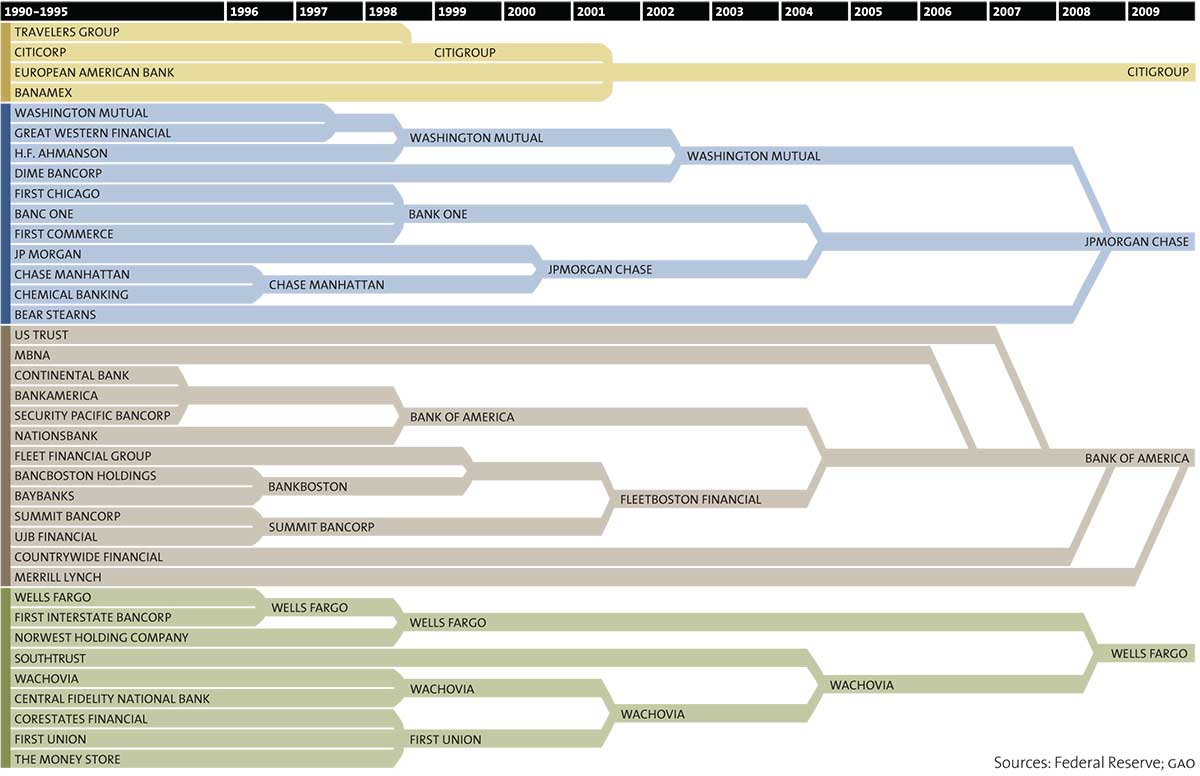
- When companies are able to buy out competitors easily and control entire markets it creates massive problems for everyone who doesn't lead the company. Today we have this problem in America when companies buy each other out which hurts competition which means that when one company fails, it has a huge market share, as was seen with banks in this famous graphic. In the movie business, six studios control 79.4% of the American and Canadian market share, which can't be good for creating new movies that question a number of issues that their owners wouldn't want to be talked about, like countless excellent documentary films.
- What we saw today was where Disney decided to close Lucasarts, despite it being one of the most popular game studios seeing all of my friends, and firing 150 people on the spot which is cold and will mean they will make absolutely nothing out of those games. Though they are thinking of contracting out to other studios, Disney would make more money by just keeping the games developed in Lucasarts which mean they get to keep 100% of the profit, which they don't want for some reason. A smaller company would never consider going out of business for such a reason, but would take their company and figure out how to make their company more profitable instead of just killing it.
The economy is a delicate organism, and it needs reasonable laws that are out of the way when not needed, and has good laws that creates a system where fraud and recessions can be avoided or at least minimized. To have an unrestrained free market creates a situation where recessions will happen, as we saw in 1929 and 2008, which is bad for everyone from the unemployed man on the street to the richest man in the world. To have an economy like existed in the Soviet Union or exists today in North Korea is just as bad in the short and long term as a system where people are able to be extorted in the name of profit for no pay as happened in the American South in the name of slavery.
Subscribe to:
Posts (Atom)