Showing posts with label free travel. Show all posts

Friday, December 21, 2018

Proposal to expand Schengen

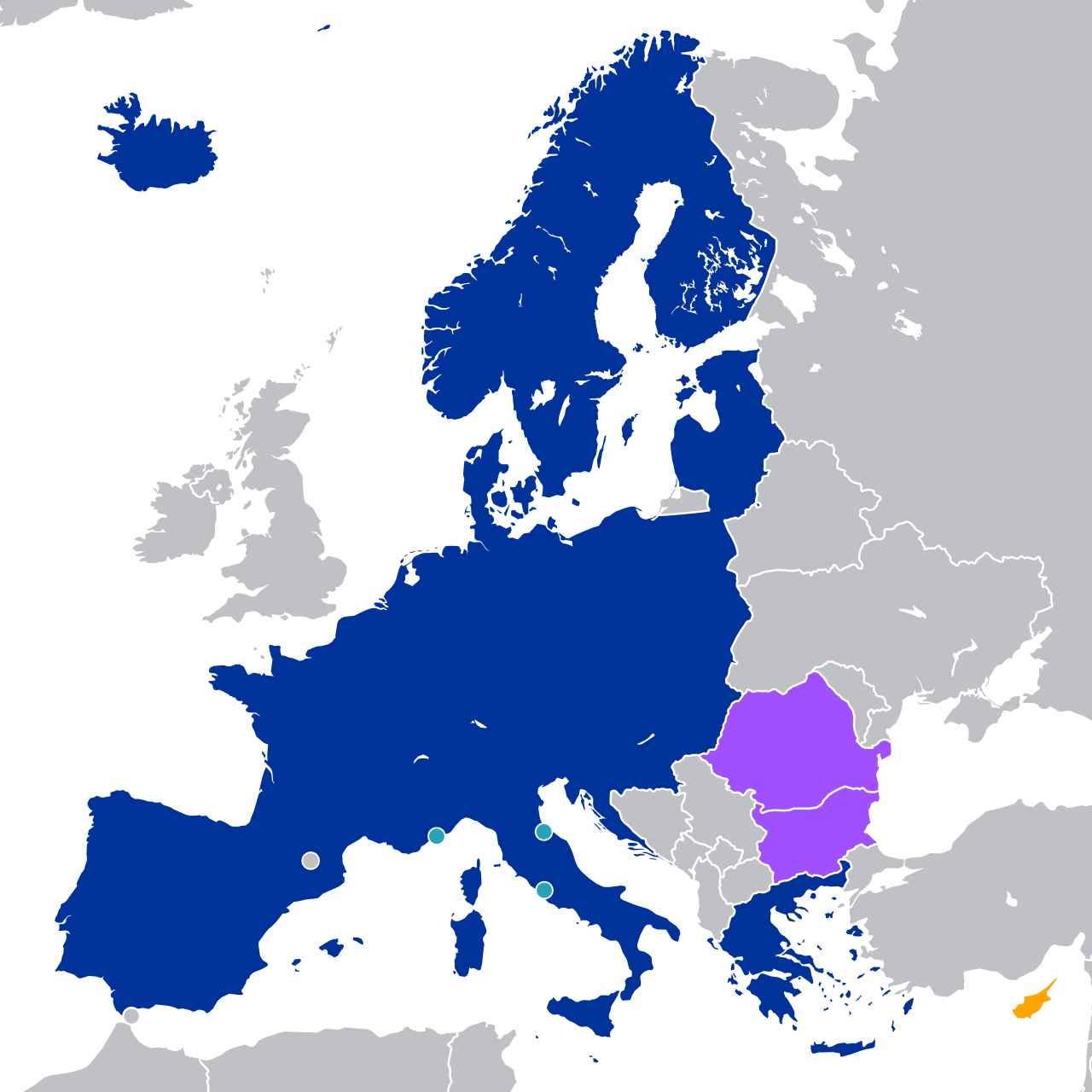
The Schengen Treaty is without a doubt one of the most important treaties in the world. It comprises 26 states, most of which are members of the European Union, have a GDP of $15 trillion and a population of 419 million people. People are free to move within this area, they can live and work in any other member state, as there are no customs whatsoever between any of these countries. Most members are EU members, with a few exceptions, Iceland, Liechstenstein, Monaco, Norway, San Marino, Switzerland, and Vatican City.
The Schengen Area
This is the pure liberal dream. The idea is that without trade barriers between these countries that people will have less of a desire to go to war with others. And it has worked along with the free trade area which has grown out of the European Coal and Steel Community which was founded in the 1950s. Bulgaria, Croatia, Cyprus, and Romania are currently pending the next council meeting.

The question now is, should Schengen be expanded, and if it is, how? As the title of this article suggests, I am in favor of expansion. The Schengen Treaty, as a legal document presents very clear rules on what is to move in between borders. The bulk of the laws are included in section 1, under the 14 June 1985 convention. The rules are laid out in the following titles as follows in this convention:
  1. Definitions
  2. Abolition of Checks at Internal Borders and Movement of Persons
    1. Crossing Internal Borders
    2. Crossing External Borders
    3. Visas
      1. Short-Stay Visas
      2. Long-Stay Visas
    4. Conditions Governing the Movement of Aliens
    5. Residence Permits and Alerts for the Purposes of Refusing Entry
    6. Accompanying Measures
    7. Responsibility for Processing Applications for Asylum
  3. Police and Security
    1. Police Cooperation
    2. Mutual Assistance in Criminal Matters
    3. Application of the Ne Bis In Idem Principle (No double jeopardy)
    4. Extradition
    5. Transfer of the Enforcement of Criminal Judgements
    6. Narcotic Drugs
    7. Firearms and Ammunition
  4. Schengen Information System
    1. Establishment of the Schengen Information System
    2. Operation and Use of the Schengen Information System
    3. Protection of Personal Data and Security of Data in the Schengen Information System
    4. Apportionment of the Costs of the Schengen Information System
  5. Transport and Movement of Goods
  6. Protection of Personal Data
  7. Executive Committee
  8. Final Provisions
All of the laws and regulations are already in existence already, and the rules for Schengen are really straight forward and reasonable. Basically, control the borders, Mutual recognition of each other's visas, police need to cooperate and respect the laws and decisions of other countries in the area, sharing of information between countries when it comes to visa relevant information, a common tariff policy, don't leak data, and each member has a seat in the executive committee. That's the entire agreement in a nutshell.

There is also, notably, no requirement of a country to be in the European Union or even Europe to join the Schengen Area in the original document. This means, theoretically, that the Schengen Area could be expanded to outside Europe if I am not missing another law which regards Schengen membership. This seems to be the case because Switzerland joined in 2008, and it is not a member of the EU, and Liechtenstein joined in 2011 after the Treaty of Lisbon, the last major amendment to European law. This means that non-member states can indeed join the Schengen area.

The question then becomes... who should be included? Prospective countries to join the Schengen treaty could be established by fitting the following criteria in my mind:
  1. Adopt the European Charter of Rights and Freedoms as law, or have comparable laws on the books already.
  2. Have a Corruption Perceptions Index at least as high as the Schengen member with the lowest score.
  3. Have a better Press Freedom Index then the member state with the lowest score. This is a useful proxy for how well the Charter of Rights and Freedoms are respected.
  4. Have an economic system which makes it easy for businesses to flourish, using the Ease of Doing Business Index. We want the member country to be fully engaged in the common market.
  5. Have no significant domestic terrorism. This can be measured by homicide rate.

These are 5 things which can easily be implemented.
https://upload.wikimedia.org/wikipedia/commons/b/b3/Corruption_Perception_index_2017.svg
Corruption Perceptions Index

https://upload.wikimedia.org/wikipedia/commons/e/e7/Press_freedom_2018.svg
Press Freedom Index


The Schengen member with the highest (worst) Corruptions Perception Index currently is Greece, at 44. they ranked #69 in the world as of 2017, which leaves 43 potential members by that metric.

The Schengen member with the highest press freedom score currently is still Greece, though Bulgaria will likely acede soon and it has the worst score, but they will likely not be chosen due to the factors which cause them to fare so poorly on the press freedom index, so that leaves Greece as the lowest score. They rank #70 in the world as of 2018 (yes, these are significantly correlated indexes) and that again leaves 44 potential members by this metric.

The obvious choices for membership by these two metrics combined are:
  1. New Zealand
  2. Canada
  3. United Kingdom
  4. Australia
  5. United States
  6. Ireland
  7. Japan
  8. Uruguay
  9. Chile
  10. Taiwan
  11. Botswana
  12. Cape Verde
  13. Costa Rica
  14. Georgia
  15. Cyprus
  16. Mauritius
  17. South Korea
  18. Namibia
  19. Croatia
  20. Romania
  21. Senegal
  22. South Africa
  23. Suriname

This map is interesting for many reasons. Following this logic there are countries which are qualified to join the Schengen Area using my first two criteria on every continent. Some countries which have expressed interest are missing from the map, Israel is blank because their press isn't free enough, Bulgaria is blank despite being considered to join the Schengen area because they are too corrupt,  Ukraine is both too corrupt and their press is not free enough.

The one other variable which could be useful in determining whether a country would be able to join the Schengen Area would be the Ease of Doing Business Indicator. The reason for this one is the acquis on the free movement of capital, and if a country doesn't allow ease of movement of capital within its own borders it will not be able to join Schengen. This significantly reduces the number of countries which are eligible to join down to 17 prime candidates. The economies of Botswana, Cape Verde, Namibia, Senegal, Suriname, and Uruguay are less free than that of Malta, the Schengen member with the least free economy, which means that the best candidates for joining the Schengen map looks like this:
Every country shaded in red on this list has a Corruptions Perceptions Index, Press Freedom Index, and Ease of Doing Business Index ranking better than the worst performer currently in the Schengen region.

The top performer not currently in Schengen currently is New Zealand when you multiply the CPI, DBI and divide by the PFI. The order of this ranking follows as Canada, Australia, Ireland, United Kingdom, Costa Rica, United States, Taiwan, Chile, Cyprus, Japan, South Korea, Georgia, Mauritius, Romania, South Africa, and then Croatia. If the current member states of the Schengen Area and these 17 countries chose to unify their customs into the Schengen area this would be mutually beneficial.

The countries which would most benefit from joining would honestly be the United States and Canada. With the world's longest border, highly developed economies and being among the most free in the world, we could benefit in joining.

Another factor when it comes to opening up your borders to another country is safety. This is easily measured using homicide rate as a rough approximation of the relative safety of one country or another. Three countries unfortunately have homicide rates which the European Union will likely find unacceptable, and those are Costa Rica, South Africa, and my home, the USA. The country with the highest murder rate in the Schengen area is Lithuania with a homicide rate of 5.25 people per 100,000. The United States unfortunately has a homicide rate of 5.35 meaning if the Schengen Area would not allow new members due to an intentional homicide rate we are just above the threshold.

This problem deserves special attention because we are so close to having a low enough murder rate to qualify for Schengen Membership, if this was a qualifier. Looking at murder rates by states and territories, the ones which have a higher murder rate than Lithuania are in descending murder rate (by latest available data): Louisiana, Missouri, Nevada, Maryland, Arkansas, Alaska, Alabama, Mississippi, Illinois, South Carolina, Tennessee, New Mexico, Georgia, Oklahoma, Ohio, Indiana, Arizona, Kentucky, North Carolina, Pennsylvania, and Michigan. Reference

This deserves an article of its own, and we need to focus on reducing our murder rate as a country.

This still leaves 14 countries around the world which have the proper statistics to join the Schengen travel area, from every continent. These 14 have low corruption, and are safe. Schengen is estimated to boost the trade and economics of the member states, and there is overwhelming economic evidence that increasing trade reduces the likelihood of war. For these reasons I believe it would be wise for the Schengen Treaty to be expanded outside of Europe, the UK and Ireland should join Schengen (which I know is unlikely due to the whole Brexit debacle) because it is the logical next step to fostering peace in the world we live in.
Countries which could theoretically join Schengen.

Wednesday, November 12, 2014

More on Visa Policy

Since George W. Bush was in office the United States has mad large efforts to alienate us from the rest of the world, to the point where only Canadians, Palauans, Marshall Islanders, and Micronesians can enter the United States without some sort of visa. There are two ways this happens, either through the "Visa-Waiver Program" which is a misnomer, and through the normal visa system.
For those who don't know, the Visa-Waiver program is offered to 38 countries, and this requires people to sign up before they land in the United States (one major characteristic of a visa) and they pay a fine of $14 (it is basically a special type of visa). This has no real effect on catching terrorists (the people who bombed the World Trade Center and Boston Bombers all had visas) but only serves to inconvenience people who want to visit the United States by making them have to pay more money and spend more time before arriving. It is more expensive meaning more processing time for people across the world without actually protecting us.
Now Canada is going to start their own Visa Waiver Program, for everyone except the US (because we're friends) which will seriously inconvenience people who are able to visit Canada without providing any realistic benefit. I am not Canadian, but they should not give in the United States government on this issue. Unless if we were starting a customs union with Canada (which would be a very good thing for both countries) this action is completely counterproductive for Canadians.

Instead of further tightening of our border what we should do is eliminate the Visa Waiver Program altogether and institute visa-free travel from all the countries currently under it which requires no pre-registration, like every other free country except Australia practices today. Individuals who are known to be dangerous from foreign countries we have a visa-free regime with will be blocked from entry, and their passports will be blocked, and this has the advantage of blocking those we do want to block without inconveniencing everyone else. I personally am on the ultra-liberal side of having as few restrictions on travel for this issue, because I see it as a tool for furthering goodwill among nations and making for a better world altogether. I also don't see the threat when the total number of terrorist attack in every other country that has an economy like the United States and doesn't have a large group of home-grown extremists doesn't see large numbers of terrorist attacks.

I don't see any reason to believe that this prescreening works at all, and see no reason to ask people from our closest allies to fork over money to visit America when we don't have to do the same in their country. Plus, we already scan everyone's passports when the enter the country (like every other country I know of that isn't participating in a customs union with other union members) which means we will have records of who is coming in.

In general, this is the wrong direction for Canada and America. We need to fully analyze the costs of having pre-authorization for people from Europe, Japan, Australia, Taiwan, South Korea, and other highly developed stable democracies and not go backwards on such issues.

We will only know peace when the majority of people can meet people from other cultures and know that we are all human. This is how we fight extremism, and we do this by allowing as many people as possible to travel freely.

Sources:
http://www.gazette.gc.ca/rp-pr/p1/2013/2013-12-07/html/notice-avis-eng.html#d108

For further information, read about the "Perimeter Security and Economic Competitiveness Action Plan" which is the official policy between the US and Canada.

Monday, March 4, 2013

The Left has a choice to make on peace

Foreign policy usually takes the back burner when it comes to politics. Neither party in America pushes hard for a solution to the Palestinian-Israeli conflict, human rights in China or North Korea, or other important issues. The left however has a large split today, and that is between people who support free trade and people who support tariffs, because of the negative effects of some free trade agreements.

Free trade has a number of large benefits. It allows people to find work in places that pay better and escape poverty in poorer countries (which has some disadvantages, nothing is perfect), it allows free travel to come on the scene which can fight the interethnic tensions and wars that often rise when travel is restricted. To have free travel you need free trade.

Free travel, the eventual elimination of customs between different countries and allowing people to move freely will have a lot of power to eliminate hatred between different groups of people. I strongly believe that if the people of Israel and Palestine could talk to each other and there were fewer restrictions on movement the conflict would diminish and they would find they have more in common than they believe. The same political debates, the same hopes, the same dreams, and the far right in both Israel and the PLO will fall making peace possible. I believe that if people from America and Mexico could easily talk to each other and we helped them fight the violence that ravages so many communities the racist tensions that exist with the far right in my country will have less influence. There are reasons why the southern border is a very Democratic area, even in Texas.

To do this requires free trade. Free trade will be the start, and then the left needs to get together and support free travel, and within the mechanisms of free trade labor needs to demand a living wage for an honest day's work. The status quo of no communication between nations brought more conflict and allowed people like Hitler to get entire nations to do the unspeakable, because most people didn't know what the other side was actually like. There is a reason there have been no wars within the EU (an previously EC) since World War II. Personally, I believe free travel is a critical part to world peace, and is worth the costs of free trade. I also don't see how the costs of free trade are permanent.