Social Security is lauded by liberals across America as a great accomplishment, and a signature accomplishment of the American social safety net. It has become a third rail of American Politics, where any attempt to change it gets the AARP and other senior advocacy groups railing against it as betraying the working class and then their members kick out the politicians who propose changes which keeps conservatives from attacking it and others from criticizing its flaws. Since turnout among young people is routinely low and senior usually vote in large numbers this protects the program from any changes that would benefit younger people or the nation as a whole.
I am a progressive, I want to have a public option at a bare minimum for health care, ideally expand the number of people who can enroll in Medicare and Medicaid, allow Medicare to negotiate for lower drug prices, and increase equality in access across states. I want to see an investment in education for all students and help bridge the rich/poor funding divide in our schools which is reflected in resources. Creationism should NEVER be taught in science classrooms. I use and respect the science method and its findings, and change my views to fit its findings. I want to build a massive increase to inner-city mass transit and inter-city mass transit to reduce our reliance on cars and make our cities more liveable. I believe inner-city mass transit should be free to the rider. We need to have programs to help the homeless become housed and stop incarcerating drug users and the mentally ill.
I also want to kill Social Security Old Age Insurance. Yes, that's right. I want to kill OASI and replace it with a basic minimum income for people of all ages. First of all, here are the reasons why I want to kill OASI.
The biggest reason I want a radical reform to Social Security is because OASI always gives less than 100% back for the contributions people make. For the poorest Americans they receive 90 cents on the dollar for Social Security contributions up to $856 a week ($21.40/hour or $42800 per year) and then it goes down from there. These earnings are so low that putting a worker's social security benefits into bonds would yield more money. SSA and proof
I would like to have a universal basic income replace OASI. For those people who have paid into Social Security we would still get the benefits we have bought into, but for workers younger than me they would never pay into the fund. In 2015 the fund stood at $2.857 trillion dollars. At the same time OASI cost $740 billion for the year. The first issue is the investments of Social Security are not getting a good return on their investment, and we should allow the Social Security Administration to seek out any investment they deem appropriate so that we can get a better return on our investment. We only got a 0.9% return on the Investments the SSA has been able to make. If they bought longer-yield bonds from the Treasury we could get a much better return for our money and it could be enough to make the program self-sufficient at this point. The American people lost 30 billion dollars in Social Security Trust money last year because of this decision. Over a long period of time the difference of how much money the trust fund should have has become very large. With an aging population and hundreds of millions of people betting on Social Security being there for them when they retire this has become a very big issue where the Trust Fund is barely making any more money compared to the 1980s and 1990s which has made it stagnate in comparison to the amount it should be making today. history
So, if I had my druthers, I would have Americans stop paying OASI taxes, allow the trust fund to be invested freely by the Administration so that OASI can be paid out of the interest its massive reserves make every year. People who currently are owed Social Security benefits will be paid out of the interest which will be enough to cover the difference. Disability and SSI will not be changed.
The replacement of Social Security OASI will then be a Universal Basic Income. This will be a direct stimulus to poor economies across the country. People can use this money in any way they want. I would give every American $5000 when they file their taxes as their UBI every year. The payments will be given to the person as cash, and they can do whatever they want with it.
If people stop paying social security taxes and instead invested their UBI into 30 year government bonds averaging 4% annually over the long run will yield a bigger benefit to people than OASI provides. A $5000 basic income will have the benefit of people being able to invest into interest bearing assets which will grow into a far larger sum than Social Security will ever provide in a lifetime. The other benefit to Basic Income is it will help young people get a foothold on life by being able to purchase what they need to get their lives started, versus people who are in their senior years and have had decades to invest for their future. I would rather get people started on a good foot than step in at the last moment. Another advantage is if someone dies soon after retiring than the money that they have paid into Social Security will not be recovered by their families, while having assets helps families accumulate wealth. If more families had access to that then we could see less inequality. It also will not matter as much how much money your family has because young people will have the funds they need to start life on a good foot.
The total cost for my Basic Income would be $1.5 trillion, which would and in part replace less efficient programs. We spent $1.3 trillion on pensions this year, and most pensions do not perform as well as a strong index fund, and many cannot be inherited which is essentially stealing from poor and middle class families. I would rather spend money on getting everyone on a good foot to the point where people can take care of their own retirement which then will be inheritable and not transferred back to the rich. Most people I know who have financial stability have no formal training in economics. These plans are accessible if people are willing to look and have basic math skills.
One final note on my counter proposal is that the $5000 per person Basic Income would go to adults in cash to their bank account (or cash if they are dinosaurs) and it is theirs to use as they want. However, for minors half of their money will go to their legal guardians, and half of it will go into their trust fund. It will receive interest over time like how I want to change the OASI trust fund, and when they turn 18 they will receive the sum in the way they choose. This money would come out to be around $50,000 if it didn't collect interest, but if it collects 2% interest will be around $62,000 and $75,000 at 4% interest. This would make a big difference for young adults with less supportive families and make a big impact for people when starting families, particularly for those who would invest what they don't use. Everyone would have the opportunity to start their own business, take a risk, and our economy would grow significantly by the increased spending in poor areas. This positive shock to demand will create the opportunity for new businesses which will create new jobs and a better economy for everyone.
The funding for the basic income will come by treating capital gains as regular income. I have already written about that here. This will be an overall better safety net for American from which everyone will ultimately benefit.
Showing posts with label basic income. Show all posts
Showing posts with label basic income. Show all posts
Thursday, August 11, 2016

Monday, February 15, 2016
Universal Basic Income
In the United States today there are a total of about 125 million households. These people range from unemployed high school dropouts to billionaires with Ivy League education, and everywhere in the middle. 15% of these people live below the poverty line, which depending on the nature of the household ranges from about $10,000 to $26,000. umich They live all over the country, even though there are various places which have higher rates of poverty than others. The poorest counties in the United States are primarily located in South Dakota (primarily Indian country), across the Old Confederacy, and Appalachia with a few exceptions. wiki The clustering of poor counties vs. rich counties makes a poverty trap of the lack of jobs and few other opportunities cluster in regions, as can be easily seen using this map in detail.
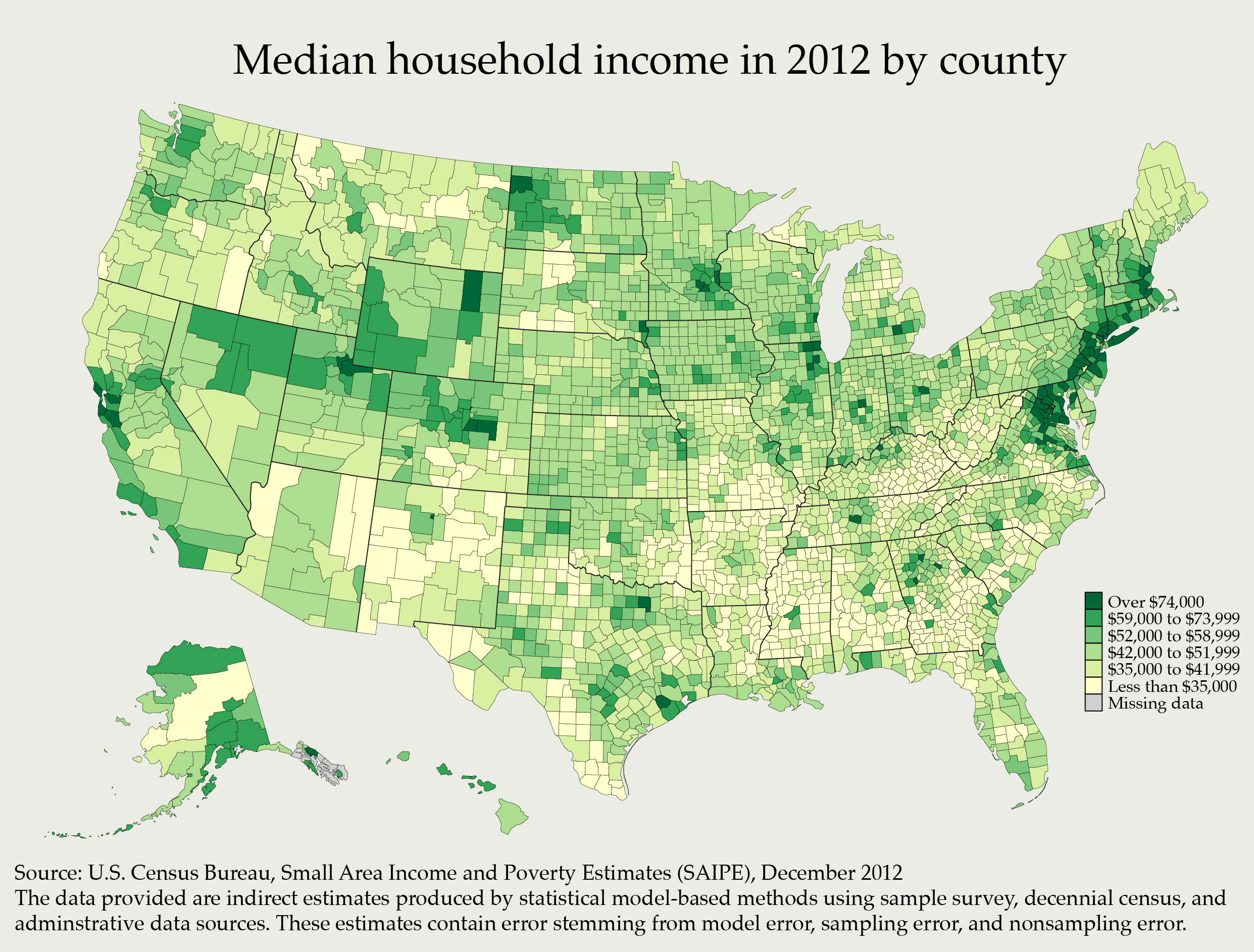 Poverty is also highly correlated with race, with African Americans and Native Americans extremely disadvantaged when it comes to opportunities their families can provide which white people (like myself) frequently take for granted. wiki African Americans and Native Americans are left behind significantly at $38,806 for Native Americans and $35,341 for African Americans while White Americans are make an average of $54,857. Alaska Natives are particularly disadvantaged at an average household income of $17,843. This gap is so wide the number of people who are able to jump the gap and get into college is significantly lower for minorities versus their white and Asian American peers.
 This only exacerbates the inequality we see in the United States today, keeping the racial inequality gap particularly wide.
This is clearly a problem, and we need to have a system which works for all people. The perpetual poverty in communities destroys lives and those of us who have had the opportunity to get educated have an ethical imperative to expand the opportunities we have had to our fellow Americans as much as we can.
Solutions to poverty obviously start with ensuring that education is available for all people, which could easily be done by expanding Pell Grants to people from low-income households. There will be a disproportionate number of minorities who receive the program because of centuries of discrimination. Past college however there is another idea which has caught my attention over the last year or two which would quickly remedy the issue of low income, and that is Universal Basic Income.
The idea is simple, every household receives a certain amount of money every year which they can use however they want or need. With 125 million households, the cost of $20,000 per household would cost us $2.5 trillion total. Even with my tax code as I refer back to often, this will still leave the government with a surplus of money, particularly when taking into account the programs that will no longer be necessary, like Social Security, Food stamps, etc. and the reduced burden on state governments for providing many different programs to support people. This also includes the negative income tax which will reward work for middle class families as opposed to taxing it, and still give the government hundreds of billions of dollars as a surplus to help cut the debt in good times or just give people an extra refund once we stop paying interest on bonds. I have already roughly calculated the effects here based on data from the Census bureau. It is an extension/modification of the tax code I shared a while ago.
Coming back to the original point, which is regional and racial inequality, this is a very easy way to quickly address the issue of poverty in these communities. With money to spend it will be worth it to create businesses where there will be an influx of money to spend, and this will create jobs and get local economies growing. No American will live in poverty, since $20,000 is close to the federal poverty line anyways, and we will be a better nation overall. Inequality will be reduced, which is correlated to numerous social ills, such as gun violence, health in general, school segregation leads to slower economic growth overall, and overall economic instability. Parliament of Australia Improving America's health will significantly lower government health expenditure which is a ticking time bomb.
If someone knows they are going to get their UBI no matter if they work and then they work as well, they are probably still going to go out since they can use that money for whatever they want, plus under my full plan low and middle income households will actually get a negative income tax which will create an even bigger incentive for people to work. Since I am not taxing people at low income levels the total earned income will increase no matter how much you work. This study of UBI basically explains as well as possible why UBI is not going to have a significant impact on employment.
The issue is that since I am not changing the amount of income you get from working for how much you get, there will never be a point where the UBI alone will make you worse off than working less (since the tax rate is exogenous, the real question is whether at the margin people will make more money if they work an extra hour, as long as the answer is yes, which it always is under this plan, they will work the extra hour. This is why people still work in practically every country in the world which starts to tax people for the first dollar they make. If people stopped working when they start getting taxed than nobody would work in any country today, which is obviously not true. We need to look at the margin to find the reality and under UBI and my tax plan without UBI the marginal income for an extra hour of work is always positive, so most people will work more, in fact the only people who will pay anything are already making millions of dollars) This is why I agree with Ed Dolan that UBI is not going to significantly reduce the amount of work done in an economy.
There is no reason for us not to do this, given the low costs and very large potential benefits. Before you declare it as socialism, remember that one of the greatest advocates of cash as social welfare was Milton Friedman. America needs to have a serious discussion about Universal Basic Income today, and we need to start doing it soon. This is something everyone could get behind.

This is clearly a problem, and we need to have a system which works for all people. The perpetual poverty in communities destroys lives and those of us who have had the opportunity to get educated have an ethical imperative to expand the opportunities we have had to our fellow Americans as much as we can.
Solutions to poverty obviously start with ensuring that education is available for all people, which could easily be done by expanding Pell Grants to people from low-income households. There will be a disproportionate number of minorities who receive the program because of centuries of discrimination. Past college however there is another idea which has caught my attention over the last year or two which would quickly remedy the issue of low income, and that is Universal Basic Income.
The idea is simple, every household receives a certain amount of money every year which they can use however they want or need. With 125 million households, the cost of $20,000 per household would cost us $2.5 trillion total. Even with my tax code as I refer back to often, this will still leave the government with a surplus of money, particularly when taking into account the programs that will no longer be necessary, like Social Security, Food stamps, etc. and the reduced burden on state governments for providing many different programs to support people. This also includes the negative income tax which will reward work for middle class families as opposed to taxing it, and still give the government hundreds of billions of dollars as a surplus to help cut the debt in good times or just give people an extra refund once we stop paying interest on bonds. I have already roughly calculated the effects here based on data from the Census bureau. It is an extension/modification of the tax code I shared a while ago.
Coming back to the original point, which is regional and racial inequality, this is a very easy way to quickly address the issue of poverty in these communities. With money to spend it will be worth it to create businesses where there will be an influx of money to spend, and this will create jobs and get local economies growing. No American will live in poverty, since $20,000 is close to the federal poverty line anyways, and we will be a better nation overall. Inequality will be reduced, which is correlated to numerous social ills, such as gun violence, health in general, school segregation leads to slower economic growth overall, and overall economic instability. Parliament of Australia Improving America's health will significantly lower government health expenditure which is a ticking time bomb.
If someone knows they are going to get their UBI no matter if they work and then they work as well, they are probably still going to go out since they can use that money for whatever they want, plus under my full plan low and middle income households will actually get a negative income tax which will create an even bigger incentive for people to work. Since I am not taxing people at low income levels the total earned income will increase no matter how much you work. This study of UBI basically explains as well as possible why UBI is not going to have a significant impact on employment.
There is no reason for us not to do this, given the low costs and very large potential benefits. Before you declare it as socialism, remember that one of the greatest advocates of cash as social welfare was Milton Friedman. America needs to have a serious discussion about Universal Basic Income today, and we need to start doing it soon. This is something everyone could get behind.
Thursday, November 14, 2013
Basic Income
I saw an interesting post today on Facebook talking about a new method to jumpstart small poor economies. After watching the video of the people in India and thinking of how government spending is done today having some direct-to-citizen cash transfers makes sense to me.
The US government spends hundreds of billions of dollars on recipients, many of them extremely wealthy companies.
Seeing what is being done right now in Madhya Pradesh is stunning seeing how giving people these small gifts (100 Rials is just over $3.00 USD) turning their lives around. Not everyone is so wise, but given the amount of economic value added to these people's lives and the amount of change it makes for them, it makes sense for the government to do small things to help people become financially independent. When people are able to work to their full capacity we have a greater economy. When the average consumer increases his/her income there is a larger demand for normal goods which incentivizes producers of these goods to increase their demand. In economics there is a concept called marginal utility. As someone buys more and more of a good there comes a point where the value added decreases. When we spend hundreds of billions of dollars on (primarily) military contracts for these large companies it makes a very small impact on the economy because the people who own the majority of these companies have everything they want and have no incentive to buy more goods when their income increases. If I already can afford all the electronics, books, vehicles, and trips I want in a year, increasing my income is not going to make a significant difference to my quality of living or spending, so I will put it in stocks.
Investment is important, but businesses need both investment and demand. If no one else is able to purchase goods the investment is worthless. If businesses don't see demand for their services rise they will not grow. Businesses have to pay back the money that is invested in them at a future date (sometimes specified in bonds, sometimes not in terms of stocks). The money that they make from income is theirs after expenses. As a small business owner, I would prefer customers over investment after I meet my expenses.
A better solution would be what the Basic Income people are proposing and seeing the impacts it makes to people in India. Instead of passing out food stamps and assistance that is dedicated to some things it would be better to just give them cash, which is actually what Milton Friedman argued for and why we have an alternative minimum tax. If the federal government gave small businesses grants and state governments ensured that licenses are processed in a timely and efficient manner, our economy will be much better off. If you take someone who was making $20,000 a year and double their income you will find that their consumer spending will change in a far more significant way than someone who is making $20,000,000 a year. A $10,000 grant to someone working minimum wage who wants to start a business makes a huge difference to someone , while it would take a hundred times that to make the same proportional difference to someone making 1000 times that, which means it is a far less expensive method to boost our GDP. If we provided free education to every American (as I have posted in other blog posts) and we had 10,000,000 students, it would cost roughly $20,000,000,000. Lockheed Martin alone received $31,000,000,000 last fiscal year, excluding the other big fish of Boeing, Lockheed Martin, Raytheon, GD, etc. People who say we can't afford this just haven't seen the facts.
The government already gives small business loans, we should shift these to be grants which will be an even bigger stimulus to our economy.
As a sidenote, I personally suspect that the amount of money the government grants to these companies is caused by the enormous sum of money they pay to politician's campaigns, which is why I still want to have Occupy's goal of publically funded campaigns. These companies need to diversify away from military, there are many other things they are manufacturing because it is just too expensive to support such a complex.
The European Proposal:
https://www.youtube.com/user/BasicIncomeEurope?feature=watch
American spending by recipient:
http://www.usaspending.gov/?tab=By+Prime+Awardee&q=explore&fromfiscal=yes&trendreport=top_cont
Major campaign donaters:
https://www.opensecrets.org/lobby/top.php?indexType=s&showYear=2013
President Eisenhower:
https://www.youtube.com/watch?v=7gahL5j4ack
The US government spends hundreds of billions of dollars on recipients, many of them extremely wealthy companies.
Seeing what is being done right now in Madhya Pradesh is stunning seeing how giving people these small gifts (100 Rials is just over $3.00 USD) turning their lives around. Not everyone is so wise, but given the amount of economic value added to these people's lives and the amount of change it makes for them, it makes sense for the government to do small things to help people become financially independent. When people are able to work to their full capacity we have a greater economy. When the average consumer increases his/her income there is a larger demand for normal goods which incentivizes producers of these goods to increase their demand. In economics there is a concept called marginal utility. As someone buys more and more of a good there comes a point where the value added decreases. When we spend hundreds of billions of dollars on (primarily) military contracts for these large companies it makes a very small impact on the economy because the people who own the majority of these companies have everything they want and have no incentive to buy more goods when their income increases. If I already can afford all the electronics, books, vehicles, and trips I want in a year, increasing my income is not going to make a significant difference to my quality of living or spending, so I will put it in stocks.
Investment is important, but businesses need both investment and demand. If no one else is able to purchase goods the investment is worthless. If businesses don't see demand for their services rise they will not grow. Businesses have to pay back the money that is invested in them at a future date (sometimes specified in bonds, sometimes not in terms of stocks). The money that they make from income is theirs after expenses. As a small business owner, I would prefer customers over investment after I meet my expenses.
A better solution would be what the Basic Income people are proposing and seeing the impacts it makes to people in India. Instead of passing out food stamps and assistance that is dedicated to some things it would be better to just give them cash, which is actually what Milton Friedman argued for and why we have an alternative minimum tax. If the federal government gave small businesses grants and state governments ensured that licenses are processed in a timely and efficient manner, our economy will be much better off. If you take someone who was making $20,000 a year and double their income you will find that their consumer spending will change in a far more significant way than someone who is making $20,000,000 a year. A $10,000 grant to someone working minimum wage who wants to start a business makes a huge difference to someone , while it would take a hundred times that to make the same proportional difference to someone making 1000 times that, which means it is a far less expensive method to boost our GDP. If we provided free education to every American (as I have posted in other blog posts) and we had 10,000,000 students, it would cost roughly $20,000,000,000. Lockheed Martin alone received $31,000,000,000 last fiscal year, excluding the other big fish of Boeing, Lockheed Martin, Raytheon, GD, etc. People who say we can't afford this just haven't seen the facts.
The government already gives small business loans, we should shift these to be grants which will be an even bigger stimulus to our economy.
As a sidenote, I personally suspect that the amount of money the government grants to these companies is caused by the enormous sum of money they pay to politician's campaigns, which is why I still want to have Occupy's goal of publically funded campaigns. These companies need to diversify away from military, there are many other things they are manufacturing because it is just too expensive to support such a complex.
The European Proposal:
https://www.youtube.com/user/BasicIncomeEurope?feature=watch
American spending by recipient:
http://www.usaspending.gov/?tab=By+Prime+Awardee&q=explore&fromfiscal=yes&trendreport=top_cont
Major campaign donaters:
https://www.opensecrets.org/lobby/top.php?indexType=s&showYear=2013
President Eisenhower:
https://www.youtube.com/watch?v=7gahL5j4ack
Subscribe to:
Posts (Atom)