Showing posts with label income inequality. Show all posts

Tuesday, July 30, 2019

Characteristics of American homicide

As I keep working on studying the relations of which countries do and do not have open borders, the one variable in the United States which keeps sticking out is our very high homicide rate relative to other countries. It is the only variable where we are consistently doing worse than every member of the Schengen Area. Our corruption perceptions index, ease of doing business index, and our press freedom are all in line with member states of the European Union. However, our homicide rate is significantly higher than that of any member state of the Schengen Area.

The big question of course is why, and in order to answer this question I am going to describe what the data shows in several variables:
  1. Regionally
  2. Racial
  3. Inequality

Regions

When it comes to regions, murder rates vary wildly city to city. Statista has the data to fully see where people are most likely to be shot. They found that the cities in the United States with the highest murder rates today are in:
  • St. Louis 66.07
  • Baltimore 55.77
  • Detroit 39.8
  • New Orleans 39.5
  • Cleveland 27.77
  • Memphis 27.73
  • Newark 27.14
  • Chicago 24.13
  • Cincinnati 23.4
  • Philadelphia 20.06
  • Milwaukee 19.83
  • Pittsburgh 17.98
  • Indianapolis 17.91
  • Stockton 17.77
  • Tulsa 17.29
  • Washington, DC 16.72
  • Atlanta 16.41
  • Nashville 16.3
St. Louis has the largest rate by far and than the rate drops significantly after that. Shootings around St. Louis tend to be concentrated around downtown, and in Black neighborhoods. Shooting map, Race map. Almost all of the murders were committed using a firearm.

 When it comes to states, we see (unsurprisingly) a similar pattern:
  1. Louisiana
  2. Missouri
  3. Nevada
  4. Maryland
  5. Arkansas
  6. Alaska
  7. Alabama
  8. Mississippi
  9. Illinois
  10. South Carolina
  11. Tennessee
  12. New Mexico
  13. Georgia

Race

Murder disproportionately impacts African Americans more than anyone else.
https://www.acsh.org/news/2017/08/10/african-american-homicide-rate-nearly-quadruple-national-average-11680

Inequality

Here is a map of states with a higher homicide rate than Lithuania:

Here is a map of US Inequality from Wikipedia:


Not a perfect fit, but still pretty darn close.

The best theory so far which I have tested myself and have not broken is that income inequality is the biggest driver of homicide. This journal article shows how the inequality hypothesis is an unbreakable hypothesis (I tried and failed to disprove the inequality hypothesis myself when I was in college) in determining where there will be more homicides using a linear regression. Meaning, the relationship between them is so strong that it is a linear one at that, which is actually highly unusual.

More articles examining the link, none are very long and all are worth reading:
Reading through these articles, along with my own research, I am completely convinced that in order to reduce our homicide rate we need to focus on reducing our inequality.

So, what does this look like in practice?
  1. Well, the first thing we can do is tax reform. Reducing taxes on low income earners and increasing taxes on the wealthiest in America will make an immediate and lasting effect on American income inequality. This should be fairly obvious. I do not oppose other methods to reduce inequality, but I personally believe this should be the first step. This is part of why I was so quick to join Carbon Washington while studying political economy in college.
  2. What is the point of increasing disability payments if 10% of that money goes right back to the state? What is the point of increasing TANF when property taxes are hitting low income families the hardest as a percentage of income and 13.4% of their income goes to what is essentially a Ponzi scheme which most low income earners will lose money on? We should obviously do both tax reform and improve our safety net.
  3. We should invest in Early Childhood Education. The impacts of Preschool are shown to be lifelong. It allows parents to go back to work, increasing their economic well-being, and substantially helps children with their social skills.
  4. Improving Social security Old Age Insurance would make a significant impact on the ability of people to save and help money in poor families stay in their pockets. I have already written about how Social Security takes money from people who die young (read, are poor and more likely to be a racial minority) and transfers it to people who die old (read, are rich and more likely to be White). Replacing SS OASI with a Basic Income would instead transfer money to those people who need it most, reducing inequality, instead of probably increasing it. That money would stay in their families, not be transferred to richer old white people. The biggest policy move we can do to reduce inequality actually comes from a Republican proposal (if you have read my blog you know I generally have a very low opinion on United Russia, oh, Republicans), and that is to give people the option to privatize their Old Age Insurance contributions. I expect this would end the program within a decade because everyone would opt to privatize their contributions in a situation similar to what Singapore uses. The big difference is when people pass away this money is then inheritable by their heirs because it exists, as opposed to being transferred to rich old white people, as is the policy today. We could also give people the option to put their money in Real Estate as payments on their house mortgage, which is an option in Singapore, which has one of the highest home ownership rates in the world. We could also just end the Payroll tax because it is the most regressive tax in America, though I do like the idea of forcing people to invest in their future in a way which actually provides value to their heirs, which OASI does not. This would literally save lives by reducing inequality.
  5. Ensure all Americans have access to health care, in order to end medical debt which is eating us alive.
  6. We can significantly increase funding for education at all levels. Free college will put young people on a path to save for retirement which will significantly reduce inequality for the long term. Improving schools in poorer neighborhoods by ending the dependence on local property taxes will have long term effects on economic inequality in the United States.
  7. We should expand the Earned Income Tax Credit as soon as possible because it works at reducing inequality.
  8. America seriously needs to join the bandwagon with the rest of the world and implement paid parental leave. This will allow people to keep their jobs and reduce the number of people who have to leave the workforce to take care of their children.
  9. Ending racial segregation is the 6th idea from the Berkeley article, which will of course be the hardest to implement, but allowing people to use their payroll taxes to pay off their house will help this.
  10. The OECD points out that tax incentives for education and health care disproportionately benefit the wealthy. We need to switch to a model which subsidizes these activities.
  11. Improving unemployment benefits for people who lose work which is temporary would help reduce inequality.
  12. Reducing the gender wage gap, which deserves an article on its own because unlike how social security takes from the poor and gives to the rich, this one is super complicated.
  13. Cutting unnecessary government expenditures, particularly when it comes to the military, and then using that money for effective social welfare programs will help inequality by making it so money goes to people who actually need it.
  14. Have no income tax on incomes below $100,000 per year for an individual.
As you can see, there are no shortage of policies the US government can do right now to reduce inequality, save lives, and save money. We should do as many of these as politically possible as soon as we can.

This is ultimately how we will reduce our homicide rate to be in line with other developed economies.

We need to do this now.

Lives are literally on the line.

Black Lives Matter.

References for inequality mitigation:
  • https://haasinstitute.berkeley.edu/six-policies-reduce-economic-inequality
  • http://www.oecd.org/eco/labour/49421421.pdf

Monday, February 15, 2016

Universal Basic Income

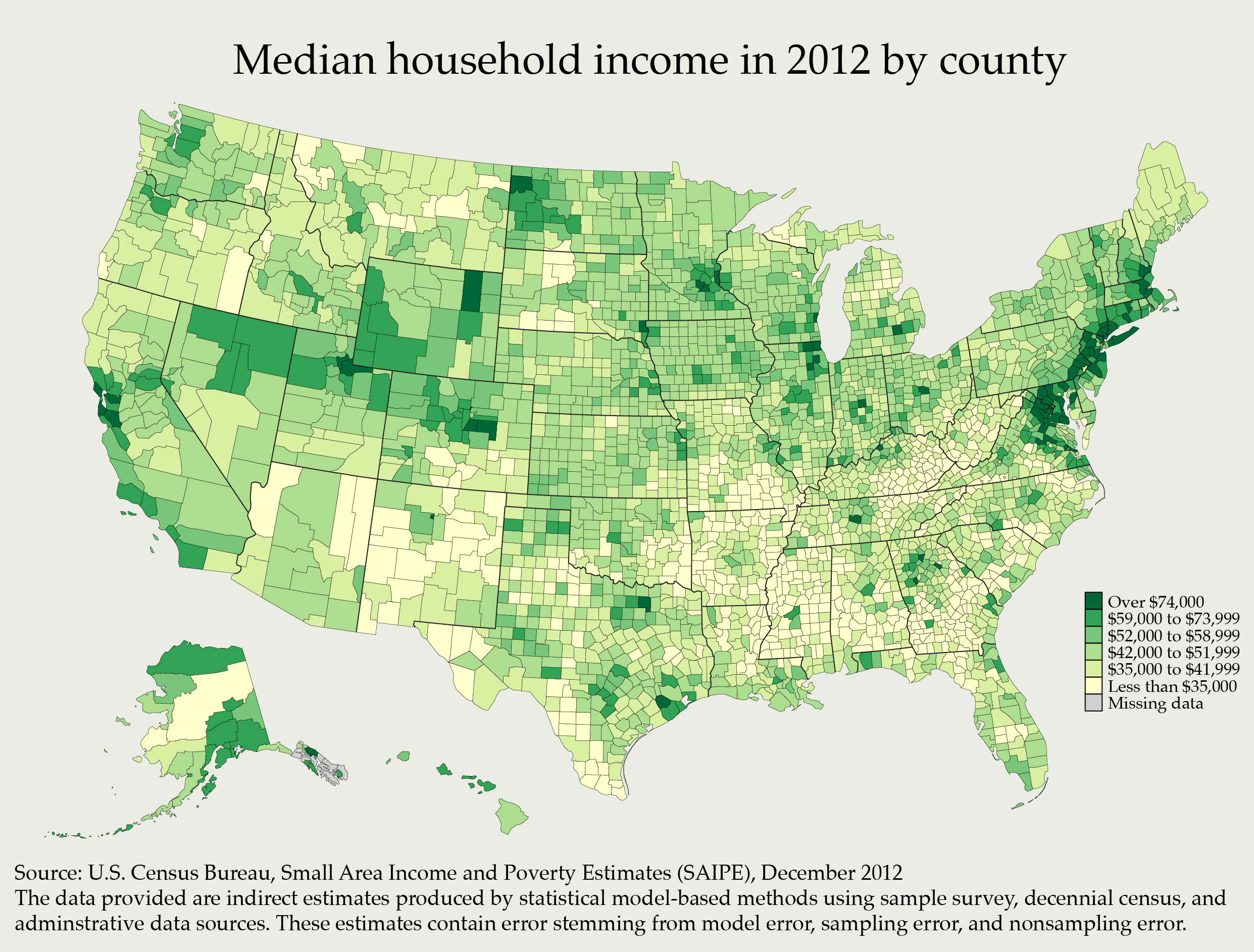
In the United States today there are a total of about 125 million households. These people range from unemployed high school dropouts to billionaires with Ivy League education, and everywhere in the middle. 15% of these people live below the poverty line, which depending on the nature of the household ranges from about $10,000 to $26,000. umich They live all over the country, even though there are various places which have higher rates of poverty than others. The poorest counties in the United States are primarily located in South Dakota (primarily Indian country), across the Old Confederacy, and Appalachia with a few exceptions. wiki The clustering of poor counties vs. rich counties makes a poverty trap of the lack of jobs and few other opportunities cluster in regions, as can be easily seen using this map in detail.

https://upload.wikimedia.org/wikipedia/commons/9/9e/US_county_household_median_income_2012.png
Poverty is also highly correlated with race, with African Americans and Native Americans extremely disadvantaged when it comes to opportunities their families can provide which white people (like myself) frequently take for granted. wiki African Americans and Native Americans are left behind significantly at $38,806 for Native Americans and $35,341 for African Americans while White Americans are make an average of $54,857. Alaska Natives are particularly disadvantaged at an average household income of $17,843. This gap is so wide the number of people who are able to jump the gap and get into college is significantly lower for minorities versus their white and Asian American peers.
http://poppov.org/Home/Publications/Reports/2010/useconomicsocialtrends.aspx
This only exacerbates the inequality we see in the United States today, keeping the racial inequality gap particularly wide.

This is clearly a problem, and we need to have a system which works for all people. The perpetual poverty in communities destroys lives and those of us who have had the opportunity to get educated have an ethical imperative to expand the opportunities we have had to our fellow Americans as much as we can.

Solutions to poverty obviously start with ensuring that education is available for all people, which could easily be done by expanding Pell Grants to people from low-income households. There will be a disproportionate number of minorities who receive the program because of centuries of discrimination. Past college however there is another idea which has caught my attention over the last year or two which would quickly remedy the issue of low income, and that is Universal Basic Income.

The idea is simple, every household receives a certain amount of money every year which they can use however they want or need. With 125 million households, the cost of $20,000 per household would cost us $2.5 trillion total. Even with my tax code as I refer back to often, this will still leave the government with a surplus of money, particularly when taking into account the programs that will no longer be necessary, like Social Security, Food stamps, etc. and the reduced burden on state governments for providing many different programs to support people. This also includes the negative income tax which will reward work for middle class families as opposed to taxing it, and still give the government hundreds of billions of dollars as a surplus to help cut the debt in good times or just give people an extra refund once we stop paying interest on bonds. I have already roughly calculated the effects here based on data from the Census bureau. It is an extension/modification of the tax code I shared a while ago.

Coming back to the original point, which is regional and racial inequality, this is a very easy way to quickly address the issue of poverty in these communities. With money to spend it will be worth it to create businesses where there will be an influx of money to spend, and this will create jobs and get local economies growing. No American will live in poverty, since $20,000 is close to the federal poverty line anyways, and we will be a better nation overall. Inequality will be reduced, which is correlated to numerous social ills, such as gun violence, health in general, school segregation leads to slower economic growth overall, and overall economic instability. Parliament of Australia Improving America's health will significantly lower government health expenditure which is a ticking time bomb.

If someone knows they are going to get their UBI no matter if they work and then they work as well, they are probably still going to go out since they can use that money for whatever they want, plus under my full plan low and middle income households will actually get a negative income tax which will create an even bigger incentive for people to work. Since I am not taxing people at low income levels the total earned income will increase no matter how much you work. This study of UBI basically explains as well as possible why UBI is not going to have a significant impact on employment.

The issue is that since I am not changing the amount of income you get from working for how much you get, there will never be a point where the UBI alone will make you worse off than working less (since the tax rate is exogenous, the real question is whether at the margin people will make more money if they work an extra hour, as long as the answer is yes, which it always is under this plan, they will work the extra hour. This is why people still work in practically every country in the world which starts to tax people for the first dollar they make. If people stopped working when they start getting taxed than nobody would work in any country today, which is obviously not true. We need to look at the margin to find the reality and under UBI and my tax plan without UBI the marginal income for an extra hour of work is always positive, so most people will work more, in fact the only people who will pay anything are already making millions of dollars) This is why I agree with Ed Dolan that UBI is not going to significantly reduce the amount of work done in an economy.

There is no reason for us not to do this, given the low costs and very large potential benefits. Before you declare it as socialism, remember that one of the greatest advocates of cash as social welfare was Milton Friedman. America needs to have a serious discussion about Universal Basic Income today, and we need to start doing it soon. This is something everyone could get behind.

Tuesday, July 21, 2015

Ceilings, Floors, Taxes, Subsidies and Inequality, Oh my!

In popular economics and the field as a whole inequality is one of the hot button issues everyone has emotions about and thinks about. The question of how to deal with such inequality is one of the big questions in economics, with a lot of questions about how to weigh the costs and the benefits of each, along with understanding what things we view as costs and benefits is at issue as well. There are of course several major ways people deal with inequality, the most popular being the minimum wage and progressive income tax. These do reduce inequality, but have other effects as well.

So, basic economic theory uses the supply and demand diagram to analyze the effects of various policies. The minimum wage is one of the most studied as a way of introducing this concept to people new to the subject so I will start there. The minimum wage is a price floor, meaning that it then is illegal for a firm or individual to pay someone less than that amount. The line in the following diagram demonstrates what this creates:

This diagram clearly demonstrates what we generally find is the effect of a minimum wage. First of all we observe a raise in the wage, which is of course the goal, but this isn't free and comes at the cost of unemployment. At a minimum wage above the equilibrium (where supply meets demand) more people are willing to work (the supply of labor) than people are willing to hire them. This creates unemployment. While it does increase wages it does so at a real cost.

The idea of a maximum wage has the opposite problem, for the same reason. Capping CEO salaries means the number of firms seeking high value added individuals cannot find enough individuals with those skills to match market demand, meaning a reduction in productivity.
This is similar to the idea proposed to Milton Friedman of the Earned Income Tax Credit. We can raise real incomes to the same level as we could do with a minimum wage but we get an increase in labor which means a reduction in unemployment and a bigger overall boost to the economy and reduction in inequality than we would have with a minimum wage (assuming the funds to fund such a plan are done in a reasonable way). Imagine if you can make your pie and eat it to? Welcome to the world of the EITC.
Finally, because this post couldn't be complete without it is the impacts of an income tax. It increases the cost of hiring for firms as well as reducing overall income employees receive. The overall number of workers at this new point is lower than it would have had at equilibrium creating a reduction in the work force. (which is technically different from unemployment) The only other question remaining is what the government does with the revenue in who will ultimately benefit from such policies.

There you are, the four major ways the government can effect the labor market with taxes, subsidies, floors and ceilings.

Tuesday, July 7, 2015

Smooth income tax

As I was coming home on October 7th this year, I thought of my tax code which I have designed, and found one flaw. The corporate income tax part is fine, and will be smoothed as well, but I wanted to make it a more elegant equation.

A Daily Kos author beat me to the punch by several years (probably due to being older than me) and wrote a beautiful equation. I have made a few tweaks to it, first of all I removed his 20% increase at the end and reduced the maximum rate to 50%. This reduces the maximum rate and increases the number of people who get money from the government, which will be a big boost to the economy since they spend close to 100% of their income.

The only other issue is how the government will be able to afford everything. The one thing with his calculation is that he probably didn't include capital gains as regular income, which I do. I need to do some work on to see what the impact will be of this policy change in the future, but I expect that treating capital gains as regular income, since they make up most of the income of millionaires, will make a tremendous difference to the government budget.

The only other thing is I increased the number of people who would pay a negative income tax. Using Census bureau data from Wikipedia it is then very easy to calculate how much revenue the government will receive from any tax code.

My equation looks like this: (Maximum Rate*Taxable Income/0% Tax threshold-Subtractor)/Square root(Divisor+(Taxable Income/0% Tax threshold)^2. This is basically the same as the equation proposed in the Daily Kos article, but made so the variables are undefined so they are easily changed. The values I used make the equation look like this: (0.50*Taxable Income/Cost of living for your family in your state - 4)/Square Root(50+(Taxable Income/Cost of living for your family in your state)^2.

For this equation this means that the average family making under roughly $142,000 will receive money as opposed to paying taxes, because of how unequal our distribution of wealth is, and everyone above that number will pay taxes. The Actual tax rate's lowest amount with these numbers is -28.28% and it increases forever approaching but never touching and never exceeding 50%. There will be a few deductions for things such as health care and education as well.

For a family in the 98th percentile they will pay around 15% of their income in total Federal income tax. Even while paying for the negative income tax for 86% of all Americans they will still have close to $5 trillion in income to pay for our expenses (I say our because they are public projects). For comparison the Federal government spent $3.5 trillion last year. This will mean we can either increase the amount of transfer payments people receive or pay off the deficit, whatever will be best for the economy.

When it come to income inequality this tax code will make a tremendous difference. The top 2% of wage earners currently make approximately 58.2% of all income is my estimation in the spreadsheet I used to model this, after tax income for them will then be reduced to 39.5% of income, for almost a 20% reduction. This will help make us a much more equal society.

This has a direct impact to poorer regions in the United States. Let's say you live in a county where the median household income is $40,000. The average tax rate in this county will be approximately -9.8%, meaning a stimulus of approximately $4,000 per person in the county. This tax code will help stimulate the economies of rural areas which will help small businesses across the nation by putting money in the hands of customers who will then spend that money in these local stores. If we look at the economy of Spokane County, Washington (for a random example) they have a median household income of $37,308 and a population of 471,428. This means an economic stimulus of $900 million to their economy, or $2000 per person. Every county in America will receive a stimulus since the top 7% who will pay taxes are dispersed across America and spend only a small percent of their income, and every county's median income is below the 0% threshold.

On the extreme side, Owsley county, Kentucky is the third poorest county in the nation with a median household income of $15,000, a per capita income of $10,000 and a population of 4,600 would have an average tax rate of roughly -25% meaning they would receive approximately $2500 per person for a grand total of $1.2 million. This will stimulate local businesses in these regions which are constantly in depression and move them towards a better future. This is what a tax code should do.

We need a more progressive tax structure, and one of the easiest ways to alleviate poverty and create a more equitable distribution of income is to give people money. This is hardly a Marxist idea since it was proposed by Milton Friedman of all people, and is something that we should all agree on to make our nation a better place. When one looks at what countries use taxation, the vast majority have a progressive tax structure, with the majority of countries with flat taxes being former Warsaw Pact nations, which are hardly known for their successful economic policies. If you want to stimulate an economy you have to look at the multiplier effect on the people your policies are going to effect, and this means that you want to tax the poor who spend the highest percent of their income the least (since consumption has the highest available multiplier, and they use almost all their income for consumption) while those who make the largest amount of money use most of their money for investment which has a lower multiplier than consumption. This is a basic fact of modern economics, and essential to conducting good policy. So, a good tax policy will tax the most on places and people which have lowest impact on overall productivity and tax the least on places and people which use almost all of their income for consumption. This is because the added benefit of one more unit of consumption decreases the more I own. Going from having no lunch to one lunch makes me very happy. Getting a second bite to eat might make me more happy if I am still slightly hungry, but there will come a point where I am going to be full, and at that point getting more to eat might actually make me worse off than just not eating more food. This is satiation. Satiation is why people who make more money save more money as a percentage of their total income than people who make less. This is the reason why we want to have a progressive income tax which means government investment doesn't cut too much into consumption but means that public sector investment is mostly displacing private investment as opposed to consumption, though it will always displace some consumption such an effect is minimized.

I have designed the whole code and here is what the effect on income inequality would be like based on US Census Bureau Data on American Income Inequality:

This shows that while the effect for the my tax code will be relatively small for most people, it will significantly reduce the wealth inequality at the top. This will yield $4.2 trillion of revenue after tax transfers. The income of the top 1% which currently sits at 58.2% of national income will reduce to 40.6% of after-tax income.

This is a good thing because short-term economic growth comes from consumption, and if we cut that too much we could trigger a current recession. The government expenditure should mostly be focused on long-term investment in normal non-recessionary times anyways, meaning it has minimized its disturbance in the economy. This is why we want a progressive income tax.

Friday, December 13, 2013

Why is Canada doing better than America?

Today I found a great article on the BBC talking about how Canada has a much lower unemployment rate than most European countries and now has a shortage of labor for the booming oil sands in Alberta.

This made me wonder why Canada is doing so much better than the US and Europe and what the underlying differences are between the three major economics (Europe is for obvious reasons more fragmented but their economy is in recession as a whole and that is where people are coming from).

Looking at the underlying features between the US and Canada they are very similar. They have extremely similar labor laws, extremely similar proportions on who works in what industries, and almost every other major figure is similar except for three important features:
  1. Canadians are paid more at the lower wage levels.
  2. Capital Gains are taxed at a progressive rate in Canada, but not in the United States.
  3. It takes only a day to start a business in Canada and they are ranked by the World Bank as the best country in the world, meaning competition in the private sector.
These three features are why Canada is doing so well right now and are finding such a developed economy.

The first point, higher wage levels, means that there is a higher demand for goods and services in Canada at the local level nationwide than in the US or Europe. The US is having a lagging economy right now, almost certainly due to lower consumer demand. Wal-Mart and other retailers are not finding people to purchase their services which is contributing to poor economic performance. Companies cannot stay open if no one will buy their product. Canada doesn't have this problem because everyone working full-time can survive. This helps small businesses and the entire economy.

Taxing capital gains as regular income solves the problem of the government not losing a lot of money during a recession, which keeps deficit low. However, I can't observe a difference in the stock markets so it doesn't dissuade people from removing their money from the market.

The United States has a similar sector makeup, and the oil boom is isolated to Northern Alberta, and the United States is also having an increase in drilling in different regions. But Canada's entire economy is doing better than the US and Europe, so blaming the oil boom is not enough, since it accounts for less than 19% of the economy.

So, the response of the stock markets is the same, the sector makeup is the same, all but one major feature of these economies I find are comparable, and that feature is distribution of wealth.

After the recession in 2008 the rest of the world came back (except Europe, but only after the implementation of austerity) and there was high demand for goods and services. The average Canadian is paid more than the average American, their distribution of wealth is a lot more equitable, close to what Americans want actually. Because of this difference, the change in economic spending wasn't so large in these other countries. a lot of America's economic growth of the past 40 years was also based in a lot of lending, through a system of government incentives for people borrowing for houses, and schools, which is more than other countries that have seen more steady growth. When the economy collapsed, millions of workers were laid off, and demand struggled. Without massive incentives to change this fact and increase the quality of life we will continue to see a major shift in economic growth. Nick Hanauer (an entrepeneur) made a TED talk talking about how the economy is an ecosystem (I'm paraphrasing) and that it requires transactions to be made, and when one large group of people are unable to make the transactions the entire ecosystem/economy falls apart. Other developed countries don't have this problem like us, and it is the only major characteristic that separates the US and Canada.

If we want to see growth and faster recoveries from recessions we need to increase our economy from the bottom so more people can participate, because no entrepreneur can start a business in a market where there is no demand. This is the reason the American economy is stagnating. It is also similar to the reason why the European economy is in depression, because millions of people have had their income taken from them and the aggregate demand curve has collapsed, leaving firms new and old with no demand, decreasing employment, and decreasing GDP, creating a cycle that has been feeding on itself. Western Europe (which has had large economic ties for the past 40 years) is now divided between north and south (though it hasn't always been to the same extent) between the employed and the unemployed, and this has reduced demand for goods and until they find that people in Southern Europe have opportunities restored, I have little doubt Europe will remain in recession. Other major economies are still growing at increased rates (as long as they didn't implement austerity).

I also predict that Canada saw a reduction in their GDP growth in 2012 because they are so heavily tied to the American economy which hasn't been growing as fast as we need to.

We need more avenues to the middle class so everyone with the skill and will can be as well off as possible. It will be a huge boom to our country's economy.

Sources:
https://en.wikipedia.org/wiki/Economy_of_the_United_States
https://en.wikipedia.org/wiki/Economy_of_Canada
https://en.wikipedia.org/wiki/Taxation_in_Canada
http://data.worldbank.org/indicator/NY.GDP.MKTP.KD.ZG economic growth by country where available
https://www.youtube.com/watch?v=f0ehzfQ4hAQ Summary of distribution of wealth
https://www.youtube.com/watch?v=CKCvf8E7V1g TED Talk

Thursday, April 25, 2013

How to solve income inequality

A very fascinating video about monkeys and income inequality: http://www.upworthy.com/2-monkeys-were-paid-unequally-see-what-happens-next

When he says it is the wall street protest he is absolutely right. When people are taken advantage of, they are going to revolt. This type of attitude was exactly what made our country independent in the first place. The 13 colonies were being treated unfairly by King George III before we became independent and we knew it. We then revolted, just as this monkey does throwing back the cucumber, because he wants a grape.

When you look at Occupy Wall Street you see people who have been working just as hard getting paid less and less and don't have the resources available to start their own businesses because they have to support themselves. This is why we called for ending the corruption in our government by overturning FEC vs. Citizens United.

When you look at the Arab Spring we see how they were being treated horribly by their governments and looked across the Mediterranean and saw how Europeans live. There is no reason they can't live like that, so they are in a revolution and I know that in the end the progressives will win, even though there are times when it doesn't seem like it.

No rational person would be content with being mistreated when the person right next to them is getting paid far more for the same work. This is a real source of income inequality in the world, compare state worker salaries and private worker salaries who work for corporations of a similar size and the comparison holds to my last two.

How do we solve it? First of all, we need to form cross-corporation unions. We need to say that we are going to set our prices at a point where we can make enough to live. This is one step towards making our economy more sustainable, but it isn't enough.

We then need to look at how much money we spend on gasoline, communications, and electricity and recognize that we can pay less if we set up corporations which won't be so greedy and treat their customers with respect. When it comes to gasoline we can move towards more competitive alternatives, like fuel cells, which will be a very important change in how our economy works. This will create competition as long as we allow competition to exist and don't allow monopolies to form on such a critical part of our economic infrastructure. When it comes to communications we need to have reasonable regulations to prevent corporations like Comcast and AT&T from forming cartels and keeping prices high. With no one else to turn to once these companies control the economy we need to make certain that there are regulations preventing price gauging which hurts economic growth.

Another important aspect to the economy is the stock market. When you look at the stock market you will find how banks and investment institutions own large shares in many different corporations. I have found Yahoo to be the most intuitive for finding which companies own large shares in other corporations. This presents the largest hurdle, because when a collection of banks own large shares of all publicly traded companies in a sector, they really do control the whole market. The easiest way to fight this is refuse to deal with companies that own these other corporations and end your bank accounts with them. Concentrated power is never a good thing, and that is why keeping your bank accounts with small locally owned credit unions helps prevent monopolies and limit the resources that big banks can get. With the major players in a market not competing to keep prices low, and paying people as little as they can, there is very little that local businesses can do to reverse the trend of how the purchasing power of the middle class has shrunk.
This is main reason that the major corporate media outlets don't push certain issues, they are all owned by the same people who have no incentive in talking about ranked voting, income inequality, or other major issues, but instead fill the time with cute 10 year old baseball teams, pundits who don't know the facts, and Justin Bieber (currently). It keeps them from talking about major issues and most international catastrophes (namely human rights abuses in North Korea, Darfur, and the Congo Wars among others). This is a serious threat to the political health of our country and other countries seeing similar concentrations of poew.The next step is for many different people to own stocks in their own name, and if enough progressive decide that instead of boycotting WalMart, Exxon, etc. they will buy the stock and vote in better people, followed by taking their earnings and investing in local companies, it will help limit the concentration of power that is so dangerous for both our economic and political cultures. It is a large shift but I think this is the way.

There will be anarchists and communists who say their way is better. The problem with the anarchists is removing the government from influencing the economy won't solve any problems in the long run. It is dangerously close to the hands off approach in the Guilded Age which saw massive monopolies, impoverished people, and if it weren't for the unions and the anti-trust legislation the Guilded Age would still be here. The communists who say that the government needs to control the economy leave the government with complete control of the economy which leads to the inefficiencies of planning boards which plagued every communist country. It also leads to a new ruling class similar to the old based on who is the leader of the party which means nothing has really changed for most people.

I favor a center approach. When it comes to competitive goods I see no reason for price controls, or anything more than a minimum wage and the right to organize to insure people will be able to be paid enough to live. When it comes to monopolistic or oligopolistic goods, I see the government needs a role in insuring that the monopoly or oligopoly that forms will not raise their prices to the point where they control everything and individuals have no power, or just control the monopolistic good (mainly oil, electricity, telecommunications) which is successfully done in many highly developed countries. This is a way to help the economy grow by circumventing the choking power that these companies have when they have no competition and no one can enter the market to create new competition. This helps people get better products for a lower price and gives people different places to work so that if unemployment gets low it will be the corporation that is competing for the most skilled workers, not the workers competing for the best jobs. This will make prices rise which will cause the aggregate demand to increase, which will reduce prices and increase GDP. Aggregate Demand on Khan Academy