Showing posts with label schengen. Show all posts

Thursday, October 31, 2019

How to get Visa-free access to the United States

The United States is one of the least welcoming countries in the world based on our visa policy. Only Canadians, Palauans, Marshall Islanders, and Micronesians can come here without some sort of visa. Everyone else needs to either preregister for $14 or pay $140 for a ten year visa. Most people need to pay the $140.

I think this is ridiculous because many countries which require visas are safer than we are, and we are really not protecting ourselves by making German tourists pre-register before they invade with socks and sandals.

All jokes aside, this should be a much bigger diplomatic issue. There are a few options for countries to reciprocate. Some countries usually will charge the citizens of the other country the same amount before abolishing visas, but I think there is a better way to do this.

When most Americans travel abroad off the continent we will most likely travel to The European Union. These countries are our allies, and safer than us by practically every metric. There is absolutely no reason to have visas for German and French tourists. I count a visa as any document which a tourist must pre-register for and pay money before they arrive, whether there is a 99.9% approval rate or not. The European Union should negotiate with my country to get visa-free access for their citizens by making a demand.

Either all Schengen Treaty citizens get visa free access to the United States,or the following laws will trigger.

  1. Americans will have to pay $140 for a 10 year visa to visit the Schengen Area effective immediately. This will be an on-line application. Each and every applicant will be given a message that this is reciprocity, and if they want visa-free access to call their member of congress which the EU will provide for them on the page.
  2. Elected government officials must pay $1000 for a single entry 14 day visa to visit the European Union or Schengen Area effective immediately.
  3. The United States President and Secretary of State are banned from entering the European Union or Schengen Area effective immediately.
  4. Ambassadors must pay $3 per day to remain in the European Union. Starting 1 January 2021 Ambassadors must pay $1000 per day to remain in the European Union.

Or the United States can give EU and Schengen Area members visa-free entry.

Tourist visa fees will be refunded after visa-free access is granted.

This would probably work.

Unfortunately, the European Union is not doing this plan. Instead, under the leadership of Juncker they are deciding to go with a similar plan to the US, Canada, and Australia of having low-cost visas for tourists starting the beginning of 2021. They said themselves back when the US started charging for ETA that the idea that it would increase tourism is ludicrous. However, 8 years later they end up doing the same thing which will not help their tourism industry. It will not keep Europeans safe, neither will it increase goodwill between countries. Their system is even worse because applicants will need to announce which country they intend to enter in and will not be allowed to enter in other countries in the Schengen Area. This means that unless if they see sense before then that people will be required to always to fly through one country and then transfer, which will hurt tourism.

I personally have family in Germany, Finland, Switzerland, and the United Kingdom. Saying I MUST always enter through Germany to go to Finland for a three year period is inconvenient, and doesn't benefit anyone.

The system we have now where we present our passport when we arrive and get a stamp is as much as we need (probably more than we need actually) in terms of safety on both sides of the Atlantic relative to both countries. ETIAS is also not just being targeted at the US, Canada, and Australia who have similar absolutely ridiculous systems.

More than this, pre-registration like ESTA, ETA, and ETIAS push refugees out of sight and out of mind, enabling fascists. With the EU, Canada, USA, and Australia implementing such systems, the number of places where refugees can safely go to avoid persecution grow low in number. These programs are not being targeted at countries like Saudi Arabia which would be a real security risk given their attacks on other countries with their paramilitaries, but instead between free and developed countries, where they simply do not belong.

There also isn't nearly enough research on the impact of such systems on tourism or safety, meaning they are not making us safer, and the government has failed to provide any proof that they actually keep terrorists from crossing borders.

We need proof that these are not working, and to abolish them as fast as politically possible. Europeans need to vote out EPP, Australians need to vote in Labour, and Americans need to vote in Democrats. Then a Democratic Party, Labour Party, Liberal, S&D alliance can work on ending visas between the EU, Canada, United States, and Australia since the far-right coalition has failed to provide any evidence that these programs actually keep people safe.

Wir sind ein Volk.

Appendix:
The ESTA was funded to support The Brand USA, a private-public partnership funded by ESTA visa fees to advertise tourism to the United States. They state on their website: "As one of the best levers for driving economic growth, international travel to the United States currently supports over two million American jobs (directly and indirectly) and benefits virtually every sector of the U.S. economy."

Sounds like a self-aware wolf to me... because they are literally funded by a program which is proven to reduce tourism to the United States...

This is just too rich.

Friday, December 21, 2018

Proposal to expand Schengen

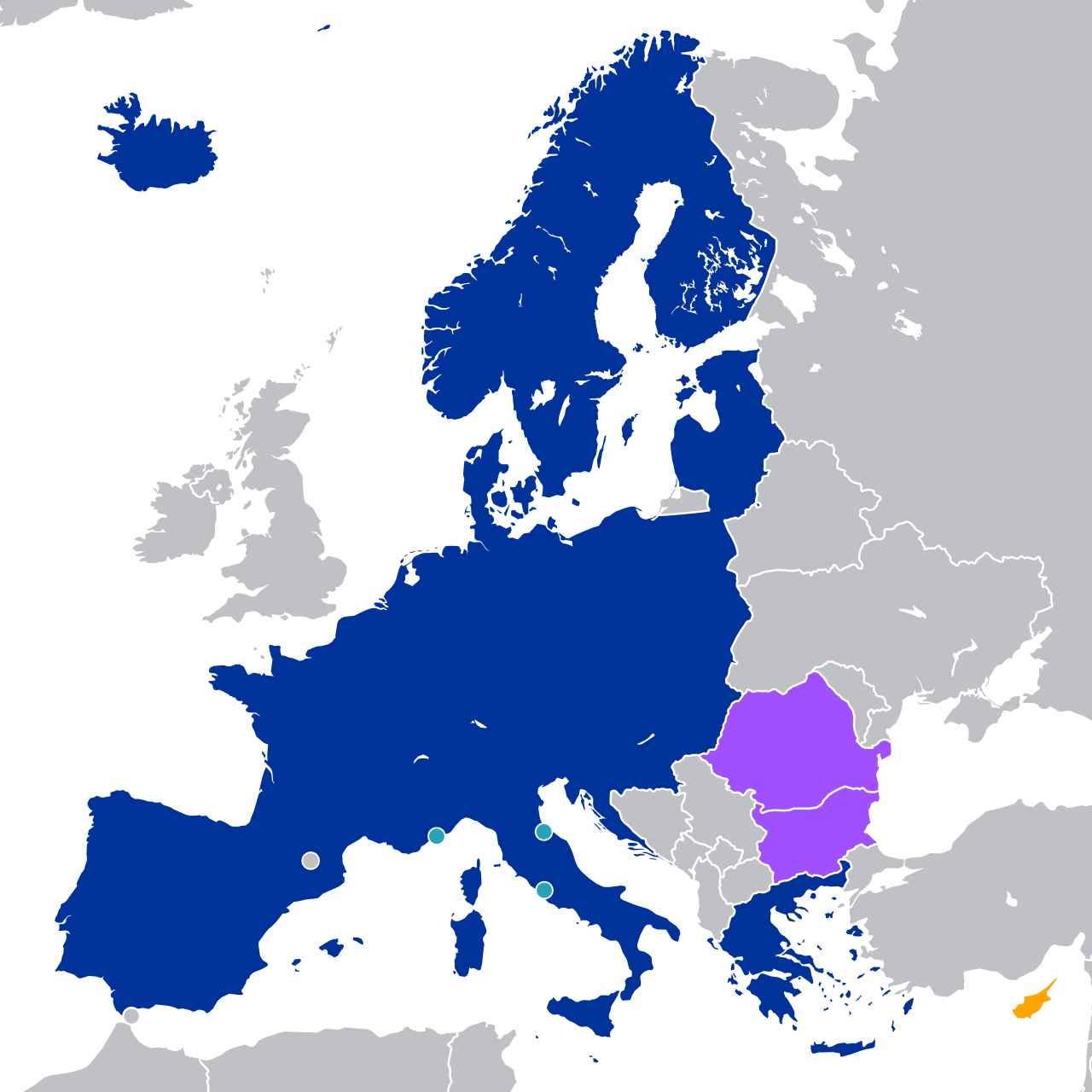
The Schengen Treaty is without a doubt one of the most important treaties in the world. It comprises 26 states, most of which are members of the European Union, have a GDP of $15 trillion and a population of 419 million people. People are free to move within this area, they can live and work in any other member state, as there are no customs whatsoever between any of these countries. Most members are EU members, with a few exceptions, Iceland, Liechstenstein, Monaco, Norway, San Marino, Switzerland, and Vatican City.
The Schengen Area
This is the pure liberal dream. The idea is that without trade barriers between these countries that people will have less of a desire to go to war with others. And it has worked along with the free trade area which has grown out of the European Coal and Steel Community which was founded in the 1950s. Bulgaria, Croatia, Cyprus, and Romania are currently pending the next council meeting.

The question now is, should Schengen be expanded, and if it is, how? As the title of this article suggests, I am in favor of expansion. The Schengen Treaty, as a legal document presents very clear rules on what is to move in between borders. The bulk of the laws are included in section 1, under the 14 June 1985 convention. The rules are laid out in the following titles as follows in this convention:
  1. Definitions
  2. Abolition of Checks at Internal Borders and Movement of Persons
    1. Crossing Internal Borders
    2. Crossing External Borders
    3. Visas
      1. Short-Stay Visas
      2. Long-Stay Visas
    4. Conditions Governing the Movement of Aliens
    5. Residence Permits and Alerts for the Purposes of Refusing Entry
    6. Accompanying Measures
    7. Responsibility for Processing Applications for Asylum
  3. Police and Security
    1. Police Cooperation
    2. Mutual Assistance in Criminal Matters
    3. Application of the Ne Bis In Idem Principle (No double jeopardy)
    4. Extradition
    5. Transfer of the Enforcement of Criminal Judgements
    6. Narcotic Drugs
    7. Firearms and Ammunition
  4. Schengen Information System
    1. Establishment of the Schengen Information System
    2. Operation and Use of the Schengen Information System
    3. Protection of Personal Data and Security of Data in the Schengen Information System
    4. Apportionment of the Costs of the Schengen Information System
  5. Transport and Movement of Goods
  6. Protection of Personal Data
  7. Executive Committee
  8. Final Provisions
All of the laws and regulations are already in existence already, and the rules for Schengen are really straight forward and reasonable. Basically, control the borders, Mutual recognition of each other's visas, police need to cooperate and respect the laws and decisions of other countries in the area, sharing of information between countries when it comes to visa relevant information, a common tariff policy, don't leak data, and each member has a seat in the executive committee. That's the entire agreement in a nutshell.

There is also, notably, no requirement of a country to be in the European Union or even Europe to join the Schengen Area in the original document. This means, theoretically, that the Schengen Area could be expanded to outside Europe if I am not missing another law which regards Schengen membership. This seems to be the case because Switzerland joined in 2008, and it is not a member of the EU, and Liechtenstein joined in 2011 after the Treaty of Lisbon, the last major amendment to European law. This means that non-member states can indeed join the Schengen area.

The question then becomes... who should be included? Prospective countries to join the Schengen treaty could be established by fitting the following criteria in my mind:
  1. Adopt the European Charter of Rights and Freedoms as law, or have comparable laws on the books already.
  2. Have a Corruption Perceptions Index at least as high as the Schengen member with the lowest score.
  3. Have a better Press Freedom Index then the member state with the lowest score. This is a useful proxy for how well the Charter of Rights and Freedoms are respected.
  4. Have an economic system which makes it easy for businesses to flourish, using the Ease of Doing Business Index. We want the member country to be fully engaged in the common market.
  5. Have no significant domestic terrorism. This can be measured by homicide rate.

These are 5 things which can easily be implemented.
https://upload.wikimedia.org/wikipedia/commons/b/b3/Corruption_Perception_index_2017.svg
Corruption Perceptions Index

https://upload.wikimedia.org/wikipedia/commons/e/e7/Press_freedom_2018.svg
Press Freedom Index


The Schengen member with the highest (worst) Corruptions Perception Index currently is Greece, at 44. they ranked #69 in the world as of 2017, which leaves 43 potential members by that metric.

The Schengen member with the highest press freedom score currently is still Greece, though Bulgaria will likely acede soon and it has the worst score, but they will likely not be chosen due to the factors which cause them to fare so poorly on the press freedom index, so that leaves Greece as the lowest score. They rank #70 in the world as of 2018 (yes, these are significantly correlated indexes) and that again leaves 44 potential members by this metric.

The obvious choices for membership by these two metrics combined are:
  1. New Zealand
  2. Canada
  3. United Kingdom
  4. Australia
  5. United States
  6. Ireland
  7. Japan
  8. Uruguay
  9. Chile
  10. Taiwan
  11. Botswana
  12. Cape Verde
  13. Costa Rica
  14. Georgia
  15. Cyprus
  16. Mauritius
  17. South Korea
  18. Namibia
  19. Croatia
  20. Romania
  21. Senegal
  22. South Africa
  23. Suriname

This map is interesting for many reasons. Following this logic there are countries which are qualified to join the Schengen Area using my first two criteria on every continent. Some countries which have expressed interest are missing from the map, Israel is blank because their press isn't free enough, Bulgaria is blank despite being considered to join the Schengen area because they are too corrupt,  Ukraine is both too corrupt and their press is not free enough.

The one other variable which could be useful in determining whether a country would be able to join the Schengen Area would be the Ease of Doing Business Indicator. The reason for this one is the acquis on the free movement of capital, and if a country doesn't allow ease of movement of capital within its own borders it will not be able to join Schengen. This significantly reduces the number of countries which are eligible to join down to 17 prime candidates. The economies of Botswana, Cape Verde, Namibia, Senegal, Suriname, and Uruguay are less free than that of Malta, the Schengen member with the least free economy, which means that the best candidates for joining the Schengen map looks like this:
Every country shaded in red on this list has a Corruptions Perceptions Index, Press Freedom Index, and Ease of Doing Business Index ranking better than the worst performer currently in the Schengen region.

The top performer not currently in Schengen currently is New Zealand when you multiply the CPI, DBI and divide by the PFI. The order of this ranking follows as Canada, Australia, Ireland, United Kingdom, Costa Rica, United States, Taiwan, Chile, Cyprus, Japan, South Korea, Georgia, Mauritius, Romania, South Africa, and then Croatia. If the current member states of the Schengen Area and these 17 countries chose to unify their customs into the Schengen area this would be mutually beneficial.

The countries which would most benefit from joining would honestly be the United States and Canada. With the world's longest border, highly developed economies and being among the most free in the world, we could benefit in joining.

Another factor when it comes to opening up your borders to another country is safety. This is easily measured using homicide rate as a rough approximation of the relative safety of one country or another. Three countries unfortunately have homicide rates which the European Union will likely find unacceptable, and those are Costa Rica, South Africa, and my home, the USA. The country with the highest murder rate in the Schengen area is Lithuania with a homicide rate of 5.25 people per 100,000. The United States unfortunately has a homicide rate of 5.35 meaning if the Schengen Area would not allow new members due to an intentional homicide rate we are just above the threshold.

This problem deserves special attention because we are so close to having a low enough murder rate to qualify for Schengen Membership, if this was a qualifier. Looking at murder rates by states and territories, the ones which have a higher murder rate than Lithuania are in descending murder rate (by latest available data): Louisiana, Missouri, Nevada, Maryland, Arkansas, Alaska, Alabama, Mississippi, Illinois, South Carolina, Tennessee, New Mexico, Georgia, Oklahoma, Ohio, Indiana, Arizona, Kentucky, North Carolina, Pennsylvania, and Michigan. Reference

This deserves an article of its own, and we need to focus on reducing our murder rate as a country.

This still leaves 14 countries around the world which have the proper statistics to join the Schengen travel area, from every continent. These 14 have low corruption, and are safe. Schengen is estimated to boost the trade and economics of the member states, and there is overwhelming economic evidence that increasing trade reduces the likelihood of war. For these reasons I believe it would be wise for the Schengen Treaty to be expanded outside of Europe, the UK and Ireland should join Schengen (which I know is unlikely due to the whole Brexit debacle) because it is the logical next step to fostering peace in the world we live in.
Countries which could theoretically join Schengen.