Monday, March 14, 2016
Pay by mile is flawed

Obama has 50% approval
Thursday, February 25, 2016
2016 election, late February 2016
So the big question now is that who will be Clinton's running mate? My personal favorite would be Bernie Sanders actually. It would help win over a lot of current Bernie Sanders supporters, and if he accepted the nomination would all but guarantee a victory. The biggest advantage to this is that campaigning together Sanders could rile up his crowds, all but guaranteeing them supporting the ticket, and Clinton will fulfill the lifelong dream of many feminists of having a woman as president (as I have seen far too often on-line). Sanders will help Clinton from drifting too far right on many social issues as her Vice President, and Clinton will hopefully help make sure their economic policies have a chance that people will vote for them. This is the best possible ticket at this point in time, it will keep the Executive Office from drifting too far right (like happened with Clinton's husband) and make sure the policies have a chance of actually passing Congress with Sanders as VP. While I wish for a more inspiring team overall, as I wrote about several months ago, and it is by no means a dream ticket, I think this is the best possible ticket at this point in time. I see it as a choice between someone who is hyper idealistic who doesn't consult advisors and doesn't propose anything with a chance in hell of passing, and someone who is too quick to run to center trying to appeal to as many people as possible. As a team together hopefully they will balance each other out like the Earth and Moon.

 Click the map to create your own at
 I will not be voting in the primary this year, but I will be voting for the Democratic Nominee in the General Election no matter who wins.
Monday, February 15, 2016
Universal Basic Income
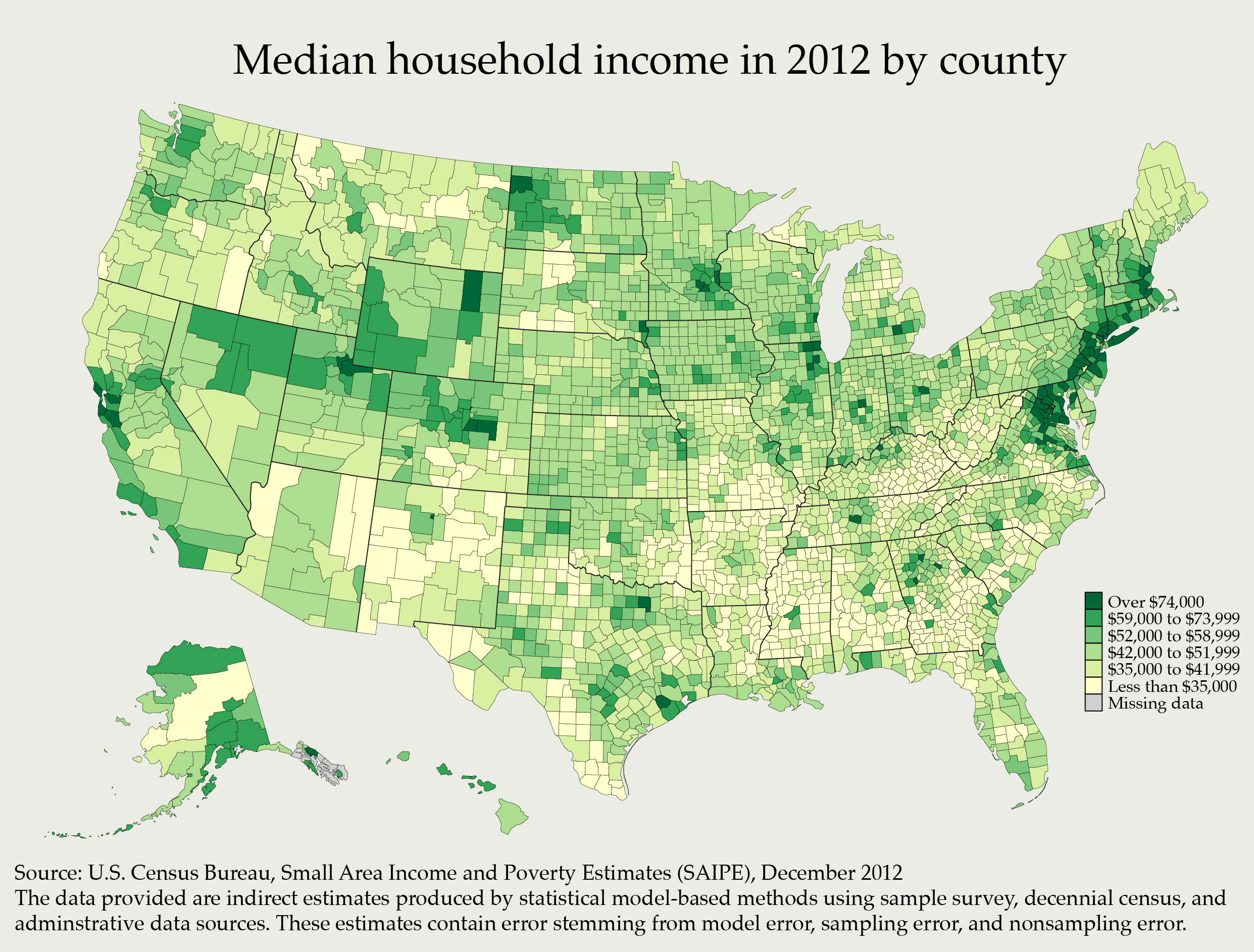

This is clearly a problem, and we need to have a system which works for all people. The perpetual poverty in communities destroys lives and those of us who have had the opportunity to get educated have an ethical imperative to expand the opportunities we have had to our fellow Americans as much as we can.
Solutions to poverty obviously start with ensuring that education is available for all people, which could easily be done by expanding Pell Grants to people from low-income households. There will be a disproportionate number of minorities who receive the program because of centuries of discrimination. Past college however there is another idea which has caught my attention over the last year or two which would quickly remedy the issue of low income, and that is Universal Basic Income.
The idea is simple, every household receives a certain amount of money every year which they can use however they want or need. With 125 million households, the cost of $20,000 per household would cost us $2.5 trillion total. Even with my tax code as I refer back to often, this will still leave the government with a surplus of money, particularly when taking into account the programs that will no longer be necessary, like Social Security, Food stamps, etc. and the reduced burden on state governments for providing many different programs to support people. This also includes the negative income tax which will reward work for middle class families as opposed to taxing it, and still give the government hundreds of billions of dollars as a surplus to help cut the debt in good times or just give people an extra refund once we stop paying interest on bonds. I have already roughly calculated the effects here based on data from the Census bureau. It is an extension/modification of the tax code I shared a while ago.
Coming back to the original point, which is regional and racial inequality, this is a very easy way to quickly address the issue of poverty in these communities. With money to spend it will be worth it to create businesses where there will be an influx of money to spend, and this will create jobs and get local economies growing. No American will live in poverty, since $20,000 is close to the federal poverty line anyways, and we will be a better nation overall. Inequality will be reduced, which is correlated to numerous social ills, such as gun violence, health in general, school segregation leads to slower economic growth overall, and overall economic instability. Parliament of Australia Improving America's health will significantly lower government health expenditure which is a ticking time bomb.
If someone knows they are going to get their UBI no matter if they work and then they work as well, they are probably still going to go out since they can use that money for whatever they want, plus under my full plan low and middle income households will actually get a negative income tax which will create an even bigger incentive for people to work. Since I am not taxing people at low income levels the total earned income will increase no matter how much you work. This study of UBI basically explains as well as possible why UBI is not going to have a significant impact on employment.
There is no reason for us not to do this, given the low costs and very large potential benefits. Before you declare it as socialism, remember that one of the greatest advocates of cash as social welfare was Milton Friedman. America needs to have a serious discussion about Universal Basic Income today, and we need to start doing it soon. This is something everyone could get behind.
Thursday, February 11, 2016
Why Americans drive so much
If we built the interstate highway system as fast as we build mass transit, it wouldn't be finished yet.
The issue of livability of cities is a central question for local governments around the world. In order to cut down on congestion many cities are choosing to increase the cost of parking.
I expect that this will increase revenue for cities but it won't reduce the overall carbon emissions. The central problem is there are no alternatives to driving in many cities, and once you have a car it makes no financial sense to ride mass transit which costs more per trip than driving. This makes driving less expensive on a day to day basis for many so people choose to drive. What buses we do run are mostly unnecessarily slower than driving which reduces demand and means more people drive. Given the ineffiency of most bus routes people in under served areas drive which creates congestion. With no substitute people choose to drive and parking necessarily becomes very expensive or there will likely be a shortage from a price ceiling.
The solution is to remove price controls for parking and significantly increase availability of mass transit. This will solve the congestion crisis in most American cities.
http://www.pewtrusts.org/en/research-and-analysis/blogs/stateline/2016/02/03/cities-try-hourly-parking-to-cut-congestion-pollution
Monday, January 18, 2016
Priorities: Education and Social Security
However, when it comes to one of the biggest issues in America's budget perhaps no bigger one is who the government gives handouts. The Federal Government redistributed $850 billion ($2700 per person), $705 billion went to the elderly ($2238 per capita), and $144 billion went to disabled people ($457 per capita). This is also one of the most re-distributive programs in America since people get a larger percentage of the amount they put in at lower income levels.
While it is re-distributive the bigger issue is everyone pays in more than the amount of money they get out of social security. Compared to investing in assets this is clearly a worse plan than if people were to invest their money in a diversified index fund. According to Politifact, the average couple will pay in $722,000 in taxes to Social Security and get back $966,000 in benefits, for a return of about 33%. On the other hand, someone who deposited $4000 a year, increasing at 1% a year (even at an income of $40,000, this is reasonable if not on the low side if you have an employer matching Roth 401k program) starting today for the next 40 years and got the average rate of return on capital (which is 8% based on the last 40 years of the S&P 500) would retire with $1.2 million saved on a $201,500 deposit for a 600% return on investment. Here is my work. Even assuming in Compared to an index fund which performs at market rate Social Security does not come close to comparing. If people invested wisely Social Security Old Age Insurance would be completely pointless, even for people near the poverty line.
The bigger issue with this is what we do not fund which is education. Education is the lifeblood of the American economy. If people are not educated it doesn't matter how many computers we have because people won't know how to use them. Education is so important that when it is put into the Solow-Swan growth model it almost completely explains economic differences between countries. If countries are to grow they need both access to capital and education, meaning high quality education is one of the most important issues to economics. Despite this, the gap in educational opportunity in the United States is extremely wide. Schools start with their funding from their local communities which are extremely unequal in terms of resources to start with and the amount which state governments equalize the inequality varies significantly state to state. Students end up at the mercy of their state governments in how much help the state provides to fix the inequality. The Federal government does little to help equalize this inequality in funding available to children (to no fault of the children) despite the amount it would cost would not be a lot. There are currently 50.1 million students in the United States in K-12. If the Federal government were to give an average of $3000 per student to help equalize the inequality between students (which could be used to get extra training for teachers, new computers, whatever they need) this would only cost us $150 billion, which would be only 25% of what we spend on military and 3.8% of the budget. Even $6000 per student would be only half of what we currently spend on military and 7.6% of the budget, assuming that spending comes from other programs. The per capita cost would also be only $476 or $922 per person, which of course would be paid more by the rich than the poor. We can afford this, in fact, we can't afford not to prepare our next generation for the technology of the future. The economic impact of an educated population is far larger than the cost of that education. If I spend $36000 on a student over 12 years and end up boosting her salary from $30000 a year to $60,000 per year it is easy to see what an impact this would have on the economy as a whole.
So, should we get rid of Social Security to pay for better education for young Americans? I'm not sure this is really a choice we have to make. One option we could do is eliminate the cap on Social Security income, fix the system so people at get at least the same amount of money than they put in on average, and use the added revenue to invest in America's education in the form of Treasury Bonds, which is what we already do with Social Security's $2 trillion surplus (and counting). This would guarantee Social Security will essentially never run out of money and provide education to those who desperately need it. Combined with the rest of my tax code this will mean that many people will have credits in Social Security but not end up paying taxes under such a system. This will help protect people, because if your parents don't end up with enough when they retire it will be the children and grandchildren who pay without a program Social Security, and it helps directly redistribute money to the people who need it. Ultimately, the choice between Social Security and education is a false dilemma as long as we are willing to tweak the Social Security program. This is possible, and this is what we must do.
Monday, January 11, 2016
The future
This is bullshit. These companies feel like they need to be protected by the government from technology, that they don't need to be required to stay on par with new technology, probably because they find that technology is difficult. That's their problem ultimately and they need to stay up to date with the modern world. We don't use wax cylinders anymore, and they need to get used to it.
The reality is that if you make an amazing music video which people watch you can make a lot of money. Let's say you get a million views on your video and you have an ad at the bottom that only 1% of the people watching the video clicked on. That will give you a total of $30,000 for that ad. If Adwords gives ads that people are actually interested in by making them relevant to their lives (because Adblock does not block text ads) than you will be able to make more money than that. If you have a channel and frequently make videos every week this can become a real business model very quickly. A large music studio pumping out perhaps 100 videos could make millions of dollars on their music videos, which is enough to stay floating. If the videos are then made accessible to all people in the world and each person watches an ad, it becomes very easy to make millions of dollars per episode of a popular show like Doctor Who or The Simpsons on ad revenue, as the TV industry has survived on for the last 100 years. This model is not new, in fact it is what producers have lived off since they began. An added advantage to this is if all the episodes are always available for free to the viewer somewhere like Youtube than there will be no reason to pirate the video and they can have Youtube take down rip offs without people losing any content if someone does choose to pirate it, increasing overall revenues.
Instead of complaining about new technology companies need to be willing to adapt to a new world, or else they will become obsolete and hopefully the artists of the world will realize this and choose to go to companies which offer them better pay. A company which is modern and makes it so no one wants to pirate would be very profitable and able to make money off of everyone who watches there video.
http://videopower.org/how-many-views-to-make-money-on-youtube/