Seriously though, most of the mistakes we are doing today are repetitions of mistakes our ancestors have made. There are a lot of huge similarities between today and the Great Depression, and our leaders don't seem to understand that in their religious zealotry for Milton Friedman. They are repeating the same mistakes that historical figures have made, namely Andrew Mellon (head of the Federal Reserve from 1921-1932), Herbert Hoover (US President, 1929-1933), and Heinrich Bruning (Last Chancellor of the Weimar Republic 1930-1932). Besides being contemporaneous, these three fine gentlemen (at least they would be if Friedman's guesses were correct, you need some evidence to make a theory, so I will call his writings guesses) followed the assumptions of Milton Friedman while they were in power, before they were replaced by Keynesians in the United States and Nazis in Germany. They desired a limited role for their governments and central banks to play in stimulating their economy, firing of public workers and decreasing wages, and cut government spending. If Milton Friedman was correct, the great depression would have never happened or would have finished before 1933 under their policies, because they did exactly what he and similar guessers would have them do. I hope I don't have to mention that did not happen.
Unfortuntately for the libertarian/Republican/CDU/pseudo-economics etc. movement, this didn't happen. The policies of Mellon, Hoover, Bruning and others with the same mentality led to the worst economic crisis in history. GDPs fell, wages fell, unemployment rates rose, everything that Milton Friedman says wouldn't happen given the situation did. Why do we want to emulate these three crooks?
President Obama, Chancellor Angela Merkel, Prime Minister Stephen Harper, Prime Minister David Cameron, Chairman Ben Bernanke, President Jens Weidmann, President Mario Draghi, Governor Mervyn King, Secretary Jacob Lew, General Director Christine Lagarde, and Speaker John Boehner, if you people value your legacies, please choose the right path, proven economics over unproven speculated pseudo-economics. Every single one of you has been choosing to emulate the three people I mention above, and you are all doing close to what Milton Friedman would tell you to do, either through austerity or not fighting hard enough for proven economics. Fortunately you aren't doing the last major part of the policies of 1929-1932 which was the shutting down of the global market through tariffs, which created economies that approached that of modern North Korea which is the only country to currently pursue self-sufficiency, but you have managed to do every other important policy that set the great depression in motion and kept it going those four horrible years!
I don't consider the monetarist theories valid economics because they have absolutely no proof for their claims and every single time their ideas have been done the countries that try them have been worse off in the end with higher unemployment, lower GDPs, and other major failures of the global economic system. Please switch to scientifically proven Keynesian economics as soon as you can, because the people of the world need to have a system that works, and we don't have the time or patience to disprove Milton Friedman yet again. Nobody wins with your system in the end, not even the banking crackpots who tell you to do this. We need a system that works now!
Our unemployment is at a 30 year low right now in America, don't make it go any lower!
This post was inspired by Gerald Silverberg, an economist who is willing to do the legwork and prove things before he says them. If only Milton Friedman did the same the world would be a much better place.
BEDA post #7
Sunday, April 7, 2013

Saturday, April 6, 2013
United States v. Windsor
US v. Windsor will be finished at the end of today, and before it is done I want to present my prediction.
The Supreme court will approve gay marriage across the United States and strike down discriminatory laws for the same reasons they struck down the bullshit Jim Crow Laws back in the 1960s and passed Lawrence v. Texas in 2003. It will be a 7-2 decision, the people who will support the decision will be Kennedy, Ginsburg, Breyer, Roberts (he has argued in favor of gay rights before), Alito (who was an advocate for legalizing sodomy and argued against employment discrimination), Sotomayer and Kagan, and those who are opposed will be Scalia and Thomas. I base this on their histories of voting and their personal philosophies, being mostly libertarian, this outcome is likely. Given the jurisprudence and history of the Supreme Court cases given gay rights and human rights at large this is likely.
They will overturn Section 3 of DOMA and they will give rights to all married couples in the United States for the same reason that they overturned Jim Crow Laws in Brown v. Board among other very important decisions that overturned local laws because they were counter to the United States Constitution.
One place where the decision they will make is not completely clear to me is whether the State Constitution amendments which say that gay marriage is illegal is unconstitutional under the 14th amendment 2nd section's equal protection clause. I could understand the argument stating that is illegal, and if that isn't illegal than how could the state rights that were curtailed under Brown v. Board be considered valid? The only valid decision regarding these state laws based on jurisprudence would be to invalidate these laws because they run counter to the 14th amendment 2nd section, or throw out that crucial part of our constitution. Whether the states must perform gay marriage should be done under the same jurisprudence which was done in the 1960s with interracial marriage.
On this issue I feel optimistic that the Supreme Court will make the right choice to recognize gay marriage at the Federal level, looking at the history of each Justice's opinions over the years.
This month I am doing one blogpost every day, BEDA, Blog Every Day April, as inspired by Hank Green of the Vlogbrothers. DFTBA!
The Supreme court will approve gay marriage across the United States and strike down discriminatory laws for the same reasons they struck down the bullshit Jim Crow Laws back in the 1960s and passed Lawrence v. Texas in 2003. It will be a 7-2 decision, the people who will support the decision will be Kennedy, Ginsburg, Breyer, Roberts (he has argued in favor of gay rights before), Alito (who was an advocate for legalizing sodomy and argued against employment discrimination), Sotomayer and Kagan, and those who are opposed will be Scalia and Thomas. I base this on their histories of voting and their personal philosophies, being mostly libertarian, this outcome is likely. Given the jurisprudence and history of the Supreme Court cases given gay rights and human rights at large this is likely.
They will overturn Section 3 of DOMA and they will give rights to all married couples in the United States for the same reason that they overturned Jim Crow Laws in Brown v. Board among other very important decisions that overturned local laws because they were counter to the United States Constitution.
One place where the decision they will make is not completely clear to me is whether the State Constitution amendments which say that gay marriage is illegal is unconstitutional under the 14th amendment 2nd section's equal protection clause. I could understand the argument stating that is illegal, and if that isn't illegal than how could the state rights that were curtailed under Brown v. Board be considered valid? The only valid decision regarding these state laws based on jurisprudence would be to invalidate these laws because they run counter to the 14th amendment 2nd section, or throw out that crucial part of our constitution. Whether the states must perform gay marriage should be done under the same jurisprudence which was done in the 1960s with interracial marriage.
On this issue I feel optimistic that the Supreme Court will make the right choice to recognize gay marriage at the Federal level, looking at the history of each Justice's opinions over the years.
This month I am doing one blogpost every day, BEDA, Blog Every Day April, as inspired by Hank Green of the Vlogbrothers. DFTBA!
Friday, April 5, 2013
Venezuela-American relations
America's relationship with Venezuela is... complicated. Venezuela currently holds the largest depository of proven oil in the world, and their government doesn't want our oil companies taking their oil, but want to use it for their own national development. This causes tensions, as America's politicians who routinely receive large donations (read bribes) from the oil companies that want to tap the largest proven oil reserve in the world. Venezuela is in a unique position that their late leader Hugo Chavez was a populist, with the goal of protecting Venezuela's natural resources for Venezuelan companies. This caused massive tensions between the government of the United States and Venezuela. Since President Theodore Roosevelt, the United States has mostly pursued an expansionist foreign policy not of military ends, but of economic. When we controlled Cuba under their pre-Castro dictators (let me be clear I am no fan of Castro, he was a dictator by any measure) we had access to large plats of land that we farmed, and controlled our economic interest mostly through military means. Venezuela and the United States have a similar interest in one another, and from the discovery of oil in 1908, which developed strong relations between Venezuela and American oil companies (represented by our government) which for 90 years was a very important source of revenue for our government. In 1943 they set up a 50/50 split with American oil companies which gave immense wealth to both American oil companies and the Venezuelan government.
2001 was a crucial year for the disintegration of Venezuelan-American relations because President Chavez declared all oil in Venezuela property of the state, as in not property of American companies. This means that the American companies that formerly owned and operated oil in Venezuela can't anymore. Oil companies have immense influence in several important ways, first of all they regular give campaign donations to our elected and appointed government officials. (which is often referred to as lobbying, which I personally refer to as bribery) President Bush of course made his fortune in the oil industry, which means that his company and the companies fellow oilmen in his cabinet lead/led (Condoleeza Rice was on the executive board for Chevron, among other high-profile connections) lost billions of dollars in assets in Venezuela with the Venezuelans seeking control over their own economy. This is what turned our relations sour. The second way that oil companies greatly influence our country is through popular perception, and I would bet that they have connections at some level. Corporate America is a very complicated mixture of companies and looking at who is on the boards of directors of different companies I find a lot of people will be on different boards. I didn't find any clear connection between the large companies that own American media (which are News Corporation, Disney, Comcast, and National Amusements) but I did find many connections between them and people on the boards of large financial institutions. Here the skeptical investigator reaches a question... is this enough evidence to become convinced there is a clear conflict of interest between the four large channels and reporting on Venezuela given its complicated connections to the oil industry? Oil is one of the most profitable industries in the world, and if a bank wanted a great industry to make a killing in, a large market would be oil. Looking at the list of people who are on the boards of directors of companies that are available, it is easy to see that many people who lead these massive companies are members of multiple boards, and many investment banks are represented. Looking at large corporations, here is a very small sample of the fortunes of oil in Fortune 500 companies:
With all of this evidence, it is hard to not be convinced that there is a major conflict of interest between the major news broadcasters regardless of their political alignment and their desire for the largest proven oil reserve in the world... It is quite damning in my opinion. This is enough information for me to conclude that there is enough evidence showing a clear conflict of interest in the foreign reporting of all major corporate American broadcasters.
No wonder American-Venezuelan relations are so poor.
2001 was a crucial year for the disintegration of Venezuelan-American relations because President Chavez declared all oil in Venezuela property of the state, as in not property of American companies. This means that the American companies that formerly owned and operated oil in Venezuela can't anymore. Oil companies have immense influence in several important ways, first of all they regular give campaign donations to our elected and appointed government officials. (which is often referred to as lobbying, which I personally refer to as bribery) President Bush of course made his fortune in the oil industry, which means that his company and the companies fellow oilmen in his cabinet lead/led (Condoleeza Rice was on the executive board for Chevron, among other high-profile connections) lost billions of dollars in assets in Venezuela with the Venezuelans seeking control over their own economy. This is what turned our relations sour. The second way that oil companies greatly influence our country is through popular perception, and I would bet that they have connections at some level. Corporate America is a very complicated mixture of companies and looking at who is on the boards of directors of different companies I find a lot of people will be on different boards. I didn't find any clear connection between the large companies that own American media (which are News Corporation, Disney, Comcast, and National Amusements) but I did find many connections between them and people on the boards of large financial institutions. Here the skeptical investigator reaches a question... is this enough evidence to become convinced there is a clear conflict of interest between the four large channels and reporting on Venezuela given its complicated connections to the oil industry? Oil is one of the most profitable industries in the world, and if a bank wanted a great industry to make a killing in, a large market would be oil. Looking at the list of people who are on the boards of directors of companies that are available, it is easy to see that many people who lead these massive companies are members of multiple boards, and many investment banks are represented. Looking at large corporations, here is a very small sample of the fortunes of oil in Fortune 500 companies:
- Berkshire Hathaway has an interest in cheap oil through their subsidiary Lubrizol
- Chase bank played a big role in financing Enron
- One needs to look no further than the list of major holders of Exxon Mobil where one can see a number of large banking institutions.
With all of this evidence, it is hard to not be convinced that there is a major conflict of interest between the major news broadcasters regardless of their political alignment and their desire for the largest proven oil reserve in the world... It is quite damning in my opinion. This is enough information for me to conclude that there is enough evidence showing a clear conflict of interest in the foreign reporting of all major corporate American broadcasters.
No wonder American-Venezuelan relations are so poor.
Thursday, April 4, 2013
Predictions for the next 2 years in gay rights
OK, now to go off on a limb.
As of today, 51 senators approve gay marriage. That number is only going to go up for two reasons: people know that gay marriage is going to happen, and I expect the Republicans are going to lose seats in 2014 and 2016 (by which point it hopefully won't matter).
Right now as I write this Wikipedia lists 177 representatives who support gay marriage. There are currently 24 Democrats who haven't announced their support of gay marriage. Assuming the Democrats get on board and the President uses his bully pulpit like President L Johnson that number goes to 201. That means to get legislation passed before 2015 we need to get 16 more Republicans to get on board with gay marriage, a hard task. It might happen but I seriously doubt it will. If the Democrats win the election next year there is no turning back, gay marriage will pass both houses.
There are a few states I expect that will change their laws over the next two years before Congress acts. I anticipate Hawaii, Oregon, California, New Mexico, Colorado, Iowa, Minnesota, Wisconsin, Illinois, Michigan, Ohio, Pennsylvania, Delaware, New Jersey, and Rhode Island have the potential move closer to marriage equality. If I am right in half of these states the number of states with marriage equality will exist in 16 states.
Gay rights will be a major issue in next year's elections which are extremely important. If the Democrats pick up only 16 seats, which in a previous post I argue is likely, than I will be very surprised if gay marriage is not respected nationwide by 2016. It may not be popular in many states, particularly the south, but neither was the Civil Rights Act! I am extremely optimistic that gay marriage will have equal footing nationwide very soon.
As of today, 51 senators approve gay marriage. That number is only going to go up for two reasons: people know that gay marriage is going to happen, and I expect the Republicans are going to lose seats in 2014 and 2016 (by which point it hopefully won't matter).
Right now as I write this Wikipedia lists 177 representatives who support gay marriage. There are currently 24 Democrats who haven't announced their support of gay marriage. Assuming the Democrats get on board and the President uses his bully pulpit like President L Johnson that number goes to 201. That means to get legislation passed before 2015 we need to get 16 more Republicans to get on board with gay marriage, a hard task. It might happen but I seriously doubt it will. If the Democrats win the election next year there is no turning back, gay marriage will pass both houses.
There are a few states I expect that will change their laws over the next two years before Congress acts. I anticipate Hawaii, Oregon, California, New Mexico, Colorado, Iowa, Minnesota, Wisconsin, Illinois, Michigan, Ohio, Pennsylvania, Delaware, New Jersey, and Rhode Island have the potential move closer to marriage equality. If I am right in half of these states the number of states with marriage equality will exist in 16 states.
Gay rights will be a major issue in next year's elections which are extremely important. If the Democrats pick up only 16 seats, which in a previous post I argue is likely, than I will be very surprised if gay marriage is not respected nationwide by 2016. It may not be popular in many states, particularly the south, but neither was the Civil Rights Act! I am extremely optimistic that gay marriage will have equal footing nationwide very soon.
How the Democrats will win
We have another year until the next election for Congress kicks off, so now is the time for the Democratic party to build an honorable track record to defeat the Republicans next year. The Democrats need to pick up 17 seats and lose none in order to win. They need to play strong defense and specific offense in districts that are at risk with people who have good strong legislative track records at the state level to beat the Republicans.
The following seats and Congresspeople are at risk, according to the election rankings and Cook PVI (Any PVI Republican of 5 or less, or any Democratic PVI that has a Republican representative):
The following seats and Congresspeople are at risk, according to the election rankings and Cook PVI (Any PVI Republican of 5 or less, or any Democratic PVI that has a Republican representative):
- Arizona's 1st district
- Arizona's 2nd district
- California's 7th district
- California's 10th district
- California's 21st district
- California's 25th district
- California's 31st district
- California's 36th district
- California's 49th district
- Colorado's 3rd district
- Colorado's 6th district
- Florida's 2nd district
- Florida's 7th district
- Florida's 10th district
- Florida's 13th district
- Illinois' 6th district
- Illinois' 13th district
- Illinois' 16th district
- Indiana's 2nd district
- Iowa's 3rd district
- Kansas' 3rd district
- Kentucky's 6th district
- Michigan's 1st district
- Michigan's 3rd district
- Michigan's 4th district
- Michigan's 6th district
- Michigan's 7th district
- Michigan's 8th district
- Michigan's 10th district
- Michigan's 11th district
- Minnesota's 1st district
- Minnesota's 2nd district
- Minnesota's 3rd district
- Minnesota's 6th district
- Nevada's 2nd district
- Nevada's 3rd district
- New Jersey's 2nd district
- New Jersey's 3rd district
- New Jersey's 5th district
- New Jersey's 11th district
- New York's 2nd district
- New York's 11th district
- New York's 19th district
- New York's 21st district
- New York's 22nd district
- New York's 23rd district
- New York's 27th district
- Ohio's 10th district
- Ohio's 14th district
- Ohio's 16th district
- Pennsylvania's 3rd district
- Pennsylvania's 6th district
- Pennsylvania's 7th district
- Pennsylvania's 8th district
- Pennsylvania's 15th district
- Virginia's 2nd district
- Virginia's 10th district
- Washington's 3rd district
- Washington's 8th district
- Wisconsin's 1st district
- Wisconsin's 6th district
- Wisconsin's 7th district
- Wisconsin's 8th district
The following seats are potentially at risk for the Democrats assuming that third parties don't run because of our voting system, these are seats where Democrats won but got less than 52% of the vote:
- Arizona 1
- Arizona 2
- Arizona 9
- California 7
- California 36
- California 52
- Connecticut 5
- Florida 18
- Illinois 10
- Massachusetts 6
- Nebraska 2
- Nevada 4
- New Hampshire 1
- New Hampshire 2
- New York 18
- New York 21
- North Carolina 7
- Pennsylvania 12
- Utah 4
Basically, the next election looks really good for Democrats. If both parties lose their close seats, than the Democrats will be up 44 seats. This is due to a lot of very close districts for the Republicans. Given that the Republicans follow Democrats in most polls, it is likely that the next election could be very good for Democrats, Hispanics, and gays.
Electricity, cars, and mass transit
I am looking at the cost of energy today and thinking of how to bring down the cost of energy so that America can attain energy security at a low cost. I am looking for domestic use, business use, automobile use, and mass transit use are the four major uses of energy I am concerned about. I have found some interesting information on this.
The root of energy is how do we produce electricity and how do we bring down the cost? I found this information which gives the cost of electricity per state in 2010: http://www.electricchoice.com/electricity-prices-by-state.php
The first thing that caught my eye is it looks like a population map. States with high populations and high population densities (like Rhode Island) have more expensive electricity than states, with only a few exceptions. No correlation between geography or political stance is apparent at a glance. This implies that demand has a large impact on the cost of electricity, score 1 for Keynes, score 0 for monetarists. The first that caught my eye is Nevada. Nevada has one of the highest rates in the nation looking at this map yet is one of the smallest states. I found that more than 2/3 of their electricity comes from natural gas. One must wonder whose energy problems will be solved through natural gas, surely not the average American! I look at Washington, Oregon, Idaho which are three of the cheapest states and see that they have very low rates, and we get most of our electricity from hydroelectric dams which follows research that shows that hydroelectric is not just sustainable but inexpensive. Texas is not as high as one would expect, an it looks like they have a diverse portfolio with most natural gas and coal according to http://www.texastribune.org/texas-energy/electric-reliability-council-texas/why-texas-is-using-more-coal-wind-and-less-gas/ which could explain why they pay more than their neighbors. New York pays more than any other state in the nation except Connecticut. I am having some trouble finding reliable information on where their electricity comes from, but this might explain why, they are completely deregulated. You are never going to have a lot of electricity providers in one area, and without government regulation it is apparently harder to get accurate information. Also, there will never be a perfectly competitive market for electricity unless if everyone started putting solar panels on their roof, which is unlikely given misinformation and lack of marketing of next-generation solar panels. Illinois is another state I am looking at and I found that Illinois is completely unregulated which follows a trend I am seeing. In the county I live in we pay far more than the county next to us. Why is this? We both get our electricity from Bonneville, we are only a half hour drive away from each other, but the county I live in gets its electricity from a private company based in Australia and my neighboring county has a public utility that maintains their electricity. Their service is just as good (if not better) and their rates are far lower. The graph I shared shows I am starting to see a clear correlation that the most important part is controlling monopolies that provide a public good that people need to live in civilization without seeing rising costs above the rate of inflation. This probably explains why West Virginia paid 6.63 cents per megawatt while neighboring Maryland pays 11.77 cents per megawatt in 2010. One reason I suspect Washington pays less than Oregon is we have regulations on private utilities for their rates while Oregon does not. http://www.publicpower.org/aboutpublic/staterestructurlist.cfm is an excellent resource. West Virginia pays the lowest rate in the nation, and have price controls.
Phew, so that's the information I can find on why we pay so much for electricity in some places but not in others, which reinforces my opinion that we need to have public power with regulation to prevent private monopolies from jacking up the price of electricity, which they can when there is no regulation as we see in New York, Illinois etc. After dropping the price of electricity we need to look at producing energy for mass transit and energy for private cars etc. as a national security concern. Experts are looking at producing hydrogen at lower costs, and the DOE is looking into decreasing the cost to make our transportation fuels domestically available. Once the technology to cheaply produce hydrogen is available, which I expect and hope for in the next 7 years, then it will make sense to move over to hydrogen for our fuel of choice. We need to make it domestically producible at the station that will dispense which will cut the cost and create economic growth for all Americans by decreasing costs. I don't see a system where hydrogen will be trucked into stations, but I do see a system where the station will produce it on site eventually, which will further decrease costs by making stations compete with each other driving the cost down. This will be good for the American economy. Some people who drive mostly short distances may choose to get an electric car with a limited range, and having a plug-in electric/hydrogen hybrid makes a lot of sense to conserve hydrogen so people don't have to refuel as much (I frequently drive a Prius and it doesn't have to be refilled as often as any other car I have been in.) which is good for everybody. As these cars become older and more available the prices have dropped substantially which I expect they will continue to do.
Then it comes to mass transit. First, it makes sense from an efficiency standpoint to heavily invest in AMTRAK and local light rail, according to the DOE. By decreasing the cost of electricity the cost of mass transit that runs on electricity will drop. I see no reason why we couldn't adapt a fuel cell on a train once we have decreased the costs of attaining hydrogen in a useful form which then would decrease the cost of running a train, and there is no reason they would be limited to 55 MPH which most AMTRAK trains currently go at, but could go fast enough to be competitive with the freeway. By making railways public we would decrease costs for AMTRAK and allow freight train companies to compete with each other which will bring down the cost of freight, reward companies for being ingenuitive (which they have little reason to now given how trains are the least expensive method of transportation when done right) and make our economy better. It would allow smaller freight companies to enter the market (like the trucking market) which would be good for the American economy, and allow each company to go anywhere they want to. They would be regulated like trucking companies in that they can go wherever they want, they just have to be licensed for a reasonable fee per car so that the railways can be maintained by AMTRAK which will absorb that duty. The licensing fee will go directly to AMTRAK operations. If another train company formed to compete with AMTRAK for passengers than that would be legal, albeit unlikely because AMTRAK will hopefully be maintained in such a way so that they won't be able to get a substantial market share because AMTRAK will be well maintained. AMTRAK releases a report every year reporting on different aspects of their business, and it runs a deficit every year. Good news is that ridership for AMTRAK increases every year, so it is possible that in the future AMTRAK might be able to make a surplus with good management in the near future. None of the expenses I see seem to be extraneous. I have a few ideas on how this can be fixed. AMTRAK ran a deficit of $1.342 billion in 2011. In 2012 it ran a deficit of $1.239 billion.
This is being done right now. The future is bright.
After making AMTRAK sustainable and more convenient (for I don't think there is a choice between the two) we will need to increase investment in local mass transit systems. This will have two major effects on this country. First, there will be less traffic congestion in major cities which is a major drag on our economy. Second, people will be able to do entire trips using self-sustaining mass transit which will increase the options for tourists in this country whether they are citizens or foreign tourists. This is good for America.
The root of energy is how do we produce electricity and how do we bring down the cost? I found this information which gives the cost of electricity per state in 2010: http://www.electricchoice.com/electricity-prices-by-state.php
The first thing that caught my eye is it looks like a population map. States with high populations and high population densities (like Rhode Island) have more expensive electricity than states, with only a few exceptions. No correlation between geography or political stance is apparent at a glance. This implies that demand has a large impact on the cost of electricity, score 1 for Keynes, score 0 for monetarists. The first that caught my eye is Nevada. Nevada has one of the highest rates in the nation looking at this map yet is one of the smallest states. I found that more than 2/3 of their electricity comes from natural gas. One must wonder whose energy problems will be solved through natural gas, surely not the average American! I look at Washington, Oregon, Idaho which are three of the cheapest states and see that they have very low rates, and we get most of our electricity from hydroelectric dams which follows research that shows that hydroelectric is not just sustainable but inexpensive. Texas is not as high as one would expect, an it looks like they have a diverse portfolio with most natural gas and coal according to http://www.texastribune.org/texas-energy/electric-reliability-council-texas/why-texas-is-using-more-coal-wind-and-less-gas/ which could explain why they pay more than their neighbors. New York pays more than any other state in the nation except Connecticut. I am having some trouble finding reliable information on where their electricity comes from, but this might explain why, they are completely deregulated. You are never going to have a lot of electricity providers in one area, and without government regulation it is apparently harder to get accurate information. Also, there will never be a perfectly competitive market for electricity unless if everyone started putting solar panels on their roof, which is unlikely given misinformation and lack of marketing of next-generation solar panels. Illinois is another state I am looking at and I found that Illinois is completely unregulated which follows a trend I am seeing. In the county I live in we pay far more than the county next to us. Why is this? We both get our electricity from Bonneville, we are only a half hour drive away from each other, but the county I live in gets its electricity from a private company based in Australia and my neighboring county has a public utility that maintains their electricity. Their service is just as good (if not better) and their rates are far lower. The graph I shared shows I am starting to see a clear correlation that the most important part is controlling monopolies that provide a public good that people need to live in civilization without seeing rising costs above the rate of inflation. This probably explains why West Virginia paid 6.63 cents per megawatt while neighboring Maryland pays 11.77 cents per megawatt in 2010. One reason I suspect Washington pays less than Oregon is we have regulations on private utilities for their rates while Oregon does not. http://www.publicpower.org/aboutpublic/staterestructurlist.cfm is an excellent resource. West Virginia pays the lowest rate in the nation, and have price controls.

Phew, so that's the information I can find on why we pay so much for electricity in some places but not in others, which reinforces my opinion that we need to have public power with regulation to prevent private monopolies from jacking up the price of electricity, which they can when there is no regulation as we see in New York, Illinois etc. After dropping the price of electricity we need to look at producing energy for mass transit and energy for private cars etc. as a national security concern. Experts are looking at producing hydrogen at lower costs, and the DOE is looking into decreasing the cost to make our transportation fuels domestically available. Once the technology to cheaply produce hydrogen is available, which I expect and hope for in the next 7 years, then it will make sense to move over to hydrogen for our fuel of choice. We need to make it domestically producible at the station that will dispense which will cut the cost and create economic growth for all Americans by decreasing costs. I don't see a system where hydrogen will be trucked into stations, but I do see a system where the station will produce it on site eventually, which will further decrease costs by making stations compete with each other driving the cost down. This will be good for the American economy. Some people who drive mostly short distances may choose to get an electric car with a limited range, and having a plug-in electric/hydrogen hybrid makes a lot of sense to conserve hydrogen so people don't have to refuel as much (I frequently drive a Prius and it doesn't have to be refilled as often as any other car I have been in.) which is good for everybody. As these cars become older and more available the prices have dropped substantially which I expect they will continue to do.
Then it comes to mass transit. First, it makes sense from an efficiency standpoint to heavily invest in AMTRAK and local light rail, according to the DOE. By decreasing the cost of electricity the cost of mass transit that runs on electricity will drop. I see no reason why we couldn't adapt a fuel cell on a train once we have decreased the costs of attaining hydrogen in a useful form which then would decrease the cost of running a train, and there is no reason they would be limited to 55 MPH which most AMTRAK trains currently go at, but could go fast enough to be competitive with the freeway. By making railways public we would decrease costs for AMTRAK and allow freight train companies to compete with each other which will bring down the cost of freight, reward companies for being ingenuitive (which they have little reason to now given how trains are the least expensive method of transportation when done right) and make our economy better. It would allow smaller freight companies to enter the market (like the trucking market) which would be good for the American economy, and allow each company to go anywhere they want to. They would be regulated like trucking companies in that they can go wherever they want, they just have to be licensed for a reasonable fee per car so that the railways can be maintained by AMTRAK which will absorb that duty. The licensing fee will go directly to AMTRAK operations. If another train company formed to compete with AMTRAK for passengers than that would be legal, albeit unlikely because AMTRAK will hopefully be maintained in such a way so that they won't be able to get a substantial market share because AMTRAK will be well maintained. AMTRAK releases a report every year reporting on different aspects of their business, and it runs a deficit every year. Good news is that ridership for AMTRAK increases every year, so it is possible that in the future AMTRAK might be able to make a surplus with good management in the near future. None of the expenses I see seem to be extraneous. I have a few ideas on how this can be fixed. AMTRAK ran a deficit of $1.342 billion in 2011. In 2012 it ran a deficit of $1.239 billion.
- My first and second points of this article will decrease the costs of running trains and decrease AMTRAK's vulnerability to rising fuel costs as they report in their 2011 report.
- Due to the politics of this country, we need to move towards a system where AMTRAK can operate without additional government funding, and ideally towards a surplus that can be reinvested to improve AMTRAK service. Making faster trains that get people to places faster than driving will be key to increasing revenue so that people will decide to take AMTRAK for longer trips (like Seattle-Portland, San Francisco-Los Angeles, Dallas-Houston etc.) that will increase revenue through ridership.
- Make the regulations on AMTRAK reasonable so that there are no extraneous costs that hurt the country.
- In 2011 they had 30.2 million passengers, who paid AMTRAK $2.15 billion which equates to an average payment of approximately $71 per passenger. It would take an increase of 22 million passengers paying this average for AMTRAK to break even, or an increase of 60,000 passengers per day to break even. An average of 82,000 passengers rode AMTRAK every day in 2011, so this means an increase of 73% is needed to make AMTRAK profitable. The easiest way to do this would be to make services more efficient and faster to increase ridership.
- Looking over a four year period, 2008 through 2011, a few things become clear, the deficit has risen by $200 million.
- Passenger related revenues are at an all time high and it reasonable to expect them to grow, rising by 10% over the past 4 years (2.4% annually). This will close the gap eventually if the trend continues.
- Commuter revenues are steadily increasing.
- Interest expenses are decreasing, this will help decrease the gap.
- Salaries, wages, and benefits are most of the increase at $322 million, but if AMTRAK lays people off it won't be able to function, so this is not the answer to their problem.
- Fuel, power, and Utilities dipped during the recession but are rising again, this is one big risk to AMTRAK.
- Material costs rose by $9 million or 4.5% of the increase in the deficit.
- Facilities dipped in 2011 after a three year rise, or 15% of the increase in the deficit.
- Advertising has increased as an expense, but it is not clear how much this has helped ridership, and contributes to 10% of the increase in the deficit.
- Casualties decrease as a cost every year.
- Depreciation has increased by $100 million or 50% of the increase in cost. If AMTRAK is going to grow depreciation has to increase, so this also isn't the answer to the problem.
- Buying new trains and periodic replacements will decrease depreciation costs. http://www.amtrak.com/ccurl/778/373/Amtrak-Covers-88-Percent-of-Operating-Costs-ATK-13-022.pdf
- The services with the highest operating loss mostly serve the Western part of the United States. Investment is needed to ensure that a large number of western trains can decrease their lost revenue in order to improve their profits. This can be done by investing in new trains which although that will take a lot of money in the beginning, running faster trains on the long western routes will probably increase ridership which will be good for both environmental and economic reasons for this country.
- 2012 saw a massive change in the amount of revenue AMTRAK was able to cover. In fiscal year 2011 AMTRAK made $2,152,020,000 from passengers, but in 2012 AMTRAK made $2,269,167,000 which is a substantial increase. 2012 also saw AMTRAK's deficit decrease by over $100,000,000 which is substantial. Things are looking good. Hopefully this change from operating in a larger deficit every year but a diminishing deficit not be a blip but a new trend for AMTRAK towards an eventual surplus that will allow them to not require other federal funds to operate, which could be cut at any time by the federal government.
An important point in the necessity of AMTRAK is that access to intercity buses has diminished rapidly in a large number of states over the past decade. This gives AMTRAK new areas where it can move in and make revenue. Their Five year plan doesn't agree with this, but it is possible that they could with some reasonable investment get the increase in ridership they need. I feel confident that by continuing to increase in new trains to increase speed AMTRAK will increase ridership which will turn the deficit into a surplus.
Source for Amtrak data, along with Audited Consolidated Financial Statements
This is being done right now. The future is bright.
After making AMTRAK sustainable and more convenient (for I don't think there is a choice between the two) we will need to increase investment in local mass transit systems. This will have two major effects on this country. First, there will be less traffic congestion in major cities which is a major drag on our economy. Second, people will be able to do entire trips using self-sustaining mass transit which will increase the options for tourists in this country whether they are citizens or foreign tourists. This is good for America.
Wednesday, April 3, 2013
A Free Market Requires Regulation
Free markets are very important. They allow people to create organizations to (hopefully) manage resources efficiently which can create wealth for the people involved who own the organization or work for the corporation for mutual gain. From this we get excellent products that range from the necessity (food) the extremely useful and powerful (the computer I am using) to downright mundane (the little Darth Vader "easter eggs" on my desk right now). But this consumption creates things that people want and/or need which improves our quality of life and when done correctly, this system is clearly the best, here are a few reasons why:
- The Ease of Starting a Business Index and Human Development Index clearly correlate, and by having markets which people can easily enter and exit makes it so that people who have great ideas can capitalize the idea and it raises wealth for not just them but their employees, investors, and through taxes their entire country which invests in infrastructure which makes it so more people with great and useful ideas can improve their personal livelihoods, communities, countries, and our shared world. This is good news. This means that people who farm can capitalize on their farming which encourages an increase in food.
- Maintaining reasonable tax rates means that people can afford things like food, clothing, transportation and other essentials, and they can have ways to get around, defense, firemen, policemen, which keep society running and when those public services among others leave anarchy ensues, which is bad for business and bad for people. The truth lies somewhere in the middle.
- When someone has a remarkable idea, lets say Bill Gates and Steve Jobs pioneering the computer sector which has had a positive effect on every single sector of the economy and has led to events like the Arab Spring, a fair degree of capitalism allows these people to get something good out of their ideas which incentivizes great ideas beyond their intrinsic value to a personal gain for the people who improve our world.
- Having low barriers to free trade allows creative companies to expand their useful services to people around the world without unnecessary impediments which helps consumers, employees, and owners of businesses.
- Easy access to credit allows small business owners to invest in themselves, provide great services, and improves the economy as a whole.
- Hiring people needs to be easy, because that is how companies are able to grow and people who just want to live can get the money they need to survive and hopefully prosper.
However, it is very easy for the good things of capitalism to become too much, and that is why there need to be reasonable regulations to prevent abuses of the system.
- If no one has education, people won't have the tools they need to get started with forming their own businesses or getting their high paying jobs which holds back an entire economy. It is no mistake that the countries that lead the world in distribution of income provide the least expensive and best education in the world, and countries that adopt such policies see huge economic growth (such as China in many parts of their country).
- If there are no public services because the emphasis is completely on having low taxes society runs into the situation that is seen in a lot of undeveloped parts of the world, where there is no stability and if you start your company your chance of being stolen from and having no way of protecting your assets hurts ordinary people and the economy.
- If there are tariffs and downright barriers to trade that are extremely high than there is no incentive to export. The incentive for people to compete and improve products is lessened and everyone suffers. That was one thing that happened during Herbert Hoover's administration here and around the world which I suspect was a major factor in the huge decrease in global economic output during the early 1930s.
- If free trade is completely unmanaged you run into the situation of a concentrated amount of wealth which in history is a bad thing for stability whether it is the Russian Revolution, Fall of Communism, or Arab Spring. There need to be some regulations so people can organize unions and get paid what they are worth. It is a delicate balancing act, that when the sweet spot is hit can provide massive benefits.
- If predatory lenders are able to lend to whoever they want and run out of money they can cause a negative impact to the economy beyond the people involved in the company and their lenders. When corporate fraud is allowed to persist for years on end, it will collapse eventually and the people who invested in the company and worked for the company will be hurt, which can be millions of people if a large company fails. It is less expensive and more sustainable to have reasonable regulations in place that prevents the situation from developing in the first place.
- In places where people are not allowed to organize earnings are lower, unemployment is higher (on average), and people are worse off. "Right to Work" laws are hypocritical because they prevent people from getting wages higher which drives consumer spending. The difference between slavery and some wages some businesses give becomes small in many situations like the factories on the border in Mexico. This is both an economic and a moral issue. I have a small business and if I don't get people to buy my services nothing else matters, I will be broke. People need to be able to organize which creates the long-term demand for an economy which creates larger incentives for people to start their own businesses when they know people will be able to buy their products, larger businesses can sell more high-value goods, and increases the value of the economy.
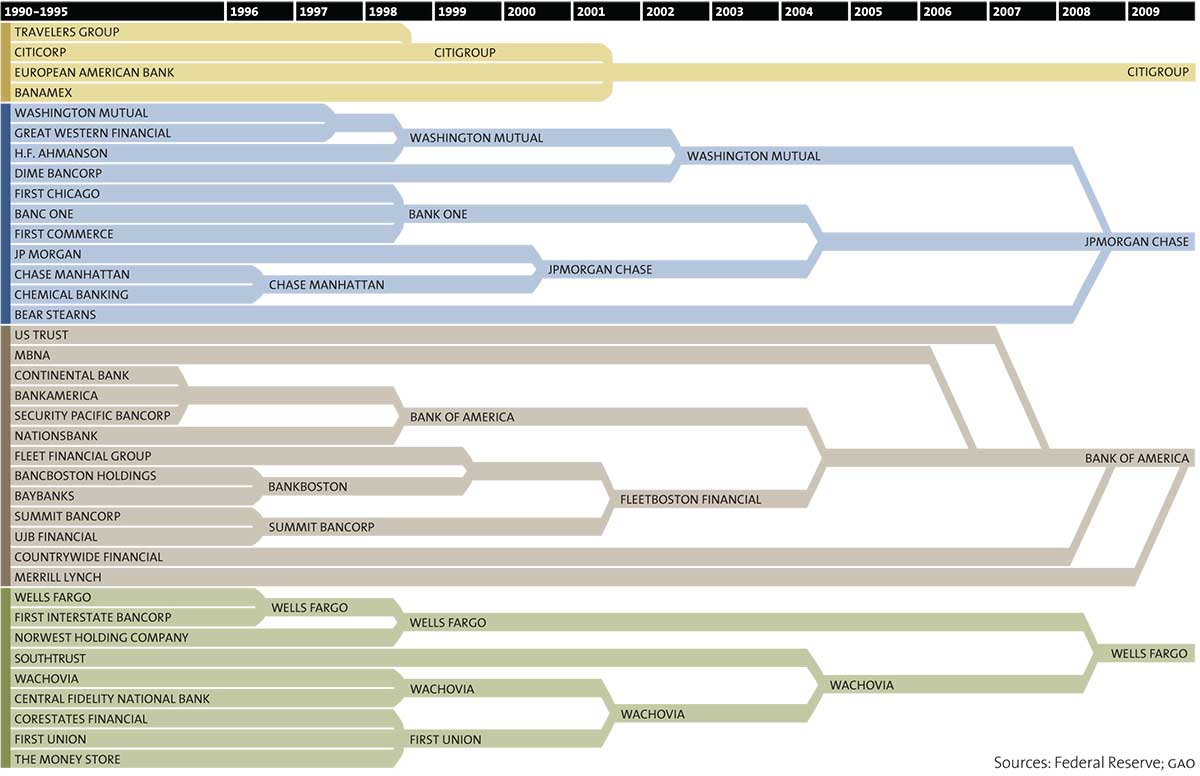
- When companies are able to buy out competitors easily and control entire markets it creates massive problems for everyone who doesn't lead the company. Today we have this problem in America when companies buy each other out which hurts competition which means that when one company fails, it has a huge market share, as was seen with banks in this famous graphic. In the movie business, six studios control 79.4% of the American and Canadian market share, which can't be good for creating new movies that question a number of issues that their owners wouldn't want to be talked about, like countless excellent documentary films.
- What we saw today was where Disney decided to close Lucasarts, despite it being one of the most popular game studios seeing all of my friends, and firing 150 people on the spot which is cold and will mean they will make absolutely nothing out of those games. Though they are thinking of contracting out to other studios, Disney would make more money by just keeping the games developed in Lucasarts which mean they get to keep 100% of the profit, which they don't want for some reason. A smaller company would never consider going out of business for such a reason, but would take their company and figure out how to make their company more profitable instead of just killing it.
The economy is a delicate organism, and it needs reasonable laws that are out of the way when not needed, and has good laws that creates a system where fraud and recessions can be avoided or at least minimized. To have an unrestrained free market creates a situation where recessions will happen, as we saw in 1929 and 2008, which is bad for everyone from the unemployed man on the street to the richest man in the world. To have an economy like existed in the Soviet Union or exists today in North Korea is just as bad in the short and long term as a system where people are able to be extorted in the name of profit for no pay as happened in the American South in the name of slavery.
Subscribe to:
Posts (Atom)