Two shut downs later, and you know what has changed?
Our credit worthiness is declining in the eyes of investors and our purchasing power has taken a small hit.
You know what hasn't changed?
DACA has not, and cannot pass this year. It just doesn't have the votes.
This is also the second time this has ever happened under a trifecta, the first time was last month. The truth is, United Russia can't govern.
It is time for a change in strategy. We need to Get Out the Vote, Degerrymander our country, and get great candidates running for office up and down the ballot.
You know the last time that happened? It was 2006 and 2008, which made very real changes in the health care for disabled people around the country and our health care inflation is down significantly from where it was a decade ago despite continuous attacks from Putin over the past year. It also restored the most important rules from the New Deal giving our financial system our stability.
Let's do what works.
Let's take back our government.
Friday, February 9, 2018

Thursday, January 25, 2018
How to make a fair election in the United States
List of Presidential elections in my lifetime Democrats have won: 1996, 2000, 2008, 2012, 2016.
List of Presidential elections in my lifetime Republicans have won: 2004.
Despite this fact that Clinton won by over 2 million votes last year, and that the Democratic party consistently wins more votes than the Republicans in nationwide elections, the only way to give the Democrats a real chance of this being reflected in the house using our current election method is to gerrymander in their favor. This is because of how Americans are split geographically.
It is impossible to make First Past the Post Single Member District (FPTP SMD) a truly proportional system no matter how you gerrymander. You will always end up with wasted votes, particularly in urban cores where you can get candidates winning by over 80% of the vote, and places where parties simply decide to not run a candidate due to there being no chance of winning.
What this does is it denies Americans a real choice in who elects us. Every vote past the 50% mark in an election is a wasted vote, because the election outcome would not have changed if that person had changed their vote or abstained. The FPTP SMD system inevitably increases the number of wasted votes in the country. Five Thirty Eight has shown we will never be able to make a system which accurately represents the desires of America with this system in their current project analyzing gerrymandering. It is not possible.
There are several solutions of course, mixed-member proportional, party-list, and single transferable vote are the most commonly used in the world today which work better to accurately represent the will of the people.
Party list is used in a large number of countries. Instead of voting for candidates directly, voters vote for the party they like the most, usually with only one vote. There are multiple ways of apportioning seats. There are many countries which use this system and end up with multiple competing parties, none of which has too much power, keeping them all in check and relatively responsive to the people. As long as a party is allowed to get into power if they win one seat this system can function extremely well, which is seen in Argentina, Austria, Bulgaria, Croatia, and many more. This also minimizes wasted votes. In a 435 seat legislature (to pick a semi-random number) under party list the number of wasted votes in this system is limited to 0.23% of total votes passed.
Mixed-Member Proportional is used in Germany, Bolivia, Lesotho, and New Zealand. This keeps the FPTP SMD at the local level, but then has a party list on top of that. There is a fixed number of districts and representatives coming from that level, on top of which you add members from the party list system as described above. Usually this is done until the percentage of seats each party has is as close as possible to the percentage they received on the party list which usually uses FPTP. You still usually end up with two main parties and smaller parties needed to form a coalition in the long run if you have a high threshold like Germany has which prevents smaller parties from gaining influence. That is one reform I believe Germany needs to do in order to make their system work better. You can still end up with large numbers of wasted votes at the district level, but having a flexible size of your legislature can fix this problem. The percent of votes which can be wasted is again limited to 1 divided by the number of total seats which are done by party list. The limit of wasted first mark votes is still 50% of votes passed in every district, assuming the district level uses FPTP.
The third option is used in Australia and Ireland, and that is the Single Transferable Vote. Candidates run in districts, and there are multiple winners for each district. As a ranked voting system, the candidate with the lowest vote count is eliminated and their votes are redistributed until the number of candidates who have reached the threshold required to be elected (usually number of votes / (number of seats + 1) + 1) is equal to the number of seats available. This is the Droop Quota and it gives the right answer all of the time for how many votes are required to be elected. Candidates represent their area and every district is competitive. You could theoretically use STV instead of FPTP in an MMP system, but this is unlikely.
With STV the biggest question is how you are going to redistrict, and there are several good ways to do this, you can focus on single split line or making districts which are as round as possible, you can try to follow existing boundaries. But the biggest point of all is that as long as you do not specifically gerrymander to favor one party or another your number of wasted votes is very low. You strike a balance between local representatives, so people who are out of the political mainstream can get elected which is one potential disadvantage to a party list system, and voters can vote for whoever they want for their first choice without their vote being wasted if their candidate is less popular the other candidates. In a 5 person race the number of votes wasted is limited to less than 20% of total ballots cast.
A fair election in the United States would use one of these three systems. I personally favor STV because I don't like giving political parties power (which I know is a very American sentiment) but I also like the extremely small number of wasted votes party list provides.
We need election reform as soon as possible. We have three main options which are tried and true across the world. Now we need to implement one of them. It doesn't matter what issue you care about, health care, education, infrastructure, foreign relations, environment, tax policy, economic regulation, scientific investment, if you don't have a good government you will not be able to reliably get good policy on any other issue and corruption will increase.
Appendix A: Maine has already voted to allow ranked voting for state elections, on Wikipedia there is a phrase which I believe needs translating to English:
Bullshit: "On October 23, 2017, the Legislature voted to delay implementation of the RCV law for all races until 2021, to allow for time to pass a state constitutional amendment to allow it.
English: "On October 23, 2017, the Legislature voted to delay implementation of the RCV law for all races until 2021, to allow one more reelection before all the motherfuckers are kicked out of office because if they really wanted it to happen they already would have passed a constitutional amendment."
Appendix B: Glossary
FPTP: First Past the Post, the system used by the United States for Congressional Elections
MMD: Multi-member district
MMP: Mixed-Member Proportional
SMD: Single-member district
STV: Single Transferable Vote
Trifecta: when one party has control of the Executive and Legislative branches of a bicameral Presidential system (eg. The United States except Nebraska)
Appendix C, news update:
Putin is the first President in American history to have a government shutdown when his party has a trifecta. (Oh, it's Trump? Silly me, a small typo, I got into the habit of substituting the Premier of the USSR with their satellite states when studying the Cold War. Wait, Russi is no longer the USSR? I couldn't tell the difference.)
List of Presidential elections in my lifetime Republicans have won: 2004.
Despite this fact that Clinton won by over 2 million votes last year, and that the Democratic party consistently wins more votes than the Republicans in nationwide elections, the only way to give the Democrats a real chance of this being reflected in the house using our current election method is to gerrymander in their favor. This is because of how Americans are split geographically.
It is impossible to make First Past the Post Single Member District (FPTP SMD) a truly proportional system no matter how you gerrymander. You will always end up with wasted votes, particularly in urban cores where you can get candidates winning by over 80% of the vote, and places where parties simply decide to not run a candidate due to there being no chance of winning.
What this does is it denies Americans a real choice in who elects us. Every vote past the 50% mark in an election is a wasted vote, because the election outcome would not have changed if that person had changed their vote or abstained. The FPTP SMD system inevitably increases the number of wasted votes in the country. Five Thirty Eight has shown we will never be able to make a system which accurately represents the desires of America with this system in their current project analyzing gerrymandering. It is not possible.
There are several solutions of course, mixed-member proportional, party-list, and single transferable vote are the most commonly used in the world today which work better to accurately represent the will of the people.
Party list is used in a large number of countries. Instead of voting for candidates directly, voters vote for the party they like the most, usually with only one vote. There are multiple ways of apportioning seats. There are many countries which use this system and end up with multiple competing parties, none of which has too much power, keeping them all in check and relatively responsive to the people. As long as a party is allowed to get into power if they win one seat this system can function extremely well, which is seen in Argentina, Austria, Bulgaria, Croatia, and many more. This also minimizes wasted votes. In a 435 seat legislature (to pick a semi-random number) under party list the number of wasted votes in this system is limited to 0.23% of total votes passed.
Mixed-Member Proportional is used in Germany, Bolivia, Lesotho, and New Zealand. This keeps the FPTP SMD at the local level, but then has a party list on top of that. There is a fixed number of districts and representatives coming from that level, on top of which you add members from the party list system as described above. Usually this is done until the percentage of seats each party has is as close as possible to the percentage they received on the party list which usually uses FPTP. You still usually end up with two main parties and smaller parties needed to form a coalition in the long run if you have a high threshold like Germany has which prevents smaller parties from gaining influence. That is one reform I believe Germany needs to do in order to make their system work better. You can still end up with large numbers of wasted votes at the district level, but having a flexible size of your legislature can fix this problem. The percent of votes which can be wasted is again limited to 1 divided by the number of total seats which are done by party list. The limit of wasted first mark votes is still 50% of votes passed in every district, assuming the district level uses FPTP.
The third option is used in Australia and Ireland, and that is the Single Transferable Vote. Candidates run in districts, and there are multiple winners for each district. As a ranked voting system, the candidate with the lowest vote count is eliminated and their votes are redistributed until the number of candidates who have reached the threshold required to be elected (usually number of votes / (number of seats + 1) + 1) is equal to the number of seats available. This is the Droop Quota and it gives the right answer all of the time for how many votes are required to be elected. Candidates represent their area and every district is competitive. You could theoretically use STV instead of FPTP in an MMP system, but this is unlikely.
With STV the biggest question is how you are going to redistrict, and there are several good ways to do this, you can focus on single split line or making districts which are as round as possible, you can try to follow existing boundaries. But the biggest point of all is that as long as you do not specifically gerrymander to favor one party or another your number of wasted votes is very low. You strike a balance between local representatives, so people who are out of the political mainstream can get elected which is one potential disadvantage to a party list system, and voters can vote for whoever they want for their first choice without their vote being wasted if their candidate is less popular the other candidates. In a 5 person race the number of votes wasted is limited to less than 20% of total ballots cast.
A fair election in the United States would use one of these three systems. I personally favor STV because I don't like giving political parties power (which I know is a very American sentiment) but I also like the extremely small number of wasted votes party list provides.
We need election reform as soon as possible. We have three main options which are tried and true across the world. Now we need to implement one of them. It doesn't matter what issue you care about, health care, education, infrastructure, foreign relations, environment, tax policy, economic regulation, scientific investment, if you don't have a good government you will not be able to reliably get good policy on any other issue and corruption will increase.
Appendix A: Maine has already voted to allow ranked voting for state elections, on Wikipedia there is a phrase which I believe needs translating to English:
Bullshit: "On October 23, 2017, the Legislature voted to delay implementation of the RCV law for all races until 2021, to allow for time to pass a state constitutional amendment to allow it.
English: "On October 23, 2017, the Legislature voted to delay implementation of the RCV law for all races until 2021, to allow one more reelection before all the motherfuckers are kicked out of office because if they really wanted it to happen they already would have passed a constitutional amendment."
Appendix B: Glossary
FPTP: First Past the Post, the system used by the United States for Congressional Elections
MMD: Multi-member district
MMP: Mixed-Member Proportional
SMD: Single-member district
STV: Single Transferable Vote
Trifecta: when one party has control of the Executive and Legislative branches of a bicameral Presidential system (eg. The United States except Nebraska)
Appendix C, news update:
Putin is the first President in American history to have a government shutdown when his party has a trifecta. (Oh, it's Trump? Silly me, a small typo, I got into the habit of substituting the Premier of the USSR with their satellite states when studying the Cold War. Wait, Russi is no longer the USSR? I couldn't tell the difference.)
Monday, December 18, 2017
DuPont AMTRAK Cascades Train crash
This morning in my home state of Washington, an AMTRAK Cascades train crashed on the new line between DuPont and Olympia. This is a route I frequently take to get between my home of Bellingham and Olympia, where my parents live.
This lies on the most important rail route in the Northwest, and one of the most important in the country. 6.3 million people live on the AMTRAK Cascades route, a not insignificant sum, and we are growing quickly. We need to have alternatives to driving and flying in this part of the country, and AMTRAK offers us the ability to do this.
Every day, there are over 300 AMTRAK trains making their normal routes every day in the United States, or about 110,000 per year. This is the 2nd accident this year on AMTRAK. 99.9982% of AMTRAK trains this year have gone without incident.
It is important to understand also how this happened. First of all, the section of track is between two tight bends as the new track crosses I-5. The speed limit here is 64 km/hr, but the train was going 130 km/hr. This is why the train crash occurred. As a consequence of a windy section, this means the train cannot go even at highway speed until it is past the second bend, but the conductor on this train did not follow the rules.
This was absolutely avoidable. Positive Train Control is a method which monitors a train's speed and automatically slows a train down when it goes through a dangerous section, to avoid driver error. On the vast majority of train rides, 99.999% this year, trains have successfully avoided this type of accident by the conductor slowing the train down on their own accord, and there is no problem. However, in this particular situation the conductor didn't, which is why we saw a disaster on the first higher-speed trip in Washington State history.
We need to keep higher-speed rail in my home state, and use this to implement and require Positive Train Control nationwide to prevent future accidents. These are extremely rare, and thousands of Americans over the next week are going to use AMTRAK to go to their family for Christmas, and they should. This accident is notable because it is rare.
Don't let one accident by one fool damn an entire region to traffic.
This lies on the most important rail route in the Northwest, and one of the most important in the country. 6.3 million people live on the AMTRAK Cascades route, a not insignificant sum, and we are growing quickly. We need to have alternatives to driving and flying in this part of the country, and AMTRAK offers us the ability to do this.
Every day, there are over 300 AMTRAK trains making their normal routes every day in the United States, or about 110,000 per year. This is the 2nd accident this year on AMTRAK. 99.9982% of AMTRAK trains this year have gone without incident.
It is important to understand also how this happened. First of all, the section of track is between two tight bends as the new track crosses I-5. The speed limit here is 64 km/hr, but the train was going 130 km/hr. This is why the train crash occurred. As a consequence of a windy section, this means the train cannot go even at highway speed until it is past the second bend, but the conductor on this train did not follow the rules.
This was absolutely avoidable. Positive Train Control is a method which monitors a train's speed and automatically slows a train down when it goes through a dangerous section, to avoid driver error. On the vast majority of train rides, 99.999% this year, trains have successfully avoided this type of accident by the conductor slowing the train down on their own accord, and there is no problem. However, in this particular situation the conductor didn't, which is why we saw a disaster on the first higher-speed trip in Washington State history.
We need to keep higher-speed rail in my home state, and use this to implement and require Positive Train Control nationwide to prevent future accidents. These are extremely rare, and thousands of Americans over the next week are going to use AMTRAK to go to their family for Christmas, and they should. This accident is notable because it is rare.
Don't let one accident by one fool damn an entire region to traffic.
Sunday, December 3, 2017
The Most American Candidate, part 2, 2017 edition
If we were to design a candidate who could speak to the majority of Americans today, an interesting intellectual exercise could determine the political positions of a presidential candidate who could win their first election with ease. This candidate would not be a centrist but would adopt policy positions which the majority of Americans agree with. These are based on the most recent poll on the issues I can find.
Here is the platform:
Social:
Economics
Here is the platform:
Social:
- Employers must provide health insurance which covers birth control regardless of personal beliefs. Pew
- Transgender people should be required to use the bathroom of the gender they identify with. Pew
- Homosexual behavior, Same-Sex Marriage, abortion, and condoms are all appropriate. Pew
- Partisan Gerrymandering should be restricted. 71% of Americans agree
Economics
- Implement a $15 minimum wage. Pew
- We should increase spending for veterans benefits, education, and health care, we shouldn't reduce spending on anything. Pew
- The rich do not pay their fair share, and should see an increase in their tax rates. Pew
- Light Rail is essential to the building of a modern city. SJSU
- Global Warming is real and we need policies to reverse it. People say this in every single state. NY Times
- ISIS is a major concern. Pew
This is a winning platform. What is most striking about this is that it is not "moderate", halfway between Democrats and Republicans. In fact, most Americans agree with several of the core policies of the Democratic Party and none of the policies of the Republican Party.
This says a few things,
- The Republican Party is in danger if it is to survive as a party, with its main positions being unpopular when polled.
- The Democratic Party needs to focus not on moving to the center (which is the effect of Median Voter Theorem) but to increase turnout among its natural voter base, which involves the majority of Americans.
The Democratic Strategy for 2018 needs to be to fight in every single district for every legislative and congressional seat. A winning candidate is going to be clear about their values and represent the majority of people, falling neatly in the progressive camp.
I do not know how many progressives are going to win next year, hopefully many. But if candidates stay reasonable, science focused, and honest to their values, they can win elections nationwide. The particular emphasis candidates have on their campaigns will change, but I do believe that with Congress sitting at 13% right now, Trump sitting at 40% approval, and both parties having less than 50% approval, our country needs some major political changes.
We have seen multiple elections in my life time where the Democratic Party running on the values most Americans share will win the majority of the vote, but still lose the House and Presidency. It is not because Americans are not voting or caring, its because we have a rigged election system. Gerrymandering combined with first past the post for the House and the Electoral College prevent us from having policies which the majority of us want.
We have seen multiple elections in my life time where the Democratic Party running on the values most Americans share will win the majority of the vote, but still lose the House and Presidency. It is not because Americans are not voting or caring, its because we have a rigged election system. Gerrymandering combined with first past the post for the House and the Electoral College prevent us from having policies which the majority of us want.
This is where ranked voting comes in. We need to fight from the grassroots to help break the two party system. We need new voices which represent Americans accurately and have more incentives to be bold, or be forced to leave. Neither the Green Party or Libertarian Party fill this role. We need more candidates like Bernie Sanders and Elizabeth Warren running for office nationwide. We need people like Kamala Harris and Martin O'Malley to rise as high as they can go, and we need these people in local politics right now.
Breaking the partisan duopoly will offer candidates the ability to be more true to their values and more responsive to voters. Ending single member districts and first past the post will allow more voices to be heard nationally, which will be a more healthy politic. Ending the presidential primary system and electing the President using IRV is the eventual goal.
I have been thinking about this issue for years (as this blog shows), and the only way I can see to break the partisan duopoly is to reform our entire election system. Getting money out of politics is more tricky because you have to be clear about the relationship between money and speech, but changing our election system is relatively easy. Washington State has already done it, though top two primaries do not allow third parties to have a real chance to form, neither does it guarantee results which represents the views of the majority. The top two primary in Seattle this year and Attorney General's race last year have made that abundantly obvious. It has not broken the toxic two party system in our state because it can't.
This is how we are going to get the most American candidate who represents the people elected. Right now it is clear to me that candidates who follow this message precisely still don't necessarily win because people have to be strategic about their voting, especially in crowded elections.
Some will say this is impossible to do, but I refer those people to the 12th amendment which radically changed how the Electoral College works. Most Americans do not remember this today, but before 1913 Senators were not elected by the people but appointed by State Legislatures. The 17th Amendment changed this completely, making the Senators directly elected by the people. Let us not also forget that Slaves were counted as 3/5 of a person in the House of Representatives until the 13th amendment. The Senate is directly elected by the people, The Electoral College works differently, the calculation method for how many representatives each states gets in the House of Representatives has changed as well. None of our original election system survives today.
Abolishing the Electoral College is no more radical than directly voting for Senators. We have already completely eliminated one indirect election method our government.
Ranked voting is a far simpler system to understand than what is written in the 12th amendment today.
Having multiple representatives in a district has historical precedence. We once had them in my home, Washington State.
For those places which require districting due to their size (looking at you, California) we should use algorithmic districting to prevent Gerrymandering. The Shortest splitline method combined with STV would be an unhackable system.
We need to do this work now, and then we can get the candidates we deserve, and the politics which the vast majority of Americans desire.
Together, we can do this.
Please get connected with Fairvote today. We deserve better elections.
Saturday, December 2, 2017
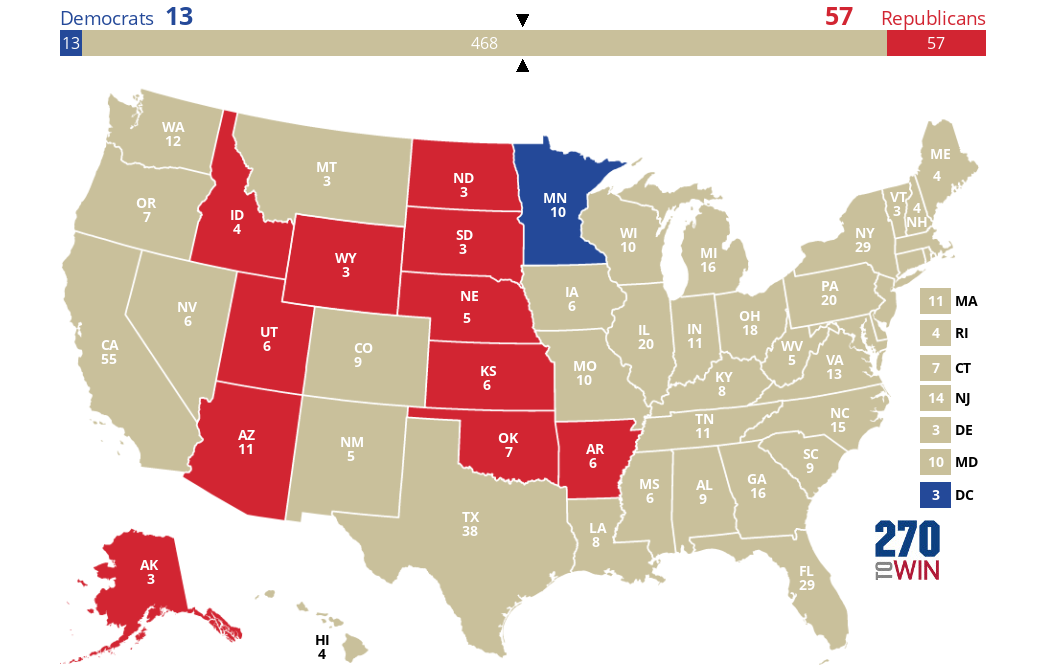
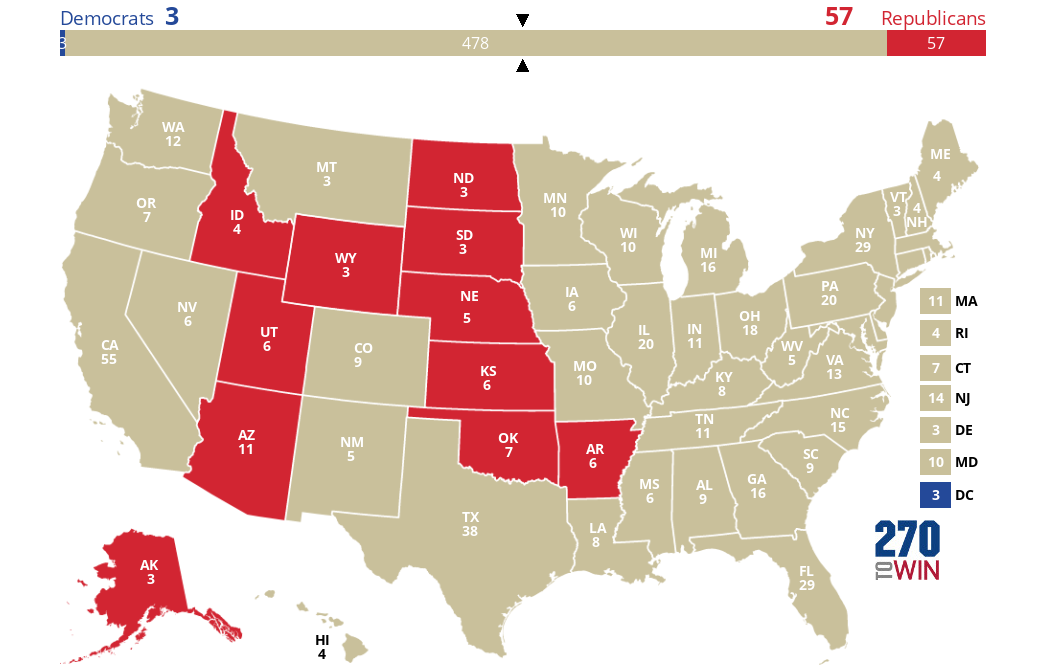
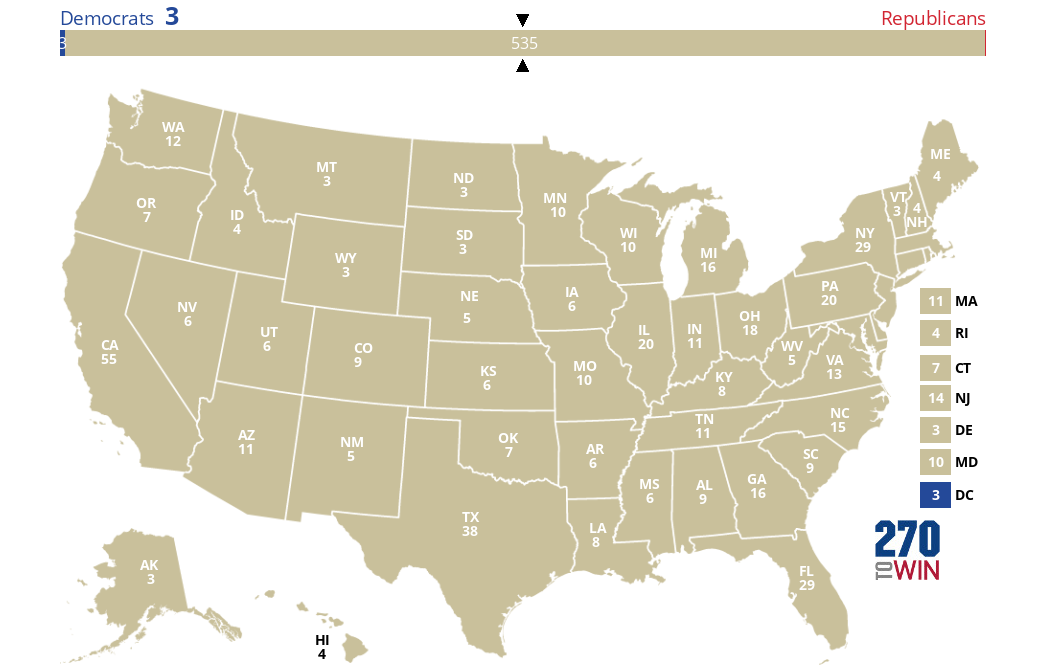
Swing States
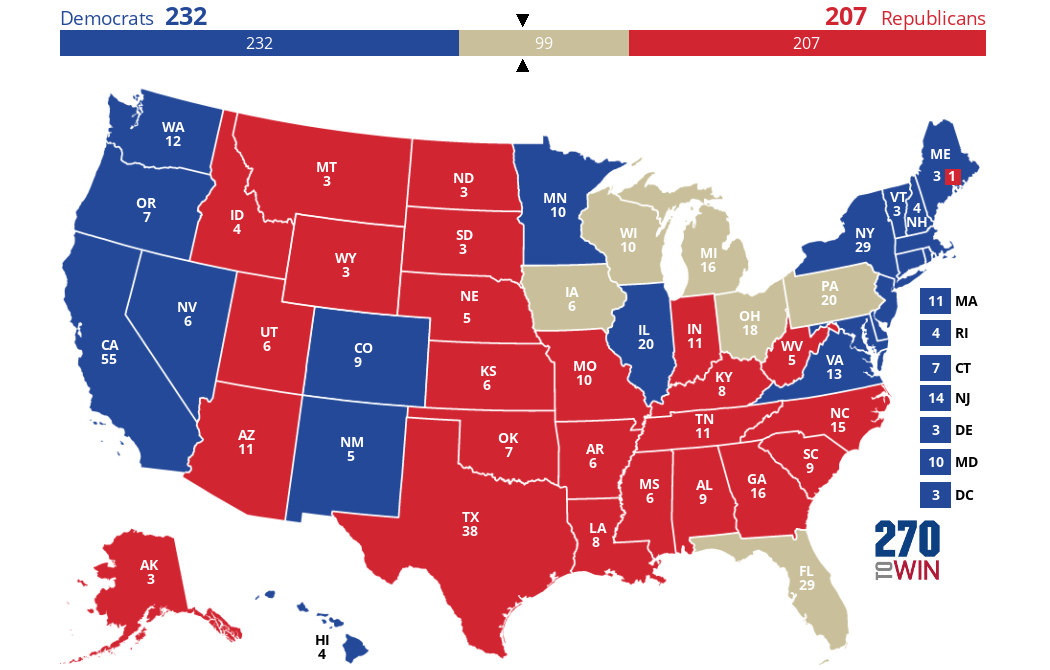
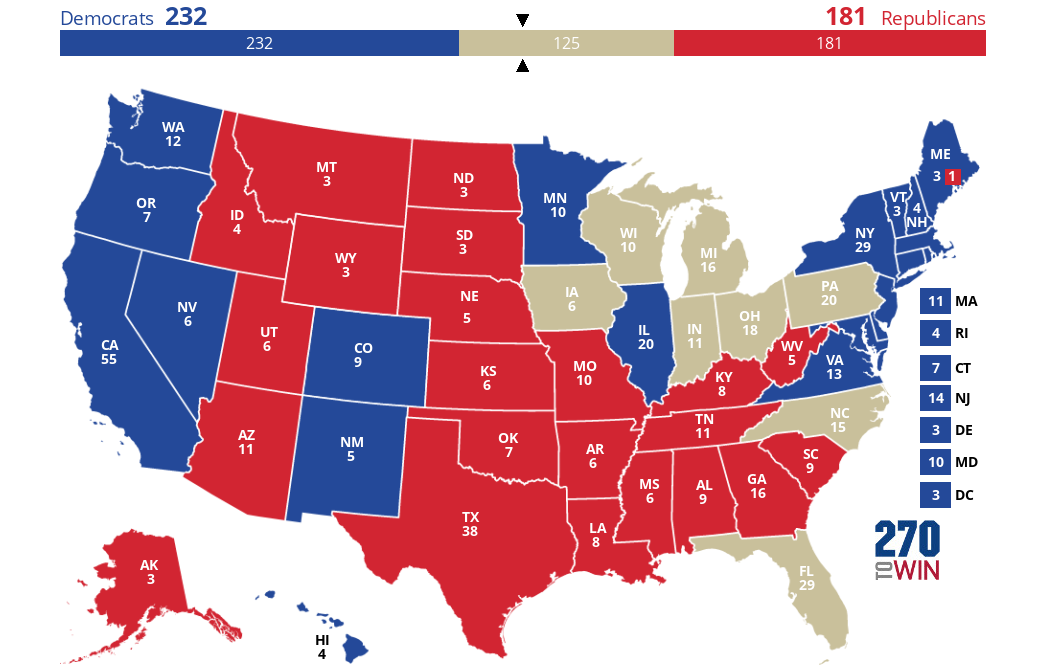
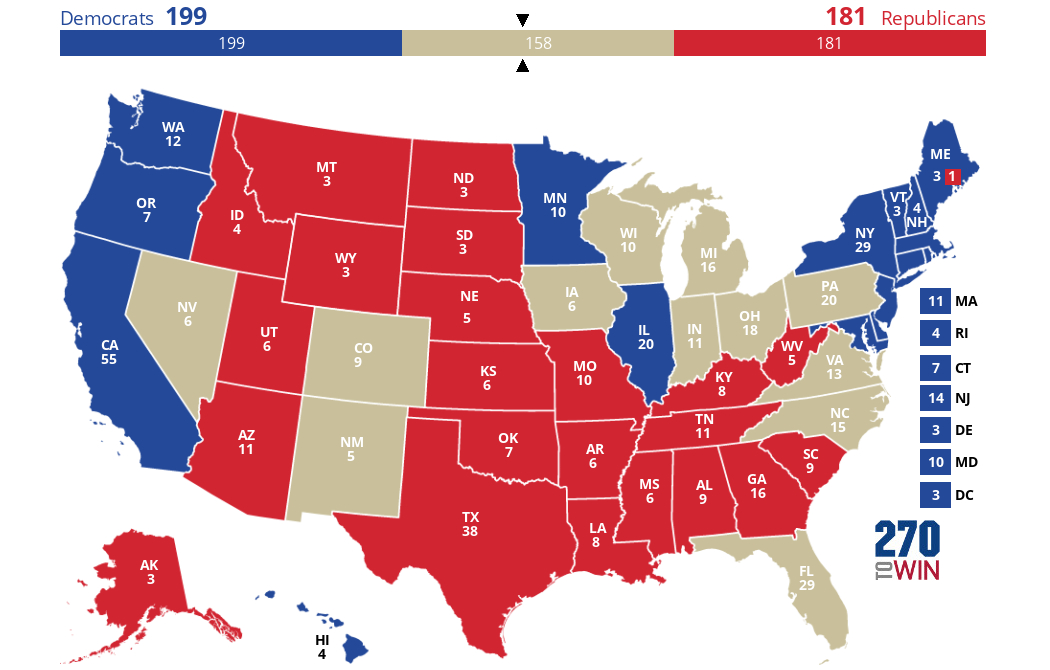
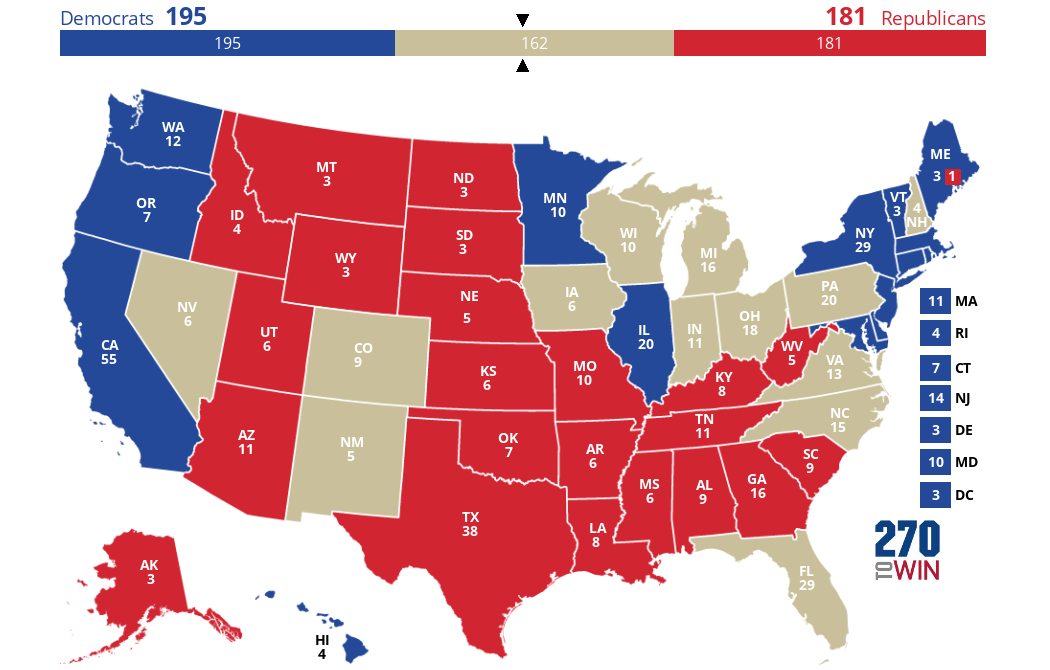
A series of maps to illustrate swing states, defined as states which have not voted for the same party for the preceding 4 Presidential elections.
If I were hired by the DNC to ensure Trump is a one term president, I would ensure to put resources everywhere I can. The first step is to fight against voter discrimination laws which should have started several years ago. It doesn't matter if you are polling 10 points ahead of the other major party if your voters cannot vote for you.
While fighting those laws in the courts and ensuring people have the right to vote, we need to also fight gerrymandering. If the Supreme Court rules that partisan gerrymandering is illegal than there will be many more cases to ensure fair districting. This will mean that we will have many more competitive districts.
Getting a great candidate in 2020, such as Kamala Harris, would help a lot to win the Presidency, and ending the super-delegates to have the primary done with a straight popular vote would be a very easy way to increase legitimacy of the Democratic Nominee. That wouldn't take any laws to change, only some rules. It would also improve the image of the Democratic Party in the eyes of Millennials. If the primary is open and ranked then we will have the best candidate possible with no question of their legitimacy.
That will be enough to win the 2020 election. Campaign everywhere and have the first national primary in America's history. Supporting local candidates, and have every Presidential rally be with a local politician to get them name recognition will help the Democratic Party more accurately match its vote share in its success.
In the long run, implementing ranked voting and ideally ending the electoral college are the only ways I know of to make a truly fair election system where voters have the ability to kick out members of congress and legislatures who don't speak for them. After that, there will be no single Democratic Party because it will split into multiple parties at various levels of liberalism which will be good for America and voters by getting more viewpoints into the national debate.
The best we can do in 2018 is get good strong candidates nationwide running for every single seat in every legislature and support them so they can win.
I know this is a big change and a big dream, but that's the only way this crazy world has ever improved. Fight for the ideal system and get as much as you can. Hopefully someone at the DNC will read this.
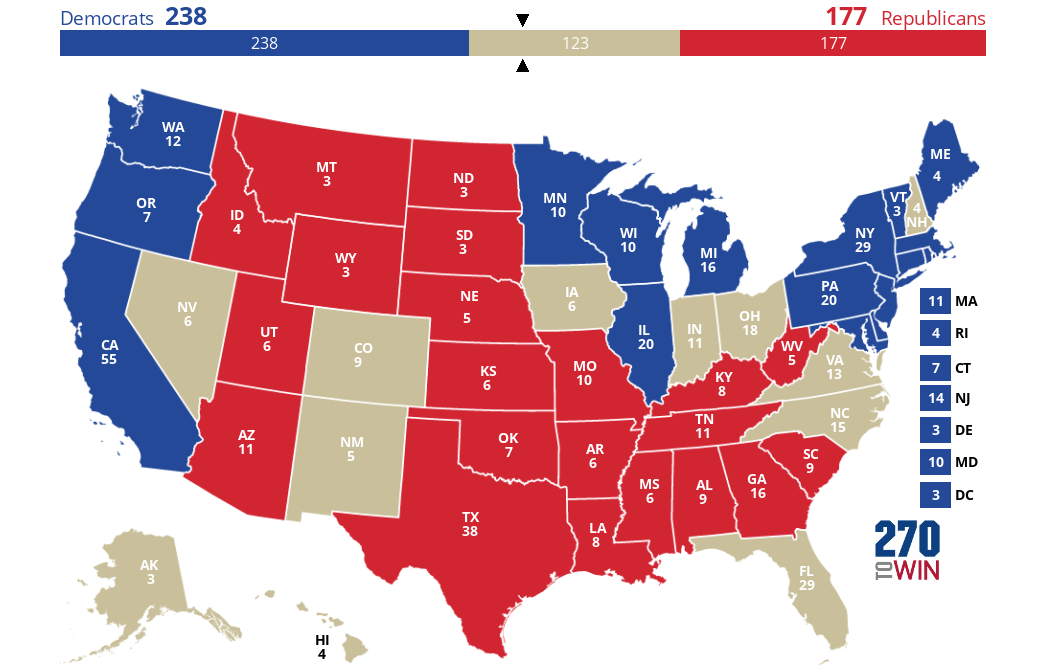
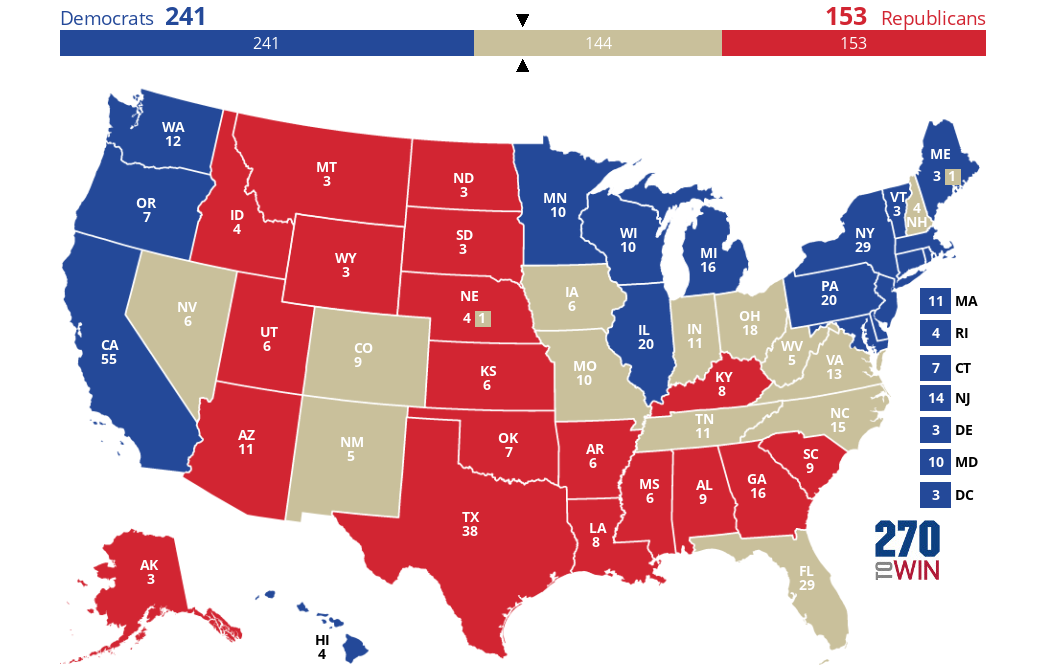
 Click the map to create your own at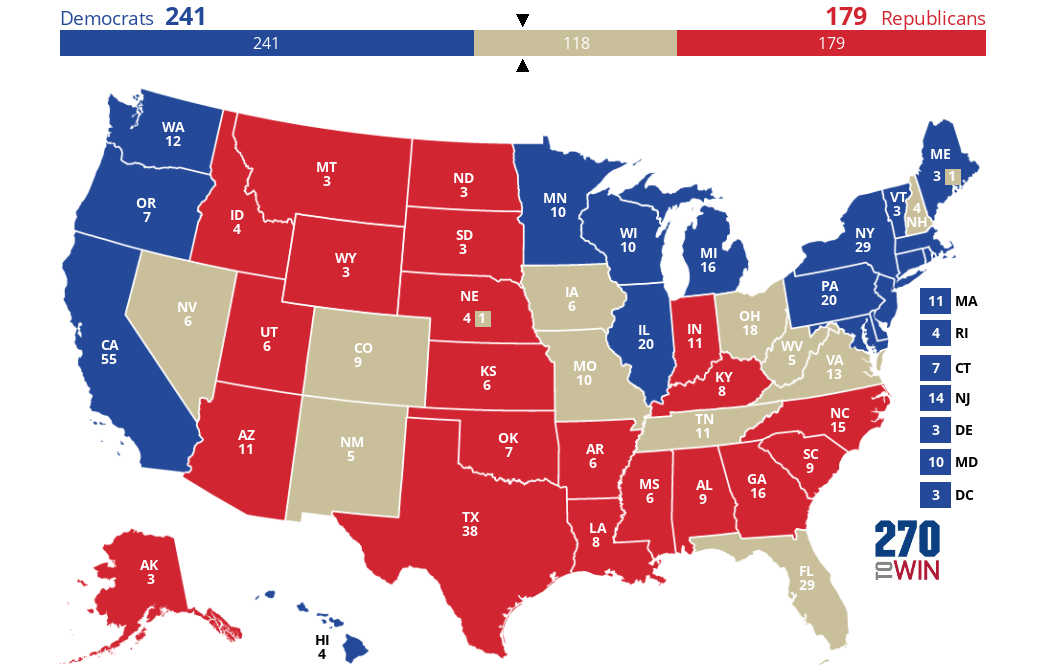
Another way to look at it, if you gradually turn states into swing states the further back you go:
1964 was the first election where DC was allowed to vote, so every state has voted for both parties except for DC over the last 50 years.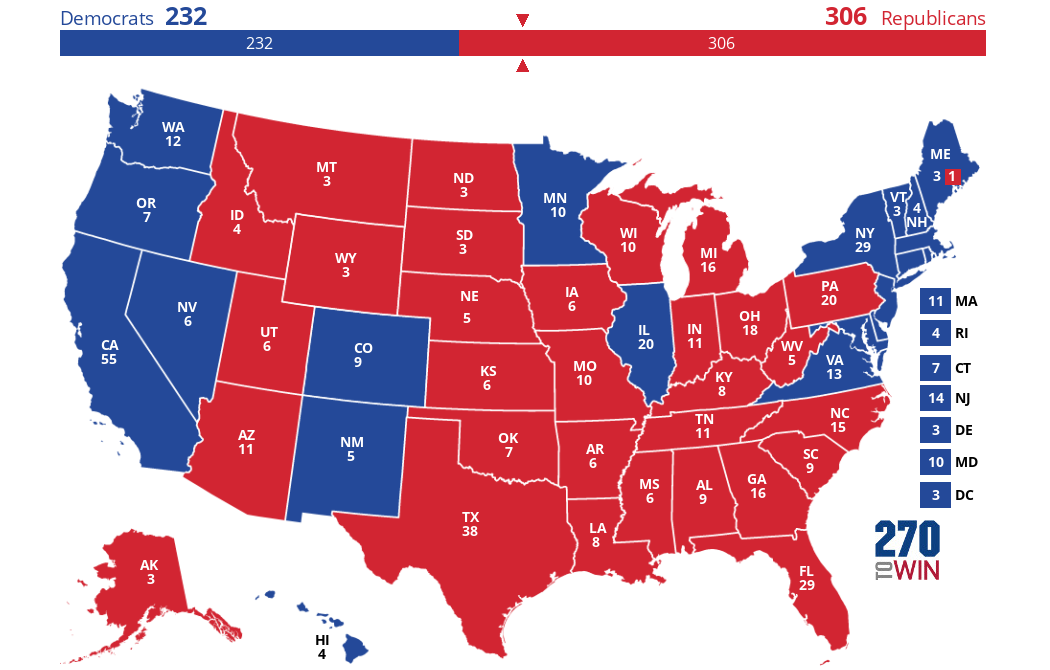
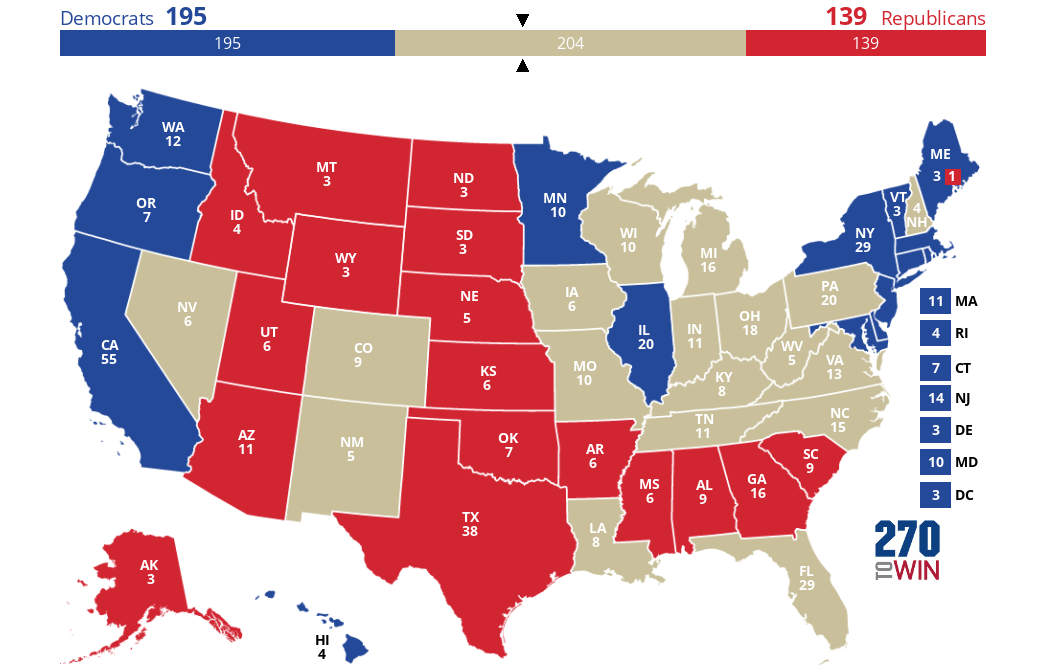
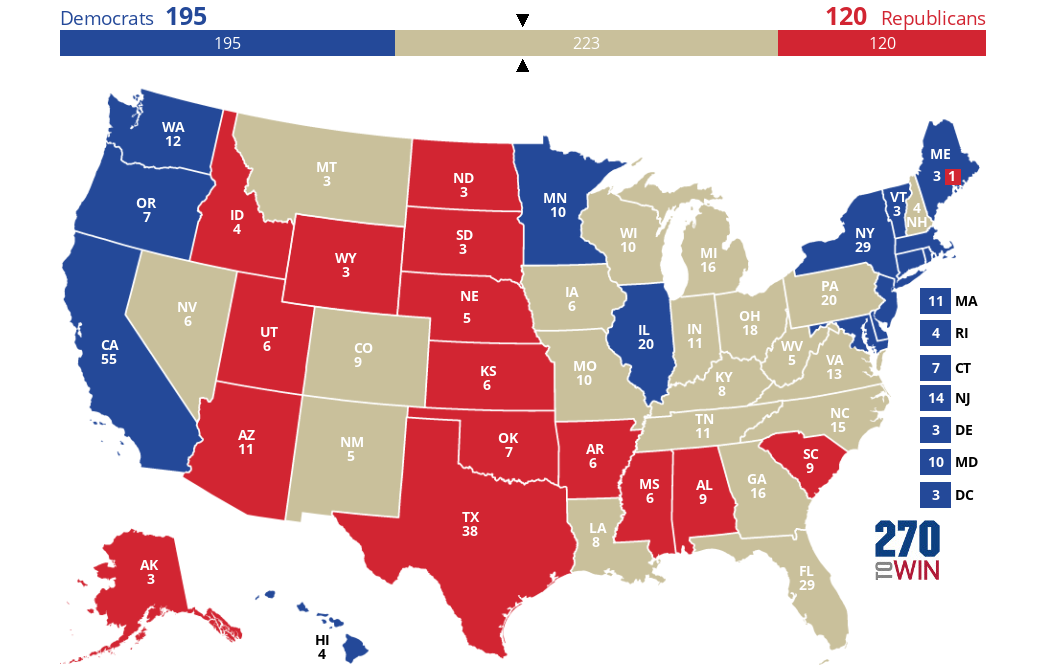
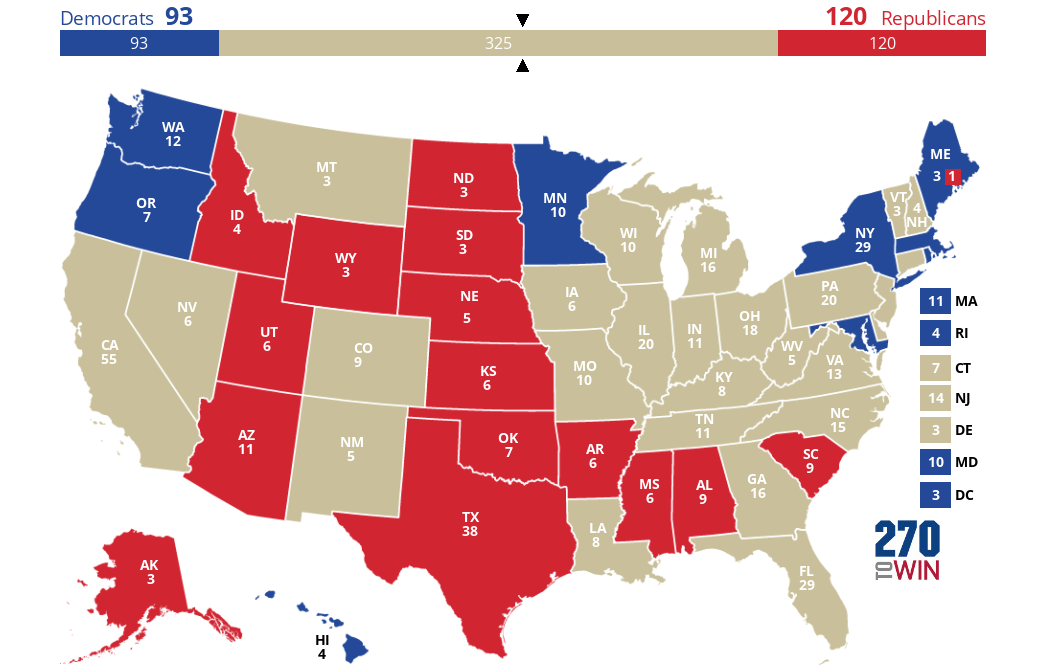
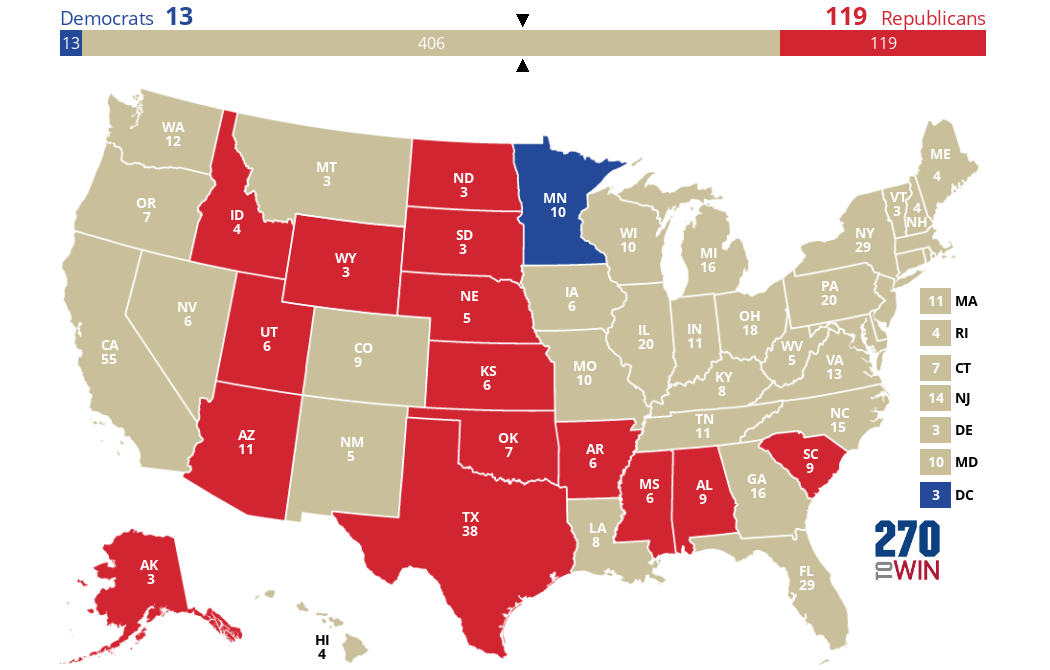
If I were hired by the DNC to ensure Trump is a one term president, I would ensure to put resources everywhere I can. The first step is to fight against voter discrimination laws which should have started several years ago. It doesn't matter if you are polling 10 points ahead of the other major party if your voters cannot vote for you.
While fighting those laws in the courts and ensuring people have the right to vote, we need to also fight gerrymandering. If the Supreme Court rules that partisan gerrymandering is illegal than there will be many more cases to ensure fair districting. This will mean that we will have many more competitive districts.
Getting a great candidate in 2020, such as Kamala Harris, would help a lot to win the Presidency, and ending the super-delegates to have the primary done with a straight popular vote would be a very easy way to increase legitimacy of the Democratic Nominee. That wouldn't take any laws to change, only some rules. It would also improve the image of the Democratic Party in the eyes of Millennials. If the primary is open and ranked then we will have the best candidate possible with no question of their legitimacy.
That will be enough to win the 2020 election. Campaign everywhere and have the first national primary in America's history. Supporting local candidates, and have every Presidential rally be with a local politician to get them name recognition will help the Democratic Party more accurately match its vote share in its success.
In the long run, implementing ranked voting and ideally ending the electoral college are the only ways I know of to make a truly fair election system where voters have the ability to kick out members of congress and legislatures who don't speak for them. After that, there will be no single Democratic Party because it will split into multiple parties at various levels of liberalism which will be good for America and voters by getting more viewpoints into the national debate.
The best we can do in 2018 is get good strong candidates nationwide running for every single seat in every legislature and support them so they can win.
I know this is a big change and a big dream, but that's the only way this crazy world has ever improved. Fight for the ideal system and get as much as you can. Hopefully someone at the DNC will read this.
Wednesday, November 8, 2017
2017 Election summary
Landslide.
The Democrats could hardly have hoped for a better possible result than what we saw last night. From Federal to State to Local, this as a victory for America, and a strong hinting against Donald Trump in one swing state.
Another big lesson tonight is to compete everywhere. The Virginia House of Delegates is within 4 seats of either party taking control. We have seen one of the biggest switches in history with Virginia moving from being a solid Republican state to a competitive state which leans blue. Democrats could form a trifecta in the near future in Virginia if they tried.
The question remaining is if this success will continue next year. This will depend highly on Trump's popularity, as unpopular presidents tend to do very poorly in their midterm elections, and I expect it could be a big gain for the Democratic Party if they try.
The Democrats could hardly have hoped for a better possible result than what we saw last night. From Federal to State to Local, this as a victory for America, and a strong hinting against Donald Trump in one swing state.
- The most important election of the night was the Democratic Party picked up the New Jersey Governorship, gaining a Trifecta (control of the Governorship and both houses of the Legislature)
- In Washington State the Republicans had a one seat lead in the Senate, but once Manka Dhingra won the seat in the 45th legislative district last night the Democratic Party gained the Senate, and another Trifecta.
- In Virginia, Democrats held onto the Governorship, preventing a Republican Trifecta.
- 4 Virginia House races are still too close to call, and it could fall into Democratic Hands, Republicans have already lost 15% of the House. This happened with 40% of the House with no opposition candidates.
In other (underreported) news we saw more Americans use ranked voting this year versus any other point in history. This saw an increase in turnout. Hopefully more cities will adopt ranked voting soon to increase democratic legitimacy. Fairvote
Star Tribune
Another big lesson tonight is to compete everywhere. The Virginia House of Delegates is within 4 seats of either party taking control. We have seen one of the biggest switches in history with Virginia moving from being a solid Republican state to a competitive state which leans blue. Democrats could form a trifecta in the near future in Virginia if they tried.
The question remaining is if this success will continue next year. This will depend highly on Trump's popularity, as unpopular presidents tend to do very poorly in their midterm elections, and I expect it could be a big gain for the Democratic Party if they try.
Thursday, August 3, 2017
PutinTrump Communications Director
Richard Nixon, sellout to the North Vietnamese and indirect killer of thousands of American soldiers, had fewer communications directors than the current White House occupant. When Reagan was undergoing the Iran Contra Scandal coming out, he had only three communications directors. We are about to see the 5th Communication Director in 8 months. Something big is going to break if even negotiating with North Vietnamese, Watergate, Iran Hostage Crisis negotiations by Reagan, and Iran-Contra Scandal (where Reagan was selling drugs to Central American terrorists and weapons to the Iranian regime) were not enough to create such turmoil with White House Public Relations.
Subscribe to:
Posts (Atom)